Introduction
Metal surfaces present unique bonding challenges that standard adhesive tapes simply can't handle. Bare metals like stainless steel and aluminum naturally support strong adhesion due to their high surface energy—but industrial coatings tell a different story. Powder coat, anodized finishes, and galvanized surfaces drastically reduce surface energy, making them as difficult to bond as PTFE. Thermal cycling, vibration, moisture exposure, and oil contamination common in manufacturing environments push that challenge further.
The right adhesive tape for metal replaces mechanical fasteners, reduces assembly time, and eliminates corrosion points between dissimilar metals. It holds up across demanding applications—from HVAC duct sealing to automotive trim bonding.
This guide covers the top tape types engineered for metal, what makes each suited for specific applications, and the key selection criteria that determine long-term performance.
Key Takeaways
- Top metal tapes span five categories: VHB structural bonding, aluminum foil, acrylic foam, duct, and high-temperature specialty
- Match adhesive chemistry (acrylic, rubber, or silicone) to surface energy, temperature range, and operating conditions
- Coated metals like powder coat and anodized aluminum need LSE-compatible tapes or surface primers for reliable adhesion
- Surface prep is the most critical variable — clean with isopropyl alcohol to remove oils and oxidation before applying any tape
- Confirm tape format, roll size, and certifications before ordering to avoid production delays
Why Metal Surfaces Need Specialized Adhesive Tape
Surface energy determines how well an adhesive wets out and bonds to a substrate. Bare metals like stainless steel (700–1100 dynes/cm) and aluminum (840 dynes/cm) have high surface energy, making them relatively easy to bond. However, industrial coatings drastically change this equation—powder coat finishes drop surface energy to just 18 dynes/cm, the same as PTFE. Anodized aluminum and galvanized steel present similar low-surface-energy (LSE) challenges depending on the specific finish and any surface contaminants present.
Beyond surface energy, metal applications expose tapes to harsh conditions that standard products can't survive:
- Expansion and contraction from thermal cycling breaks weak bonds over time
- Vibration and mechanical load require high shear and peel resistance
- Oils, solvents, and industrial fluids degrade rubber-based adhesives quickly
- Outdoor moisture and UV exposure cause adhesive migration and eventual bond failure
These conditions appear across a wide range of applications:
- HVAC duct sealing in commercial buildings
- Metal-to-metal assembly in manufacturing
- Automotive trim bonding
- Equipment repair in industrial facilities
- Mounting metal components on packaging lines
Each application demands a specific combination of adhesive chemistry, backing material, and performance rating — choices that general-purpose tapes simply aren't engineered to meet.
Best Adhesive Tapes for Metal: Top Types and Products
These five tape categories represent the most proven solutions for bonding, sealing, and mounting on metal surfaces across industrial and commercial applications. Each is selected based on adhesive strength, temperature performance, substrate compatibility, and widespread industry adoption.
3M VHB (Very High Bond) Tape
3M VHB tape is a double-sided acrylic foam tape engineered for structural bonding applications that replace rivets, welds, and screws in metal assemblies. It's the industry standard for automotive panel bonding, architectural metal panel attachment, signage mounting, and industrial equipment assembly where permanent, high-strength bonds are required.
What sets VHB apart is its viscoelastic foam core, which distributes stress across the entire bond area while conforming to surface irregularities. This stress distribution prevents the concentrated load points that cause mechanical fasteners to fail under vibration.
The modified acrylic adhesive delivers exceptional shear strength (up to 550 kPa on stainless steel) and peel resistance (39 N/cm), with outstanding UV and moisture resistance for outdoor metal applications.
| Spec | Detail |
|---|---|
| Key Features | Double-sided acrylic foam, high shear/peel strength, conformable core, UV-resistant |
| Best For | Metal panel bonding, structural mounting, automotive trim, signage on metal |
| Temperature Range | -40°F to 200°F long-term; 300°F short-term exposure |
| Application Temp | Minimum 50°F (10°C) for proper adhesive flow |
VHB tapes reach approximately 50% of full bond strength after 20 minutes, 90% after 24 hours, and 100% after 72 hours at room temperature—a critical consideration for production planning in manufacturing environments.
Aluminum Foil Tape
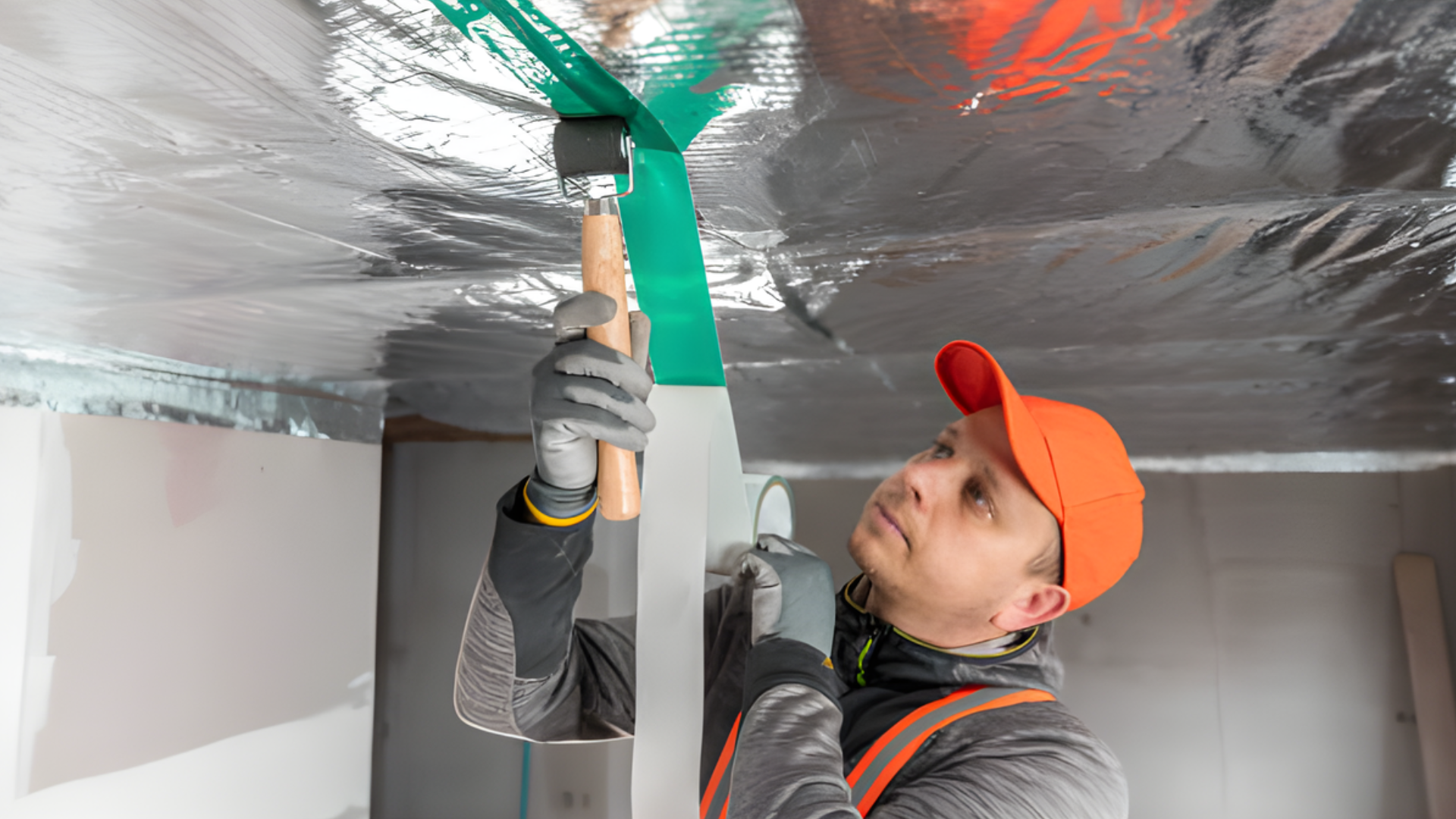
Aluminum foil tape is a single-sided tape with a metal foil backing and acrylic or rubber adhesive, widely used in HVAC, construction, and industrial settings for sealing, patching, and thermal management on metal ductwork and surfaces. For HVAC applications specifically, UL 181A-P listing is required for rigid duct sealing, mandating a minimum width of 2.5 inches.
Key performance characteristics include:
- Thermal and moisture/vapor barrier with transmission rates as low as 0.2 g/m²/24h on premium products
- Conforms easily to metal seams, joints, and irregular surfaces for a continuous, airtight seal
- Aggressive acrylic adhesive bonds reliably to clean metal even in temperature extremes
| Spec | Detail |
|---|---|
| Key Features | Metal foil backing, acrylic adhesive, reflective surface, moisture/vapor barrier |
| Best For | HVAC duct sealing, pipe insulation on metal, metal surface patching, heat shielding |
| Temperature Range | -65°F to 600°F (silicone adhesive); -20°F to 260°F (acrylic adhesive) |
The temperature range varies significantly by adhesive type—silicone-based foil tapes like 3M 433 handle extreme heat up to 600°F, while acrylic-based versions typically max out around 260°F but offer better initial tack and lower cost.
Double-Sided Acrylic Foam Tape (Non-VHB)
This category encompasses versatile mounting and bonding tapes used when a permanent, flush finish is required on metal surfaces. Commonly used in electronics assembly, appliance manufacturing, and display mounting, these tapes from manufacturers like tesa, Avery Dennison, and Nitto offer alternatives to 3M VHB with competitive performance specifications.
The pressure-sensitive acrylic adhesive bonds well to high-surface-energy metals, while the foam core provides vibration dampening and gap-filling between metal substrates. Available in varying thicknesses (500-1500 µm) and densities, these tapes can be selected for specific load-bearing requirements. Premium products like tesa ACXplus 707x series deliver shear strength up to 190 N/cm² on stainless steel and temperature resistance to 220°F short-term.
| Spec | Detail |
|---|---|
| Key Features | Pressure-sensitive acrylic adhesive, foam core, gap-filling, vibration-damping |
| Best For | Electronics enclosures, appliance panels, metal frame assembly, display mounting |
| Temperature Range | -40°F to 175°F typical; up to 220°F short-term on specialty grades |
The conformable foam core is particularly valuable for uneven metal surfaces with welds, seams, or texture where thin film tapes would bridge gaps and lose contact area.
Industrial-Grade Metal/Duct Tape
Industrial metal repair and duct tape features heavy-duty, cloth- or foil-backed construction reinforced for general-purpose metal repair, patching, and bundling. Warehousing, distribution, and MRO operations rely on these tapes for cost-effective repairs and sealing tasks that don't require structural-grade bonding.
The aggressive rubber or acrylic adhesive system provides immediate tack on metal surfaces, while the durable backing resists tearing during application and use. Available in wide widths for covering larger metal surface areas, these tapes handle everything from temporary pipe repairs to equipment patching and bundling metal components during shipping.
| Spec | Detail |
|---|---|
| Key Features | Reinforced cloth or foil backing, aggressive adhesive, tear-resistant, broad width options |
| Best For | Metal duct repair, pipe wrapping, equipment patching, bundling metal components |
| Temperature Range | 40°F to 200°F (cloth-backed); -20°F to 260°F (foil-backed) |
While not engineered for structural bonding, industrial-grade duct tapes excel in maintenance environments where quick repairs and versatility matter more than long-term outdoor durability.
High-Temperature Specialty Tape (Polyimide / PTFE / Silicone-Backed)
When standard adhesives soften, migrate, or char, high-temperature specialty tapes hold. These tapes use polyimide (Kapton-type) or PTFE backings with silicone adhesive systems for metal bonding in extreme heat—covering electronics soldering, powder coat masking, and metal processing lines.
The silicone adhesive maintains bond integrity at temperatures where acrylic and rubber adhesives break down. Critically, these tapes offer clean removal even after high-heat exposure, preventing metal surface damage that would require refinishing. Chemical resistance to oils, solvents, and industrial fluids makes them ideal for metal processing environments with heavy contamination.
| Spec | Detail |
|---|---|
| Key Features | Silicone adhesive, polyimide or PTFE backing, chemical resistance, clean removal |
| Best For | PCB masking during soldering, powder coat masking on metal, metal processing/heat shielding |
| Temperature Range | -100°F to 500°F continuous; up to 600°F short-term exposure |
Products like 3M 5413 and tesa 51408 are specifically validated for masking gold fingers on circuit boards during wave soldering and protecting metal parts during powder coating cure cycles up to 500°F.
Key Factors to Consider When Choosing Adhesive Tape for Metal
Adhesive Chemistry Match
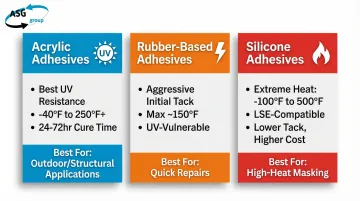
Three adhesive families dominate metal bonding applications, each with distinct performance profiles:
- Acrylic adhesives offer the best long-term durability and UV resistance, making them ideal for outdoor metal applications and structural bonds. They resist oxidation and maintain bond strength across wide temperature ranges (-40°F to 250°F+), but require 24-72 hours to reach full strength.
- Rubber-based adhesives provide aggressive initial tack for immediate handling strength, making them excellent for quick repairs and temporary bonds. However, they're vulnerable to UV degradation, high temperatures above 150°F, and chemical exposure.
- Silicone adhesives handle extreme temperatures from -100°F to 500°F and bond well to LSE surfaces, but offer lower initial tack and higher cost. They're the only choice for powder coating masking and high-heat metal processing.
Surface Energy and Substrate Type
Bare steel and aluminum bond easily due to their high surface energy (700-1100 dynes/cm), but coated metals present a different challenge. Powder-coated, anodized, or galvanized surfaces often fall below 36 dynes/cm, classifying them as low surface energy (LSE) substrates.
For LSE surfaces, specify tapes explicitly rated for LSE compatibility or use adhesion promoters like 3M Primer 94 to achieve reliable bonds.
Temperature and Environmental Exposure
Define the full range of conditions the bond must survive: thermal cycling extremes, outdoor UV exposure, chemical contact, and moisture—not just the average operating temperature.
A tape rated for 200°F continuous use may fail under repeated cycling between -20°F and 180°F. Outdoor metal applications require UV-stable acrylic adhesives; indoor manufacturing environments may allow rubber-based options.
Mechanical Load Type
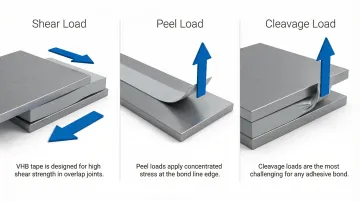
Metal bonding involves three distinct load types:
- Shear loads push parallel to the bond (holding weight on a vertical surface)
- Peel loads pull the tape away at an angle — like peeling a label from sheet metal
- Cleavage loads concentrate stress at a single edge of the bond area
Structural metal bonding applications require tapes tested for shear and tensile strength, not just peel. VHB tapes excel in shear (550 kPa) but all tapes are weakest in peel and cleavage—design bonds to minimize these load types.
Tape Thickness and Conformability
Uneven or textured metal surfaces (welds, seams, corrugated panels) need a conformable foam or rubber core that fills micro-gaps and maintains contact area. Thin film tapes may bridge gaps, creating voids where no adhesive contact occurs. Match tape thickness to surface roughness—smooth metals can use thin tapes, while textured surfaces may require 1.5mm+ foam thickness for full contact.
How to Get the Best Bond: Surface Prep and Application Tips for Metal
Surface Cleaning is Non-Negotiable
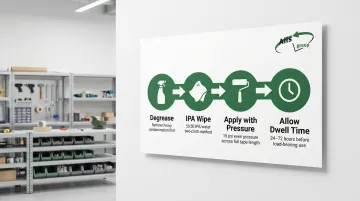
Metal surfaces must be free of oil, grease, oxide layers, and dust before tape application. The industry standard is cleaning with a 50:50 mixture of isopropyl alcohol (IPA) and water using a two-cloth method: wipe with the solvent cloth, then immediately wipe dry with a clean cloth to remove contaminants before they dry on the surface.
Even fingerprints applied after cleaning can reduce bond strength by up to 20%. For heavily contaminated metal, use a degreaser or citrus cleaner first, then follow with the IPA/water wipe. On aluminum, oxide layers may require mechanical abrasion before cleaning to expose fresh metal for bonding.
Application Pressure and Dwell Time
Pressure-sensitive adhesive tapes require firm, even pressure applied across the entire tape length immediately after placement. Use a roller or squeegee to apply approximately 15 psi of pressure to ensure the adhesive makes full contact with the metal surface.
Acrylic adhesive tapes also need time to reach full bond strength. Keep these dwell requirements in mind:
- Allow 24-72 hours before testing the bond on metal substrates
- Plan production schedules around the dwell period, not against it
- Avoid load-bearing use until dwell time is complete
Temperature at Application
Most adhesive tapes should be applied within a specified temperature window, typically above 50°F (10°C) for acrylic-based products. Below this threshold, the adhesive becomes too firm to flow and wet out the metal surface. Applying tape to cold metal in an unheated warehouse or outdoor environment can reduce initial adhesion by 50% or more, leading to immediate bond failure.
In cold environments, pre-heat the metal substrate before application or select specialized low-temperature tapes formulated to bond below 50°F.
Conclusion
The best adhesive tape for metal is never a one-size-fits-all product. The right choice depends on whether you're bonding bare aluminum or powder-coated steel, whether the application sees continuous heat or thermal cycling, and whether the load is primarily shear or peel. Prioritize adhesive chemistry match over brand recognition—an acrylic foam tape rated for LSE substrates will outperform a premium tape designed for high-surface-energy materials when bonding coated metal.
Surface preparation is the most important factor in any metal bonding application. Even the highest-rated structural tape will fail on contaminated metal, while proper cleaning can make a mid-grade tape perform beyond expectations.
For industrial and manufacturing applications, sourcing from a distributor with real technical depth matters. Alliance Packaging Group carries industrial-grade tapes from 3M, Intertape, and other trusted brands—over 10,000 products in stock for immediate nationwide shipment. Their team can help you match the right tape to your specific substrate, operating conditions, and load requirements, with factory-direct pricing and just-in-time delivery to simplify your supply chain.
Frequently Asked Questions
What tape holds metal together?
Double-sided acrylic foam tapes like 3M VHB are the most effective option, delivering shear strengths up to 550 kPa. They replace rivets, welds, and screws in structural applications by distributing stress across the bond area and providing vibration damping that mechanical fasteners cannot match.
What is the best adhesive for metals?
Acrylic adhesive systems — found on VHB and foil tapes — offer the best long-term performance on metal due to their UV resistance, oxidation stability, and wide temperature tolerance. For structural bonding specifically, double-sided acrylic foam tapes outperform rubber-based alternatives in durability and heat resistance.
Does adhesive tape work on powder-coated or anodized metal surfaces?
Yes, but standard tapes often fail on these surfaces because powder coat and anodized finishes have lower surface energy than bare metal (often below 36 dynes/cm). Use tapes rated for LSE substrates, and apply a primer like 3M Primer 94 to improve adhesion reliability.
What is the difference between aluminum foil tape and VHB tape for metal?
Aluminum foil tape handles sealing, thermal management, and HVAC applications where vapor barrier properties and heat reflection matter most. VHB tape is engineered for structural bonding where high shear and peel strength are needed to replace mechanical fasteners. They serve fundamentally different functions.
How should I prepare a metal surface before applying adhesive tape?
Clean the surface with a 50:50 mixture of isopropyl alcohol and water using a two-cloth method—wipe with solvent, then immediately dry with a clean cloth. This removes oil, grease, and oxidation that would prevent proper adhesion. Apply tape only after the surface is completely dry, and avoid touching the cleaned area with bare hands.
Can adhesive tape replace welding or mechanical fasteners on metal?
High-strength tapes like 3M VHB can replace rivets and screws in many moderate-load applications, eliminating corrosion points and adding vibration damping. They are not a substitute for welding in safety-critical or extreme-temperature joints where structural integrity is non-negotiable.