
Introduction
Packaging failures cost businesses more than just product replacements — they mean delayed shipments, customer complaints, and operational downtime. Collapsed box bottoms, crushed inventory, and wasted labor are predictable outcomes when boxes aren't matched to their load. According to industry data, improper packaging is a leading cause of damage during transit, with moisture and insufficient cushioning being the primary culprits.
Not all boxes are built the same. The right choice depends on what you're shipping, the weight of the load, and how the boxes will be handled in transit. Standard single-wall construction handles lightweight goods, while heavy-duty double-wall boxes prevent bottom blowouts under dense or heavy inventory.
This guide covers what to look for — from ECT ratings to specialty box types — so you can match the right box to the job and avoid damaged shipments and replacement costs.
Key Takeaways
- Plastic bins offer superior durability and moisture resistance for fragile items; cardboard boxes provide affordable, widely available options for general use
- Match box size to content weight: small boxes for dense items like parts or hardware, medium for equipment and components, large for lightweight bulky goods
- Specialty boxes (wardrobe, dish pack, TV) justify their cost by protecting high-value or oddly shaped items that standard boxes can't safely contain
- Box kits bundling assorted sizes with packing materials offer the best per-unit value for full-facility or office relocations
- Bulk orders through a single-source supplier with factory-direct pricing reduce per-box costs for large commercial or warehouse relocations
Types of Moving Boxes: What You Need to Know
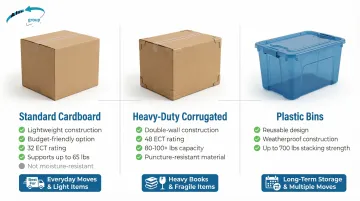
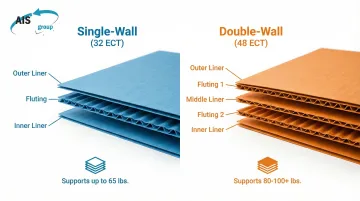
Moving boxes fall into three broad categories: standard cardboard, heavy-duty corrugated, and plastic bins. Each suits different items, budgets, and move scale. Single-wall corrugated boxes feature one layer of fluting sandwiched between two flat liner sheets, while double-wall boxes add a second fluting layer with an additional liner, creating significantly stronger construction.
The Edge Crush Test (ECT) rating is the industry standard for measuring box strength. ECT measures the force (in pounds per inch) a corrugated board can withstand on its edge before collapsing — directly predicting stacking capacity. A higher ECT number means the box bears more stacking weight, which matters most when loading a moving truck with boxes stacked multiple layers high.
Here's how the three main box types compare at a glance:
- Standard cardboard boxes — best for lightweight household items and short-distance moves on a tight budget
- Heavy-duty corrugated boxes — double-wall construction handles heavier loads and protects fragile items during long hauls
- Plastic bins — reusable and weatherproof, suited for valuables or moves where boxes will be handled repeatedly
Knowing which type fits each load before you pack saves both money and damaged goods on moving day.
Best Moving Boxes: Top Picks by Category
These picks are selected based on durability, availability, size range, and cost-effectiveness for both individual and commercial moves.
Standard Single-Wall Corrugated Moving Boxes
The most widely used moving box type, single-wall corrugated cardboard boxes are the go-to for general household items like clothing, linens, kitchenware, and books due to their lightweight design and low cost.
They stand out because they're available in small, medium, large, and extra-large sizes; easy to source from home improvement stores, online retailers, and packaging suppliers; and can be assembled and broken down quickly. However, they are not moisture-resistant and should not be used for heavy loads above their rated capacity (typically 32 ECT, supporting up to 65 lbs).
| Feature | Details |
|---|---|
| Best For | Everyday household items: clothing, books, kitchenware, pantry goods |
| Typical Sizes Available | Small (1.5 cu ft, ~16"×12"×12") to Extra-Large (6 cu ft, ~24"×18"×24") |
| Approximate Cost Range | $1.39–$1.85 (small) to $3.49–$4.08 (extra-large) |
Heavy-Duty Double-Wall Corrugated Boxes
Double-wall corrugated boxes feature two layers of fluted board between the liner sheets, making them considerably stronger than standard boxes and suitable for heavy or fragile items like dishes, electronics, tools, and small appliances.
The added wall layer increases stacking strength and puncture resistance. Look for boxes with an ECT rating of 48 or higher for heavy loads, which can support 80–100+ lbs without crushing. These boxes also eliminate the bottom blowouts common with standard cardboard under heavy weight.
| Feature | Details |
|---|---|
| Best For | Heavy items (books, tools, small appliances), fragile kitchenware, electronics |
| Key Differentiator | Double-wall construction offers 48 ECT vs. 32 ECT (single-wall), providing significantly higher stacking strength |
| Approximate Cost Range | $2.95 (small) to $7.95 (extra-large) — roughly 2× the cost of single-wall |
Plastic Moving Bins and Totes
Plastic bins and totes are the most durable moving container option. They are water-resistant, stackable, and reusable, making them particularly popular for fragile items, corporate relocations, and movers who prioritize long-term value.
Unlike cardboard, plastic bins do not weaken with moisture or repeated use. They typically feature interlocking lids for secure stacking. Industrial-grade plastic totes can support stacking loads of up to 700 lbs. However, they cost significantly more upfront and are harder to source in large quantities—renting plastic bins is often the more practical option for one-time movers.
| Feature | Details |
|---|---|
| Best For | Fragile valuables, long-distance moves, corporate relocations, long-term storage after moving |
| Reusability | Plastic bins last for multiple moves and serve as post-move storage containers; rental programs eliminate upfront cost |
| Approximate Cost Range | $8.98–$9.98 to purchase (27-gallon); $5.40/week to rent |
Specialty Moving Boxes
Specialty boxes are purpose-built for specific item types. Wardrobe boxes keep hanging clothes wrinkle-free, dish pack boxes have reinforced walls and often include dividers for glassware, and mirror/TV boxes protect flat and fragile panels that standard boxes cannot safely contain.
While more expensive than standard boxes, specialty boxes significantly reduce the risk of damage to high-value items — a worthwhile trade-off for irreplaceable or costly belongings.
| Feature | Details |
|---|---|
| Common Types | Wardrobe, dish pack, mirror/picture, flat-screen TV, mattress, lamp boxes |
| Best For | High-value, fragile, or oversized items that standard boxes cannot safely accommodate |
| Approximate Cost Range | $5.95 (lamp box) to $16.50–$20.25 (wardrobe); dish pack ~$8.10; TV boxes $29.99–$39.95 |
Moving Box Kits
Moving box kits bundle assorted box sizes with packing materials (tape, bubble wrap, packing paper, mattress covers) into a single purchase sized by home type—typically available in studio, 1–2 bedroom, 3–4 bedroom, and 4+ bedroom configurations.
Kits eliminate the guesswork of calculating individual box quantities and ensure you have matching packing materials from day one. They typically offer a lower per-box cost than buying sizes individually. Available from major retailers like U-Haul, Home Depot, and packaging suppliers.
For businesses or large office moves, consumer retail kits often fall short on volume and consistency. Bulk corrugated box orders from a single-source supplier—such as Alliance Packaging Group, which carries 1,000+ box sizes with factory-direct pricing and nationwide delivery—offer a more scalable and cost-effective alternative.
| Feature | Details |
|---|---|
| Best For | Whole-home moves or office relocations requiring multiple box sizes and packing supplies at once |
| Typical Kit Contents | Assorted small/medium/large boxes, packing tape, bubble wrap or foam, mattress cover—verify contents with specific retailers |
| Approximate Cost Range | Studio/1-bedroom: ~$69.95; 1–2 bedroom: ~$315–$320; 3–4 bedroom: ~$360–$481 |
Expert Packing Tips to Get the Most from Your Moving Boxes
Match Box Size to Item Weight
Putting heavy items in large boxes because they seem to fit is a reliable way to blow out a bottom seam mid-move. Heavy items like books, canned goods, and tools should always go in small boxes (approximately 1.5 cubic feet) to keep weight manageable and prevent box failure. Large boxes should be reserved for lightweight bulky items like pillows, duvets, and lampshades.
Reinforce Every Box Before Loading
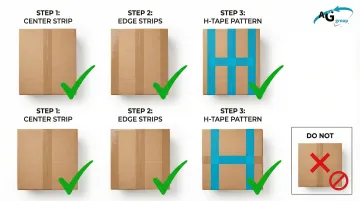
Use the H-tape method recommended by FedEx and U-Haul: apply tape along the center seam and both edge seams (forming an "H") on both the top and bottom of the box. Single strips of tape across the bottom seam alone are insufficient for boxes carrying more than a few pounds. Double-taping the bottom is especially important for heavy-duty boxes.
Pack Boxes to Capacity But Not Beyond
Underpacked boxes collapse when stacked (creating dead air space), while overpacked boxes burst at the seams. The ideal box should feel firm when lightly pressed on all sides. Use crumpled packing paper, bubble wrap, or foam peanuts to fill any remaining voids around fragile items.
Two More Tips That Save Time on Moving Day
These often-skipped steps pay off when you're unloading under pressure:
- Label destination room, contents, and handling instructions (e.g., "Fragile—This Side Up") on at least two sides of every box — stacking orientation changes what's visible, so one label isn't enough
- Secure small hardware (screws, bolts, cam locks) in labeled zip-lock bags and tape them directly to the corresponding furniture piece to avoid scrambling during reassembly
How We Chose the Best Moving Boxes
Each option was assessed on structural integrity (ECT/burst strength rating), size variety, availability, price-to-performance ratio, and suitability for both residential and commercial moves.
Key red flags movers should avoid when selecting boxes:
- Single-ply or non-rated generic boxes that lack a visible ECT or burst strength stamp
- Reused boxes with compromised corner integrity or moisture staining
- Boxes that are the wrong size for their contents (too large for heavy items, too small for bulky ones)
For businesses, offices, or multi-location relocations, sourcing from a single supplier with a broad size range and just-in-time delivery capability simplifies logistics and keeps quality consistent throughout. The larger the move, the more that consistency matters.
Conclusion
The best moving box is the one matched to the specific weight, fragility, and dimensions of what it contains. Taking time to select the right box type, size, and packing method means less damage, fewer trips, and a calmer moving day.
For businesses, warehouses, or anyone managing a large-scale move that demands consistent quality and volume, Alliance Packaging Group offers 1,000+ box sizes at factory-direct pricing with nationwide just-in-time delivery. Source everything from standard corrugated boxes to specialty sizes through one supplier. Reach out at sales@apg-go.com or call 770-309-1012.
Frequently Asked Questions
Who makes the best moving boxes?
Major U.S. manufacturers include Pratt Industries, Georgia-Pacific, and brands like Bankers Box (Fellowes). Quality is ultimately determined by the box's construction grade (ECT rating, wall type) rather than brand name alone, so always check for the Box Maker's Certificate stamp showing strength specifications.
Is it worth buying boxes for moving?
Buying is worth it when boxes will be reused for storage after the move or when items require specific sizes or strength ratings unavailable from free sources. For one-time household moves, free or rented boxes can be a cost-effective alternative if they're in good condition.
What is the strongest type of box?
Double-wall (or triple-wall) corrugated boxes with high ECT ratings (48+ for double-wall, 71–90 for triple-wall) are the strongest cardboard option. Heavy-duty plastic bins are the strongest overall moving container type due to their rigid construction and resistance to moisture and crushing.
What size moving box should I use for heavy items?
Small boxes (approximately 1.5 cubic feet, typically 16"×12"×12") are the correct choice for heavy items like books, tools, and canned goods. Larger boxes filled with heavy items become unmanageable and are more likely to fail at the seams.
How many moving boxes do I need?
General guidelines per Two Men and a Truck: 1-bedroom: 20–30 boxes; 2-bedroom: 35–50 boxes; 3-bedroom: 50–80 boxes. Use an online moving box calculator for a more accurate estimate based on packing style and lifestyle.
Can I get moving boxes for free?
Best free sources include grocery stores, liquor stores, bookstores, recycling centers, U-Haul Box Exchange, and community platforms like Facebook Marketplace, Craigslist, and Freecycle. Inspect free boxes for moisture damage or corner wear before use, as compromised boxes can fail during your move.