Introduction
Adhesive tape is one of the most widely used consumables across packaging, manufacturing, warehousing, and distribution, yet it is frequently selected by habit rather than by fit for the application. This choice carries real operational consequences. The U.S. sealing and strapping packaging tapes market reached $3.97 billion in 2024 and is projected to hit $4.76 billion by 2030, driven largely by e-commerce fulfillment demands.
Despite this massive consumption, damaged products still cost manufacturers an estimated 1% to 2% of total gross sales annually—approximately $15 billion per year in preventable expenses.
Choosing the wrong tape type creates avoidable operational problems:
- Failed seals that open in transit
- Rework that consumes labor and materials
- Surface damage from overly aggressive adhesives
- Compliance issues in temperature-controlled environments
- Unnecessary cost at scale
In high-volume operations where tape is applied thousands of times per shift, even small errors compound quickly into quality failures, line stoppages, or damaged goods.
This guide covers the major types of adhesive tapes, how each works, what they are best suited for, and how to select the right one for your specific industrial or packaging application.
Key Takeaways
- Tape performance is determined by three factors: carrier (backing) material, adhesive chemistry, and construction for the intended application
- Main industrial types include carton sealing, double-sided, filament/strapping, and duct tape—each engineered for distinct performance demands
- Acrylic adhesives handle heat and UV exposure; rubber-based adhesives grip faster on varied or low-energy surfaces
- Choosing tape by habit or lowest unit cost leads to failures that cost far more to fix than the savings justify
- Match tape to surface type, environment, load requirement, and permanence need for consistent results
What Is Adhesive Tape?
Adhesive tape is a flexible strip of material (the carrier or backing) coated on one or both sides with a pressure-sensitive adhesive that bonds to surfaces upon contact without requiring heat, water, or solvents. The Pressure Sensitive Tape Council defines it as "a continuous flexible strip of backing material coated with a permanently tacky adhesive that adheres upon contact without activation."
Three core components define every tape:
- Carrier (backing): The structural layer — polypropylene film, polyester, cloth, paper, foam, or reinforced materials — that dictates flexibility, tensile strength, and temperature resistance
- Adhesive: Determines bond strength, removability, and environmental resistance. Acrylic formulas offer superior UV resistance and temperature stability; rubber-based adhesives deliver stronger initial tack and better cold-temperature performance
- Liner: A release layer found in double-sided and specialty tapes that protects the adhesive surface until application
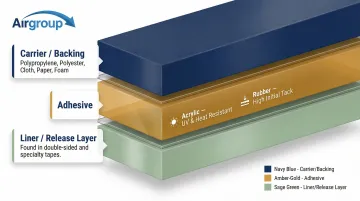
Two rolls of tape can look identical on the shelf and perform completely differently under load, heat, or UV exposure. Matching the right carrier-adhesive combination to the application is what separates a reliable bond from a failed one.
Why Tape Selection Matters in Packaging and Industrial Operations
In high-volume environments such as distribution centers, manufacturing lines, and e-commerce fulfillment operations, tape is applied thousands of times per shift—making even small errors in tape selection compound quickly into quality failures, line stoppages, or damaged goods in transit.
Common failure modes when the wrong tape is used:
- Carton seals that fail under temperature cycling during shipping or storage
- Surfaces damaged by overly aggressive adhesives during rework or returns processing
- Strapping tape that snaps under pallet load, causing load shifting or product damage
- Masking tape that bonds permanently when left on too long, requiring costly removal
- Poor wipe-down pressure during application that prevents adhesive from bonding with corrugated fibers
E-commerce return rates hover between 20% and 30%—more than double the 9% rate of traditional retail. Many of these returns stem from packaging failures during transit.
Material waste compounds the problem. 10% to 20% tape waste is considered normal in many facilities—typically the result of wrong tape selection or improper application technique.
The purchase price of tape is rarely the most important number. Total cost of use is. Evaluating tape on that basis means accounting for:
- Application speed and ease of use on your line
- Downtime caused by breakage or seal failures
- Labor spent on rework and repackaging
- Waste reduction from fewer failed applications
Types of Adhesive Tapes
Carrier material, adhesive chemistry, construction (single-sided, double-sided, no carrier), and intended environment all determine how a tape performs — and choosing the wrong type for a job costs time, money, and materials.
Dozens of subtypes exist, but the four categories below cover the core options most relevant to packaging, warehousing, manufacturing, and industrial distribution: carton sealing, double-sided, filament, and duct tape.
Carton Sealing Tape (Packaging Tape)
Carton sealing tape is a single-sided tape made with a polypropylene or polyester film carrier coated with acrylic or rubber adhesive, designed to close and seal corrugated boxes for shipping and storage. It comes in hand-application and machine-application grades, and adhesive chemistry determines performance across different temperature and humidity conditions.
Packaging tapes hold a 48.14% revenue share of the North American pressure-sensitive tapes market (2022), with global demand forecast to grow 3.4% per year — reaching 37.5 billion metric tons by 2025.
The defining characteristic is its ability to bond reliably to the rough, porous surface of corrugated cardboard — something standard tapes aren't engineered for. Acrylic grades offer better long-term aging and UV resistance; hot-melt rubber grades deliver stronger initial tack on cold or recycled-content boxes.
| Feature | Acrylic Tape | Hot Melt Tape |
|---|---|---|
| Operating Temp Range | 32°F to 140°F | 45°F to 120°F |
| Adhesion Characteristics | Strong resistance to oxidation and UV; seal strength improves over time | High initial tack and superior holding power; ideal for machine application |
| Best Use Case | Long-term storage, varying temperatures, low/high humidity | Dusty/recycled corrugate, overstuffed cartons, automated lines |
| Aging Resistance | Excellent; does not yellow with age | Prone to yellowing; less resistant to UV |
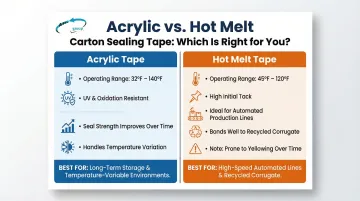
Carton sealing tape is the right choice for warehouses, e-commerce fulfillment centers, and manufacturing outbound shipping. High-volume operations should specify machine-grade rolls built for automated case sealers. Alliance Packaging Group stocks BOX Partners carton sealing tape in thicknesses from 1.6 mil to 3.5 mil and tensile strengths from 17 lb to 34 lb.
The main limitation: standard grades can fail in extreme cold (below-freezing storage or refrigerated distribution) or on wet, contaminated surfaces. Specialty grades address these conditions but at a higher cost per roll.
Double-Sided Tape
Double-sided tape carries adhesive on both faces, separated by a carrier (film, tissue, or foam) — or with no carrier at all in transfer tape configurations. The carrier type determines whether the tape is suited for temporary mounting, permanent bonding, or gap-filling on uneven surfaces.
High-bond acrylic foam tapes like 3M VHB use a foam carrier that functions as both structural material and adhesive, enabling them to replace mechanical fasteners in demanding applications.
Unlike single-sided tape, double-sided tape bonds two surfaces together while staying invisible in the finished assembly. High-bond versions offer real structural integrity: 3M VHB Tape 4611 delivers 450 kPa (65 lb/in²) overlap shear strength and 620 kPa (90 lb/in²) normal tensile strength.
Double-sided tape is the right choice wherever a clean, invisible bond matters. Common applications include:
- Electronics assembly and PCB component mounting
- Display and signage installation
- Product labeling and foam gasket bonding
- Automotive trim and architectural panel attachment
In aerospace, 3M VHB Tape replaced mechanical fixings on aircraft stair frame panels, cutting fitting and fabrication time by nearly 50% and eliminating drilling entirely. It's especially valuable when drilling would compromise substrate integrity or when visual appearance is critical.
Foam versions add conformability and vibration damping across a wide range of substrates. The main trade-offs: surfaces must be clean and free of oils or dust before application, and high-bond versions are essentially permanent — removal typically causes surface damage.
Filament (Strapping) Tape
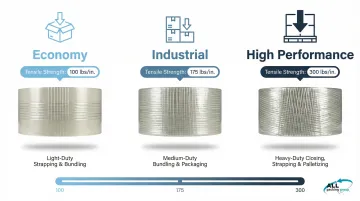
Filament tape is a single-sided tape reinforced with fiberglass or polyester filaments embedded lengthwise in the backing. Those filaments deliver tensile strength far beyond any unreinforced film tape, making it resistant to splitting or snapping under load.
That distinction matters in practice: standard packaging tape snaps under significant longitudinal load. Filament tape holds. It's a bundling and reinforcement tool — not a sealing tool.
| Grade | Tensile Strength | Application |
|---|---|---|
| High Performance | 300 lbs/in | Heavy-duty closing, strapping, palletizing |
| Industrial | 175 lbs/in | Medium-duty bundling and packaging |
| Economy | 100 lbs/in | Light-duty strapping and bundling |
Duct tape is a polyethylene-coated woven fabric tape with a high-tack rubber adhesive. The woven carrier combines flexibility, hand-tearability, and moderate tensile strength — making it broadly useful for temporary repairs, bundling, and sealing in demanding environments.
Industrial grades push that performance further. 3M Heavy Duty Duct Tape DT11, for example, delivers 49 N/cm (28 lb/in) tensile strength and handles temperatures up to 200°F for short durations.
Unlike packaging tape (built for corrugated) or filament tape (built for tensile load), duct tape is a generalist. It bonds to a wider variety of substrates — rough, irregular, or uneven — but doesn't lead in any single performance category.
Duct tape covers on-the-spot repairs, surface protection, temporary sealing, and general maintenance tasks across manufacturing plants and warehouses. It's a practical default — though a more specific tape type will often perform better and cost less when the application is clearly defined.
Versatile, conformable, and hand-tearable, it's available in contractor and industrial grades to match the job. Three limitations worth noting:
- Leaves residue on surfaces after removal
- Rubber adhesive softens above 180°F and loses tack below 0°F
- Long-term aging degrades the adhesive and can cause the cloth backing to separate
How to Choose the Right Adhesive Tape for Your Application
The correct tape is defined by fit to the specific application—not by brand familiarity or what was on the last purchase order. The key variables to evaluate are: surface type, environmental conditions, load or stress requirements, permanence (temporary vs. permanent bond), and application method (hand vs. machine).
Factors to Consider
Surface compatibility determines your adhesive chemistry before anything else. Porous surfaces like corrugated cardboard require high-tack adhesives that can flow into the fiber structure. Smooth surfaces like metal or glass work with lower-tack acrylic films. Contaminated or oily surfaces may require specialty chemistry — for example, 3M 300LSE acrylics are engineered for high bond strength to low-surface-energy materials like polypropylene and polyethylene, even with light oil contamination.
Environmental conditions — particularly temperature — are the next critical filter:
| Adhesive Type | Lower Service Limit | Upper Service Limit | Characteristics |
|---|---|---|---|
| Acrylic PSA | -40°F | 250°F (short term up to 300°F) | Excellent resistance to UV, oxidation, and chemicals; best for long-term durability |
| Rubber PSA | 0°F | 180°F | High initial tack; stiffens/loses tack in extreme cold; softens in high heat; vulnerable to UV |
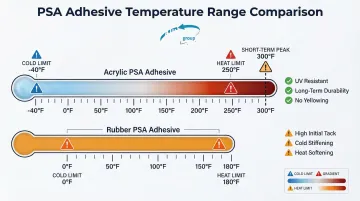
Standard hot-melt carton sealing tapes perform best between 45°F and 120°F, while acrylics offer a wider range — typically 32°F to 140°F for packing tape and -20°F to 400°F for heavy-duty double-sided applications.
For load-bearing applications — bundling, strapping, pallet reinforcement — filament tape is the right choice, with grades ranging from 100 to 300 lb/in tensile strength. When the goal is a permanent surface bond without visible hardware, evaluate high-bond double-sided tape instead.
Permanence shapes the entire adhesive selection. Permanent bonds (carton sealing, assembly) tolerate aggressive adhesives. Temporary applications — masking, surface protection, positioning — require clean-release adhesives that won't damage the substrate on removal.
For high-volume operations, match tape width and roll length to your dispenser or case-sealer specifications. Inconsistent hand application at scale introduces quality variation. Working with a distributor like Alliance Packaging Group, which stocks industrial tape from 3M, Intertape, and other major brands, reduces the number of suppliers to manage and supports supply continuity through just-in-time delivery programs.
Common Tape Selection Mistakes to Avoid
Even with the right criteria in mind, a few recurring mistakes drive up costs and rework. Watch for these:
- Defaulting to the most aggressive adhesive as a "safety" measure — overly strong adhesives cause surface damage during removal and increase rework costs without improving seal reliability when the carrier is the actual failure point
- Selecting tape on unit price alone — a slightly more expensive tape that eliminates rework nearly always costs less overall. Industry data shows 10–20% tape waste is common when the wrong tape is selected
- Relying on duct tape or other general-purpose options long-term — purpose-built tape types typically outperform them at a comparable or lower cost per use
Conclusion
Adhesive tape is one of the most operationally impactful consumables in packaging and industrial environments. The gap between a well-matched tape and a mismatched one shows up directly in seal failures, rework costs, surface damage, and throughput disruption. With the U.S. sealing and strapping packaging tapes market projected to reach $4.76 billion by 2030 and damaged products costing manufacturers $15 billion per year, tape selection decisions carry real financial weight.
The four core types—carton sealing, double-sided, filament, and duct tape—each solve a distinct set of problems. Understanding what differentiates them allows operations teams to make deliberate, cost-effective decisions aligned with actual application demands.
Putting that knowledge into practice also means having the right tapes available when production schedules demand them—not waiting on backorders or juggling multiple vendors. Alliance Packaging Group stocks over 10,000 products across tape types, widths, and grades, with nationwide just-in-time delivery, factory-direct pricing, and application-specific consultation to match the right tape to the job.
the right tape selection pays for itself in reduced failures and rework
Frequently Asked Questions
What are the different types of adhesive tapes?
The main categories include carton sealing/packaging tape, double-sided tape, filament/strapping tape, duct tape, masking tape, electrical tape, and foam tape. Each is differentiated by its carrier material (film, cloth, foam, paper) and adhesive chemistry (acrylic, rubber, silicone), making them suited to specific applications.
What is the difference between acrylic and rubber-based adhesive tape?
Acrylic adhesives offer superior UV resistance, temperature stability (-40°F to 250°F), and long-term aging performance without yellowing. Rubber-based adhesives provide stronger initial tack and perform best between 0°F and 180°F. Choose acrylics for outdoor or high-heat applications; choose rubber for immediate bonding on difficult surfaces.
When should you use double-sided tape instead of single-sided tape?
Double-sided tape is appropriate when the bond must be invisible, when two surfaces need to be joined rather than one surface secured, or when the tape needs to conform and fill a gap between substrates. High-bond acrylic foam versions can replace mechanical fasteners in applications requiring structural strength without visible hardware.
What type of tape is best for carton sealing in a warehouse?
It depends on your surface conditions and temperature range. Hot-melt polypropylene tape handles dusty or recycled corrugate and works well in automated case sealers, while acrylic tape holds up better across varying temperatures (32°F to 140°F) and long-term storage. For high-volume operations, machine-grade rolls ensure consistent application and reduce downtime.
Can adhesive tape perform reliably in extreme temperatures?
Standard rubber-based tapes lose adhesion above 180°F and below 0°F. Specialty acrylic or silicone tapes handle high-heat (up to 300°F short-term) and cold-chain environments (down to -40°F). Always verify the operating range against product specs before selecting tape for temperature-sensitive applications.
How do I know which tape backing material is right for my application?
Match the backing to your surface type and load requirements:
- Film backings (polypropylene, polyester): clean, consistent bonds on smooth surfaces
- Cloth/fabric backings: hand-tearable and conformable for irregular surfaces or temporary repairs
- Reinforced backings (filament tape with fiberglass strands): required when the tape must withstand tensile loads of 100-300 lb/in during bundling or strapping