
Introduction
A box that survives a ground delivery in the US can fall apart completely on an overseas shipment — and the difference often comes down to one overlooked spec on the box flap. International freight is a different animal.
Transit times stretch into weeks. Cargo passes through multiple hands — warehouse staff, port crews, vessel handlers, customs inspectors. Inside containers, stacking pressure and humidity swings test packaging in ways domestic shipping simply never does.
Choosing the wrong box for international shipping leads to damaged goods, costly claims, and lost customer trust. But the right box selection—matched to your product's weight, fragility, and shipping method—directly protects both margins and reputation. This guide covers the best box types for overseas shipping, the key specifications to evaluate, and expert packing techniques to ensure products arrive intact.
Key Takeaways
- Double-wall and triple-wall corrugated boxes are essential for overseas shipping — superior compression and puncture resistance are non-negotiable for long-haul freight
- ECT rating and burst strength are the specs that matter, not box size alone
- Moisture resistance is crucial for ocean freight, where humidity can reduce box strength by 34-58%
- Single-wall cartons, used boxes, and domestic-grade packaging are not suitable for international shipments
- Choose box type based on product weight, fragility, and whether you're shipping by air or ocean
Why Overseas Shipping Demands Better Boxes
International shipping subjects packaging to cumulative stresses that domestic transit never encounters. Transit times range from 25-35 days from Asia to the US, and 30-45 days to Europe, with cargo passing through multiple handling stages—warehouse consolidation, port loading, vessel stacking, customs inspection, and final delivery. Each touchpoint adds potential for drops, impacts, and compression damage.
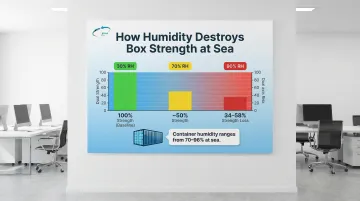
Ocean freight creates particularly harsh conditions. Shipping containers experience relative humidity fluctuations between 70-90% at sea, with peaks reaching 96% during land transport. This moisture exposure is devastating to standard corrugated board, which can lose 34-58% of its compression strength as humidity rises from 30% to 90%.
Boxes stacked at the bottom of a container must support thousands of pounds. When moisture weakens the board structure, the entire stack can collapse.
Industry data confirms the stakes: approximately 65% of cargo damage claims result from inadequate packing, according to TT Club, a leading transport insurer. Starting with the right box is the most direct way to avoid becoming part of that statistic.
What Boxes to Avoid for Overseas Shipments
Certain packaging types consistently fail in international transit:
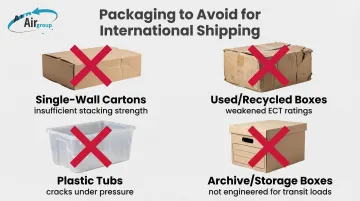
- Single-wall cartons — Lack sufficient stacking strength for container loads and are recommended only for packages under 30-50 lbs in domestic shipping
- Used or recycled boxes — Weakened structural integrity from prior use compromises ECT ratings; carriers explicitly state to ship freight in new corrugated boxes
- Plastic tubs — Prone to cracking under sustained pressure and add excess dimensional weight charges
- Archive or storage boxes — Not engineered for transit loads or stacking compression
Best Box Types for Overseas Shipping
No single box type works universally. Selection should be driven by product weight, fragility, shipping mode (air or ocean), and transit duration. Here are the industry-standard options.
Double-Wall Corrugated Boxes
Double-wall corrugated construction features two layers of fluting between three liner sheets, delivering measurably better compression and puncture resistance than single-wall cartons. This is the baseline recommendation for most overseas shipments.
It covers a wide range of B2B applications: general merchandise, packaged goods, auto parts, and consumer electronics outer packaging. The balance of protection and cost-efficiency makes it the workhorse of international freight.
| Feature | Details |
|---|---|
| Ideal For | Medium-weight goods, general merchandise, e-commerce fulfillment for international orders |
| Typical ECT Rating | 44–51 ECT for standard applications; 48–61 ECT for heavier loads |
| Key Advantage | Superior stacking strength and puncture resistance vs. single-wall; suitable for both air and ocean freight |
Alliance Packaging Group stocks over 1,000 box sizes in double-wall construction with factory-direct pricing, allowing businesses to right-size packaging without custom fabrication delays.
Heavy-Duty / Triple-Wall Corrugated Boxes
When double-wall isn't enough, triple-wall corrugated steps in. Three fluting layers between four liners make it the strongest corrugated option short of wooden crating. It's used when shipping heavy industrial components, machinery parts, or bulk goods overseas.
Triple-wall boxes offer a cost-effective alternative to wooden crates for items that don't require ISPM 15 fumigation compliance. Since corrugated cardboard is exempt from ISPM 15 phytosanitary regulations, shippers save time and avoid the customs paperwork required for wood packaging.
| Feature | Details |
|---|---|
| Ideal For | Heavy industrial parts, dense goods, palletized overseas shipments |
| Typical Weight Capacity | 240–300+ lbs with ECT ratings of 67–112 |
| Key Advantage | Extreme compression and stacking resistance; eliminates wooden crate compliance requirements |
Moisture-Resistant Corrugated Boxes
Standard corrugated cardboard can lose over half its compression strength when exposed to high humidity — a serious liability inside ocean freight containers. Moisture-resistant boxes use wax-coated or chemically treated liners to maintain structural integrity during prolonged exposure.
This type is especially relevant for businesses shipping to tropical climates or for FCL/LCL ocean shipments with multi-week transit times. Studies show untreated board absorbs moisture like a sponge, losing 34–58% of stacking strength at 90% relative humidity.
| Feature | Details |
|---|---|
| Ideal For | Ocean freight shipments, goods destined for high-humidity regions (Southeast Asia, South America) |
| Coating Type | Wax-coated (non-recyclable), water-resistant treatments, or clay-coated liner options (recyclable) |
| Key Advantage | Maintains box strength during multi-week ocean voyages; reduces moisture-related cargo claims |
For added protection, Alliance Packaging Group offers heavy-duty moisture barrier bags that can be used inside corrugated boxes to create a multi-layer defense against humidity.
Specialty / Fragile-Rated Boxes
Specialty boxes for fragile items combine double-wall or reinforced construction with interior die-cut foam inserts, suspension packaging, or cell dividers to immobilize contents. These are common in electronics, glassware, medical device, and ceramic shipments.
These boxes often include printed fragile indicators and are engineered to meet specific ISTA (International Safe Transit Association) test standards. ISTA certification proves packaging has passed rigorous drop, vibration, and compression testing — which strengthens carrier liability claims and reduces damage rates.
| Feature | Details |
|---|---|
| Ideal For | Electronics, glassware, ceramics, medical devices, precision instruments |
| Interior Options | Die-cut foam, cell dividers, suspension inserts — each suited to different product geometries |
| Key Advantage | Combines box structural integrity with interior immobilization to handle shock and vibration |
Alliance Packaging Group offers foam bottle shipper kits, Korrvu suspension packaging, and anti-static foam protection systems specifically designed for fragile international shipments.
Extra-Large / Bulk Corrugated Boxes
Extra-large boxes consolidate multiple SKUs or ship large-format items, reducing carton count, handling touchpoints, and per-unit shipping costs. However, proper internal dividers and void-fill are critical — oversized boxes that are underpacked shift loads onto box walls rather than the product, increasing damage risk.
| Feature | Details |
|---|---|
| Ideal For | Bulk shipments, multi-item consolidation, large consumer goods (appliances, sporting goods) |
| Sizing Consideration | Choose the smallest box that fits contents with 2–3 inches of cushioning material on all sides |
| Key Advantage | Reduces per-shipment carton count and handling frequency; cost-effective for high-volume orders |
Key Features to Look for in an Overseas Shipping Box
ECT Rating vs. Burst Strength
Two primary strength metrics define corrugated boxes:
- Edge Crush Test (ECT) measures how well a box resists vertical stacking compression—critical for container stacking. ECT ratings range from 32 ECT (lighter loads) to 90+ ECT (heavy industrial applications).
- Mullen Burst Test measures resistance to puncture or rupture from impact.
For overseas shipping, ECT rating is the more relevant spec because boxes must withstand sustained stacking pressure in containers. A 32 ECT box is roughly equivalent to a 200# Burst box, but ECT better predicts warehouse stacking performance.
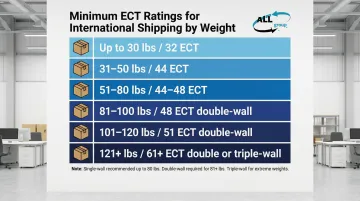
Minimum Recommended ECT Ratings by Weight:
| Shipment Weight | Minimum ECT |
|---|---|
| Up to 30 lbs | 32 ECT |
| 31–50 lbs | 44 ECT |
| 51–80 lbs | 44–48 ECT |
| 81–100 lbs | 48 ECT (double-wall) |
| 101–120 lbs | 51 ECT (double-wall) |
| 121+ lbs | 61+ ECT (double or triple-wall) |
Box Certification Standards
Boxes certified for international shipping carry a Box Maker's Certificate (BMC) printed on the bottom flap. This stamp indicates flute type, minimum weight capacity, and burst/ECT strength. Always verify this certificate rather than relying on box appearance alone—exceeding the weight limit printed on the BMC can void damage claims.
Flute Type and Its Impact
Common flute types affect cushioning versus stacking strength:
- A-Flute (4.8mm): Best cushioning for fragile goods; excellent stacking strength
- B-Flute (3.0mm): Good crush resistance; flat surface for printing
- C-Flute (4.0mm): Balanced cushioning and stacking; standard shipping cartons
- BC Double-Wall (6–7mm): Maximum compression resistance for heavy stacking loads in containers
For international shipments, BC double-wall construction is the recommended choice for heavy or high-stack loads.
Size Optimization and Dimensional Weight
International carriers—especially air freight—charge based on dimensional weight: (length × width × height) ÷ dimensional factor. For UPS and FedEx international shipments, the divisor is 139 (inches/lbs).
Oversized boxes increase shipping costs even when the product is light—so the right box dimensions protect both your goods and your freight budget. Alliance Packaging Group stocks more than 1,000 box sizes for immediate shipment, which means businesses can match dimensions precisely without waiting on custom fabrication or absorbing unnecessary dimensional weight charges.
Expert Packing Tips to Maximize Box Performance Overseas
The 2-Inch Cushioning Rule
All six interior faces of a shipping box should have at least 2 inches of cushioning material between the product and the box wall—top, bottom, and all four sides. This absorbs shock during drops and handling. The most common packing mistake is cushioning the bottom only, leaving the product vulnerable to side impacts.
Sealing Method Matters
H-tape sealing (tape across the center seam and both side seams in an H configuration) significantly improves box seal integrity. All major carriers recommend this method for international shipments. Per UPS packaging guidelines, acceptable tape options include:
- Pressure-sensitive plastic tape (minimum 2 inches wide)
- Water-activated reinforced tape (minimum 60 lb grade)
- Avoid: cellophane, duct, or masking tape — none hold under international transit stress
Alliance Packaging Group carries both reinforced and non-reinforced water-activated tape across multiple grades, from Economy to Industrial, for shipments at any scale.
Palletizing and Strapping for Container Loading
Once individual boxes are sealed and ready, proper pallet configuration determines how well that protection holds through container transit. For businesses shipping multiple cartons:
- Column stacking (boxes aligned corner-to-corner) provides 30-50% more compression strength than interlocking patterns but requires stabilization
- Stretch wrap and corner boards secure loads and prevent shifting during container transit
- Strapping with high-tensile polypropylene or polyester cord adds an extra layer of security
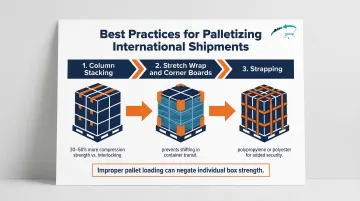
Improper pallet loading can negate the strength of even the best individual boxes. Alliance Packaging Group supplies stretch films rated from 1,600 to 4,000 lbs, polypropylene strapping, and automatic strapping systems for high-volume operations.
Conclusion
For overseas shipping, box selection is a strategic decision. The right combination of corrugated type, ECT rating, moisture resistance, and proper sizing directly reduces damage rates, claims, and the cost of replacements or returns. Evaluate your current packaging against actual transit conditions—shipping mode, destination climate, product weight and fragility—rather than defaulting to whatever box is cheapest or most available.
Alliance Packaging Group stocks over 1,000 box sizes at factory-direct pricing, including:
- Double-wall and triple-wall corrugated for heavy or fragile freight
- Moisture-resistant options for humid climates or ocean transit
- Specialty sizes for non-standard product dimensions
Nationwide just-in-time delivery means manufacturers, distributors, and shippers can stock the right box without overpaying or waiting. Contact us at sales@apg-go.com or 770-309-1012 to discuss your international packaging needs.
Frequently Asked Questions
What is the strongest type of box for overseas shipping?
Triple-wall corrugated boxes offer the highest compression and stacking strength in the corrugated category, with ECT ratings of 67-112 and weight capacities exceeding 240 lbs. For extreme loads, wooden crates may be used, but triple-wall cardboard is typically sufficient for most B2B international shipments.
Can I reuse boxes for international shipping?
No. Prior use weakens structural integrity and ECT ratings, and some customs authorities will reject packaging that previously contained organic matter. Always use new, certified boxes for overseas freight.
What ECT rating do I need for international shipping?
The minimum ECT rating depends on shipment weight. Standard guidelines recommend 32 ECT for loads under 30 lbs, 44-48 ECT for 50-80 lbs, and 51-61+ ECT for heavier or stacked shipments. Always confirm carrier requirements for your specific shipping lane.
Does box material matter differently for air freight vs. ocean freight?
Yes. Ocean freight demands greater moisture resistance and long-duration compression strength due to extended transit times and container humidity. Air freight prioritizes dimensional weight efficiency and shock absorption — transit is faster, but packages go through more handling touchpoints.
What does ISPM 15 compliance mean for international shipping boxes?
ISPM 15 is an international phytosanitary standard that applies only to wooden packaging (pallets, crates)—it requires heat treatment or fumigation to prevent pest spread. Corrugated cardboard boxes are exempt from ISPM 15, which is one reason they are preferred for international shipments.
How do I prevent box damage from humidity during ocean freight?
Use moisture-resistant or wax-coated corrugated boxes paired with desiccant packets or moisture barrier bags inside each carton. Standard corrugated can lose 34-58% of compression strength when wet, so proper container loading to minimize condensation exposure is equally important.