Introduction
Industrial labeling failures create real costs. Manufacturers, distributors, and warehouse operators routinely face compliance violations, product recalls, and operational disruptions from illegible, incorrect, or degraded labels. Research shows that unplanned downtime costs U.S. manufacturers between $260,000 and $532,000 per hour—a figure that puts label reliability in a very different light.
Choosing the right printing solution directly affects regulatory compliance (GHS, OSHA, FDA, UL), operational throughput, and traceability across pharmaceuticals, food and beverage, and chemical manufacturing.
This guide evaluates the top 5 industrial-grade label printing solutions available to USA businesses in 2026, assessing print technology, output volume, durability, connectivity, and total cost of ownership to help you make an informed procurement decision.
Key Takeaways
- Industrial label printers are ruggedized, high-volume systems built for 24/7 operation in factories, distribution centers, and warehouses—not desktop alternatives
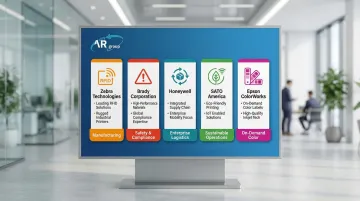
- Zebra Technologies, Brady Corporation, Honeywell, SATO America, and Epson ColorWorks lead in 2026 across use cases from asset tracking to pharmaceutical serialization
- Selection criteria include print technology (direct thermal vs. thermal transfer), durability ratings, WMS/ERP integration, label media compatibility, and monthly duty cycle
- Total cost of ownership (consumables, printhead replacement, software licensing) matters more than upfront hardware price
- Single-source suppliers consolidate procurement, cut lead times, and eliminate compatibility headaches when sourcing printers alongside label media
Overview of Industrial Label Printing in the USA Market
Industrial label printing refers to high-volume, ruggedized printing systems engineered for continuous-duty operation. These systems produce labels at production speeds no desktop printer can sustain, covering:
- Compliance labels (GHS, OSHA, FDA, UL)
- Asset tags and product identification labels
- Shipping labels with variable data (barcodes, QR codes, serialization)
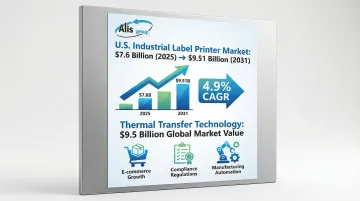
The U.S. industrial label printer market is valued at $7.6 billion in 2025 and projected to grow at a 4.9% CAGR through 2035, driven by e-commerce expansion, supply chain compliance regulations, and manufacturing automation. The broader U.S. print label market is expected to reach $8.2 billion in 2026, growing to $9.51 billion by 2031.
Thermal transfer technology — valued at $9.5 billion globally in 2025 — remains the dominant standard for industrial durability. It's the go-to choice for FDA and OSHA compliance, where label legibility must survive harsh chemical and environmental exposure.
With dozens of brands available, identifying the right industrial label printing solution requires evaluating reliability, duty cycle, compliance capability, and ecosystem support. The five solutions below are ranked against exactly those criteria.
Top 5 Industrial Label Printing Solutions for USA Businesses in 2026
These five solutions were evaluated across six criteria before making this list:
- Industrial durability ratings and build quality
- Print speed and resolution
- Label media versatility
- Compliance certification support
- Software and integration ecosystem
- Proven deployment across U.S. manufacturing, distribution, and warehousing
Zebra Technologies (ZT Series / ZD Series Industrial Printers)
Zebra Technologies has the widest deployment footprint in U.S. industrial thermal label printing. Its ZT Series (industrial) and ZD Series (desktop-industrial) are built specifically for high-volume operations requiring 24/7 uptime — and the ecosystem around them reflects that.
What separates Zebra from the rest is Link-OS, its cloud-connected operating system. Link-OS handles remote diagnostics, printer fleet management, and direct integration with WMS and ERP platforms — all without custom middleware. For multi-site manufacturers or large distribution centers, that's a meaningful operational advantage. RFID encoding and PrintSecure capabilities also cover pharmaceutical serialization and asset tracking requirements out of the box.
| Feature | Specification |
|---|---|
| Print Technology | Direct thermal and thermal transfer; up to 600 dpi resolution; speeds up to 14 inches per second (ZT600 series) |
| Best For | High-volume warehousing, distribution, pharmaceutical serialization, retail supply chain |
| Key Features | Link-OS ecosystem, RFID encoding capability, XML/ZPL programming, USB/Ethernet/Wi-Fi/Bluetooth connectivity, all-metal structural components with thermal management |
Brady Corporation (BradyPrinter Series)
Brady Corporation is purpose-built for safety and compliance labeling — not a general-purpose printer vendor that added compliance features later. If your facility needs GHS chemical labels, lockout/tagout (LOTO) safety labels, wire and cable marking, or facility management signage, Brady's the specialist in this list.
Brady's closed ecosystem — proprietary cartridges paired with Brady Workstation software — means OSHA, NEC, and ISO-compliant templates work correctly without custom configuration. That tradeoff (less flexibility, more reliability) is exactly what safety-focused operations need. The label materials themselves are lab-tested for extreme temperature, chemical exposure, and UV resistance, not just rated on spec sheets.
| Feature | Specification |
|---|---|
| Print Technology | Thermal transfer; models ranging from portable handheld (M611) to high-volume desktop (BBP35/37); print speeds up to 5 inches per second |
| Best For | Safety/compliance labeling, chemical (GHS) labels, electrical panel marking, wire/cable identification, facility management |
| Key Features | Brady Workstation compliance software (OSHA, GHS, NEC templates), proprietary cartridge system for 20-second material changeovers, extreme-environment label materials, UL/CSA/CE-certified label outputs |
Honeywell Industrial Printing (Datamax H-Class)
Honeywell's industrial printing division — carrying forward the Datamax-O'Neil and Intermec lineage — produces thermal label printers deployed widely across U.S. logistics hubs, manufacturing lines, and healthcare facilities. The core strength here is durability-first engineering combined with broad enterprise software compatibility.
Honeywell printers meet strict ingress protection (resistance to dust and liquids) and drop-resistance standards, which matters in cold storage, automotive production, and pharmaceutical environments where other printers fail. On the software side, Fingerprint and Direct Protocol programming languages cover both legacy ERP systems and modern platforms — SAP, Oracle, and Manhattan Associates are all supported without additional middleware.
| Feature | Specification |
|---|---|
| Print Technology | Direct thermal and thermal transfer; up to 600 dpi; print speeds up to 12 inches per second (H-Class Industrial) |
| Best For | Cold-chain logistics, automotive and aerospace manufacturing, healthcare/pharmaceutical labeling, multi-platform enterprise environments |
| Key Features | Fingerprint/Direct Protocol ERP compatibility, LCD color display with intuitive UI, USB/Serial/Ethernet/Wi-Fi connectivity, die-cast aluminum frame construction, hot-swappable media and ribbon design |
SATO America (CL/CT/FX Series Industrial Printers)
SATO America is a subsidiary of Japan's SATO Holdings — a 75+ year specialist in auto-ID and labeling — with a strong U.S. footprint in food and beverage, pharmaceutical, and retail supply chain sectors. SATO is particularly recognized for linerless label printing and compliance-grade traceability.
Two features set SATO apart. First, the CLNX series runs an Android-based open platform, so businesses can deploy custom labeling apps directly on the printer — no connected PC or server required. Second, SATO's linerless printing eliminates the backing liner entirely, cutting label waste by up to 40%. For U.S. enterprises where sustainability now factors into procurement decisions, that waste reduction has real budget impact.
| Feature | Specification |
|---|---|
| Print Technology | Direct thermal and thermal transfer; up to 305 dpi; print speeds up to 14 inches per second (CL series); linerless capability available |
| Best For | Food and beverage date coding/traceability, pharmaceutical compliance, retail price marking, sustainability-focused labeling operations |
| Key Features | Android-based open platform (CLNX), linerless printing (up to 40% waste reduction), SATO Online Services remote monitoring (can reduce downtime by up to 86%), USB/Ethernet/Wi-Fi/Bluetooth, IP54-rated housing options |
Epson ColorWorks Series (CW-C6000/C6500/C8000)
Epson's ColorWorks series stands apart from every other option on this list: it's the only full-color industrial printer here. It's purpose-built for businesses that need on-demand color label printing without the lead times or minimum order quantities of outsourced print runs. Adoption is strongest in food and beverage, nutraceuticals, cosmetics, and specialty chemical labeling.
PrecisionCore inkjet technology delivers full-CMYK color at photo quality on demand. In practice, that means real-time label changes for promotions, seasonal SKUs, or regulatory updates — without holding pre-printed inventory that may go obsolete. For companies currently paying outsourced label MOQ costs on every revision, ColorWorks typically pays for itself faster than buyers expect.
| Feature | Specification |
|---|---|
| Print Technology | PrecisionCore inkjet (CMYK + white option); up to 1200 dpi; print speeds up to 11.8 inches per second (CW-C8000) |
| Best For | On-demand full-color product labels (food and beverage, nutraceuticals, cosmetics, specialty chemicals), short-run and variable-data color label production |
| Key Features | Full CMYK + white ink option, 1200 dpi photo-quality resolution, pigment-based durable inks (water/scratch/UV resistant), BS 5609 certified for harsh environments, USB/Ethernet/Wi-Fi connectivity, ZPL II compatibility |
How We Chose the Best Industrial Label Printing Solutions
Selecting industrial label printing solutions for U.S. businesses requires going beyond spec sheets. Three mistakes consistently derail purchasing decisions:
- Choosing based on upfront hardware cost alone, ignoring consumables, printhead replacement, and software licensing
- Selecting a consumer or light-commercial printer for industrial duty cycles
- Failing to verify WMS/ERP integration compatibility before deployment
Key evaluation factors used:
- Duty cycle ratings rated for 10,000+ labels/day under continuous operation
- Print technology match: thermal transfer for durability, direct thermal for short-life labels, inkjet for full color
- Compliance output for GHS, OSHA, FDA, and UL certification requirements
- Media versatility across synthetics, polyester, polypropylene, paper, and linerless formats
- Connectivity support for Ethernet, Wi-Fi, ZPL/EPL/Fingerprint languages, and cloud management
- Total cost of ownership covering consumables, printhead intervals, and software licensing
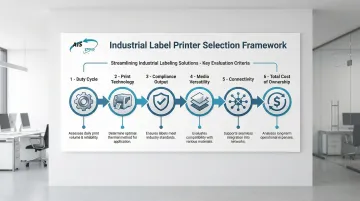
Each factor was evaluated against real industrial business outcomes: uptime reliability, regulatory compliance pass rates, label material waste reduction, and scalability for growing SKU counts or facility expansions.
One practical benchmark worth keeping in mind — industrial printers are engineered for 5–10 year lifespans under continuous operation, while desktop units typically last 3–5 years under moderate use. That gap in longevity directly affects total cost of ownership calculations.
Conclusion
Choosing the right industrial label printing solution determines whether a facility can maintain regulatory compliance, sustain operational throughput, and scale labeling workflows without production slowdowns or compliance gaps. The right solution must align with a business's specific industry requirements, label volume, connectivity infrastructure, and total cost budget.
Before finalizing a vendor decision, assess scalability alongside current needs. Key capabilities to evaluate include:
- RFID encoding support for future serialization requirements
- Linerless printing capability to reduce label waste
- Cloud-based fleet management for multi-site operations
For USA businesses looking to source industrial label printers alongside the full ecosystem of packaging and material handling supplies—including thermal transfer ribbons, synthetic label stock, and industrial tape—Alliance Packaging Group offers a single-source procurement solution with factory-direct pricing and nationwide just-in-time delivery. Contact Alliance Packaging Group at sales@apg-go.com or 770-309-1012 to discuss your industrial labeling needs.
Frequently Asked Questions
What are the leading industrial label printing solutions in the USA for 2026?
Five vendors dominate industrial label printing in the USA: Zebra Technologies (high-volume thermal and RFID), Brady Corporation (safety and compliance), Honeywell Industrial Printing (enterprise logistics), SATO America (sustainability and IoT monitoring), and Epson ColorWorks (on-demand full-color). Applications range from shipping labels and GHS compliance to pharmaceutical serialization.
What is the difference between direct thermal and thermal transfer label printing?
Direct thermal uses heat-sensitive media (no ribbon required, lower cost per label), but labels fade over time and aren't suited for harsh environments. Thermal transfer uses a wax or resin ribbon to bond ink to the label, producing durable, chemical- and UV-resistant output suited for industrial and outdoor applications where labels must remain legible for 6+ months.
What industries require industrial-grade label printers in the USA?
Manufacturing, distribution, food and beverage, pharmaceutical, chemical, automotive, and healthcare sectors all require industrial-grade printers. Compliance mandates — GHS, FDA, OSHA, UL, and DSCSA for pharma — drive demand for ruggedized, high-volume systems capable of running 24/7 in demanding environments.
How do I choose the right industrial label printer for my warehouse or manufacturing facility?
Start by evaluating monthly print volume, duty cycle, and label material (paper vs. synthetic). Factor in compliance or color output requirements, WMS/ERP integration needs, and total cost of ownership — including ribbons, printheads, and software. Then match durability rating and connectivity to your operational environment.
What label materials work best in harsh industrial environments?
Polyester, polypropylene, and vinyl label stocks provide chemical resistance, extreme temperature tolerance, and outdoor UV durability. Thermal transfer printing with resin ribbons delivers the most durable output for labels exposed to solvents, moisture, abrasion, or extreme temperatures. This combination is the standard choice for asset tracking, outdoor storage, and chemical manufacturing.
Can industrial label printers integrate with warehouse management systems (WMS)?
Yes. Zebra, Honeywell, and SATO printers support ZPL, EPL, and Fingerprint programming languages, with native connectors or middleware for SAP, Oracle, Manhattan Associates, and other WMS/ERP platforms. This enables print-on-demand triggered directly from inventory or order workflows, eliminating manual label creation.