Introduction
According to FMCSA's Large Truck and Bus Crash Facts 2022, approximately 0.2% of fatal large-truck crashes involve cargo that has shifted, fallen from, or was improperly secured on commercial motor vehicles. While that percentage seems small, the financial exposure is not: liability claims from securement failures routinely exceed $750,000 for serious incidents, with direct freight damage costs ranging from $85,000 to $285,000 per occurrence.
Those numbers translate directly into operational disruption — regulatory fines, equipment damage, delivery delays, and legal exposure across manufacturing, distribution, and e-commerce operations alike. Cargo securement isn't just best practice; it's a federal mandate under 49 CFR Part 393.
This guide covers the regulatory framework, proven securement techniques, and the failure points every shipper and driver needs to understand to protect loads, stay compliant, and avoid costly claims.
Key Takeaways
- FMCSA rules (49 CFR Part 393) require securement systems to withstand 0.8g forward, 0.5g rearward, and 0.5g lateral forces — non-compliance triggers fines and liability exposure
- Cargo securement starts at the warehouse — palletizing, stretch wrapping, strapping, and edge protection all reduce load movement before tiedowns go on
- Weight distribution matters — place heavier items low and centered; use chocks or cradles for rolling cargo
- Combined tiedown WLL must equal at least 50% of cargo weight — unmarked tiedowns automatically default to the lowest published rating
- Inspect after the first 50 miles and at every duty status change — tension drops as loads settle, so re-tighten tiedowns early
Understanding FMCSA Cargo Securement Requirements
Federal Motor Carrier Safety Administration (FMCSA) rules set the floor for how cargo must be secured on commercial vehicles — and the penalties for non-compliance go beyond fines.
49 CFR Part 393 Subpart I applies to all cargo-carrying commercial motor vehicles in interstate commerce. It covers most structured cargo, with limited exceptions: bulk liquids, gases, and loose aggregates in tanks or hoppers are excluded because those rely on container integrity rather than tiedown systems.
Performance Criteria: The Force Standards
Every cargo securement system must withstand three specific directional forces expressed as multiples of the cargo's weight:
- 0.8g forward deceleration — equivalent to hard braking; the highest force your tiedowns will face
- 0.5g rearward acceleration — forces during acceleration or backing
- 0.5g lateral acceleration — forces generated during turns or lane changes
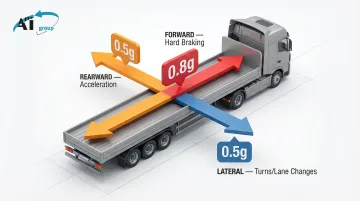
If you're securing a 10,000-lb load, your system must restrain 8,000 lbs forward, 5,000 lbs rearward, and 5,000 lbs laterally. Those numbers drive both your tiedown count and the working load limits you need.
Minimum Tiedown Count Rules
FMCSA specifies exact tiedown counts based on cargo length and weight:
| Cargo Characteristics | Minimum Tiedowns Required |
|---|---|
| ≤ 5 ft length AND ≤ 1,100 lbs | 1 tiedown |
| ≤ 5 ft length AND > 1,100 lbs | 2 tiedowns |
| > 5 ft but ≤ 10 ft (any weight) | 2 tiedowns |
| > 10 ft length | 2 tiedowns for first 10 ft + 1 additional per 10 ft (or fraction) |
Example: A 22-ft steel beam requires 2 tiedowns for the first 10 feet, plus 1 for the next 10 feet, plus 1 for the remaining 2 feet — total of 4 tiedowns minimum.
Working Load Limit (WLL) Requirement
The aggregate WLL of all tiedowns must equal at least half the weight of the cargo.
How to calculate aggregate WLL:
- Tiedowns attached from anchor point to cargo (not passing over): count 50% of the tiedown's WLL
- Tiedowns running from anchor point to anchor point over the cargo: count 100% of the tiedown's WLL
Example: Securing a 6,000-lb pallet with two 3-inch webbing straps (each rated 5,400 lbs WLL) running over the top from side to side:
- Required aggregate WLL: 6,000 lbs ÷ 2 = 3,000 lbs
- Actual aggregate WLL: 5,400 lbs + 5,400 lbs = 10,800 lbs ✓ Compliant
Commodity-Specific Rules
Certain cargo types require specialized securement methods that override general rules. Before departure, operators must identify whether their load falls under these categories:
- Metal coils
- Paper rolls
- Logs
- Dressed lumber
- Concrete pipe
- Intermodal containers
- Automobiles and light trucks
- Heavy machinery (over 10,000 lbs)
- Flattened or crushed vehicles
- Large boulders
Each commodity has specific requirements in 49 CFR 393.116 through 393.136. Metal coils, for example, require chocks or wedges to prevent rolling and tiedowns at prescribed angles — none of which the general rules cover. Verify your commodity category before loading, not after.
Cargo Securement Best Practices: From Packaging to Loading
Cargo securement is a layered system. The structural integrity of your load depends on preparation steps taken at the warehouse—not just tiedown count at the dock.
Pre-Load Preparation
Before a single tiedown is applied, cargo should be consolidated and stabilized:
- Stretch wrap consolidates stacked items and prevents internal shifting (available in 59, 80, and 120 gauge for loads from 1,600 to 4,000 lbs, rated to -5°F)
- Polypropylene or polyester strapping bundles irregularly shaped or heavy goods; Alliance Packaging Group's polyester cord strapping ranges from 110 to 800 lbs break strength
- Edge protectors distribute tiedown forces and prevent strap cutting at sharp cargo corners
Critical distinction: While stretch wrap and strapping unitize the load and reduce internal movement, they do not replace tiedowns. FMCSA requires tiedowns to secure cargo to the vehicle, but proper unitization is an essential complement recognized in the regulations.
FMCSA explicitly recognizes dunnage and dunnage bags as acceptable cargo immobilization methods. Filling void space between cargo and trailer walls prevents lateral shifting during turns and lane changes. Paper-based dunnage cushioning systems with adjustable pad volume — like those Alliance Packaging Group supplies — work with automated dunnage machines and adapt easily to different product sizes.
Load Placement
With pre-load prep complete, how you position cargo on the trailer determines how effectively your tiedowns can do their job.
Weight distribution principles to follow:
- Place heavier items on the trailer floor, centered between axles to keep the center of gravity low
- Never stack heavy cargo on top of lighter items
- Ensure side-by-side articles are in direct contact or blocked from shifting toward each other
- Position cargo against a headerboard or bulkhead when possible to reduce forward forces on tiedowns
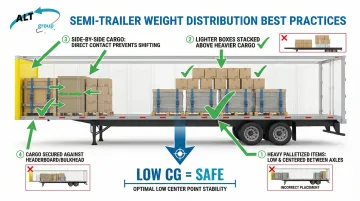
Articles likely to roll — cylinders, coils, pipe — must be restrained with chocks, wedges, cradles, or equivalent devices. This is an explicit FMCSA requirement under 49 CFR 393.106(c)(1). Restraints must be secured so they cannot come loose during transit.
Tiedown Application
Once cargo is placed correctly, tiedown selection and routing determines whether that placement holds through the full journey.
Attachment and routing rules:
- Attach all tiedowns to rated anchor points only — the WLL of the anchor point must be at least as strong as the tiedown
- Route tiedowns inboard of rub rails wherever practicable to prevent shearing during sideswipe incidents
- Secure tiedowns in a manner that prevents loosening, unfastening, or opening during transit
Avoid unmarked equipment: Unmarked welded steel chain is legally considered Grade 30 Proof Coil (the lowest grade), and unmarked synthetic webbing defaults to the lowest rating for its type. Always use clearly marked, rated tiedowns.
Whenever a tiedown contacts a cargo edge that could abrade or cut the strap or webbing, edge protection must be applied — required under 49 CFR 393.104(f)(4). Skipping this step risks sudden, complete tiedown failure under load with no visible warning beforehand.
Keeping Cargo Secure in Transit
Mandatory Inspection Schedule
FMCSA regulations under 49 CFR 392.9 require drivers to inspect cargo and securement devices:
- Within the first 50 miles of beginning a trip
- At every change of duty status
- At intervals no greater than 3 hours or 150 miles, whichever comes first
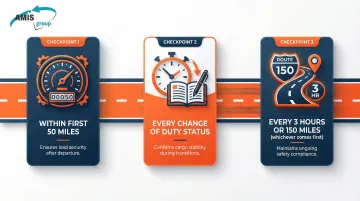
Tiedown tension drops sharply in the first miles of a trip as cargo settles and vibration works through the load. The 50-mile inspection requirement exists precisely because that window is when securement failures are most likely to begin.
What to Examine During Each Check
- Tiedown tension and condition (look for fraying, cuts, or loosening)
- Evidence of load shift or lean
- Integrity of packaging (stretch wrap, strapping, edge protectors)
- Anchor points for signs of stress or deformation
Catching problems early during inspections only goes so far — your driving behavior determines how much stress the load experiences in the first place.
Driving Behavior and Load Forces
Your driving style directly affects cargo forces:
- Hard braking generates the highest forward force (up to 0.8g)
- Sharp curves or on-ramps generate lateral forces that shift improperly secured cargo
- Practice smooth braking and reduce speed through curves to keep load forces within your securement system's limits
Secure Parking Practices
- Park on level ground whenever possible
- Avoid unsecured or poorly lit locations
- Use kingpin locks and trailer seals for extended stops
Even a well-secured load can shift during a long stationary period — particularly on uneven ground — so parking conditions are part of your securement strategy, not an afterthought.
Common Cargo Securement Mistakes to Avoid
Even experienced shippers repeat a handful of preventable errors. These three come up most often in roadside inspections and post-incident reviews:
- Using tiedowns with insufficient WLL — A common shortcut when the right equipment isn't on hand. Under hard braking, an undersized tiedown can fail outright, causing load shift, trailer damage, or a road hazard for other drivers.
- Skipping edge protection — The strap looks fine until load forces cut through the webbing at a sharp corner. When it goes, tension drops instantly with no visible warning beforehand.
- Omitting the 50-mile inspection — Loads settle quickly, and tiedown tension drops noticeably in the first miles of transit. Skipping this check is one of the most cited causes of en-route load failures — and it's a citable violation at roadside. During the 2025 International Roadcheck, cargo securement accounted for 11.4% of all vehicle out-of-service violations in North America.
Conclusion
Secure cargo depends on decisions made at every stage—from how a pallet is wrapped and strapped in the warehouse, to how tiedowns are applied at the loading dock, to whether a driver checks strap tension at the first rest stop. Treating securement as a built-in operational discipline rather than a compliance checkbox makes a measurable difference.
Done consistently, that discipline delivers:
- Fewer freight claims and product losses in transit
- Reduced risk of DOT violations and roadside inspection failures
- Safer outcomes for drivers, other motorists, and cargo handlers
- Lower costs from damaged goods and repeat shipments
The equipment matters, but so does the process. Shippers and carriers who combine correct tiedown selection with consistent pre-trip inspection are the ones who arrive with loads intact and paperwork clean.
Frequently Asked Questions
How many tiedowns are required to secure cargo under FMCSA rules?
One tiedown for items 5 ft or under and 1,100 lbs or under; two tiedowns for items over 5 ft or over 1,100 lbs. For cargo exceeding 10 ft in length, add one additional tiedown for every 10 ft (or fraction) beyond the first 10 ft.
What is a working load limit (WLL) and why does it matter for cargo securement?
WLL is the maximum load a tiedown is rated to restrain in normal service. FMCSA requires the combined WLL of all tiedowns to equal at least half the weight of the cargo being secured, ensuring the system can withstand regulatory force standards.
What types of tiedowns are best suited for different cargo types?
Match the tiedown type to the load:
- Chain — heavy, irregular, or machinery loads; highly abrasion-resistant
- Synthetic webbing — lighter or surface-sensitive cargo
- Wire rope — specialized equipment applications
Each type must meet the WLL required by the load and be clearly marked with its rating.
How often should cargo be inspected during a trip?
Inspect after the first 50 miles, at every change of duty status, and at intervals no greater than 3 hours or 150 miles. Tiedown tension drops as loads settle after initial movement, so the 50-mile check is especially important.
What are the consequences of improper cargo securement?
Consequences range from regulatory penalties to serious financial liability:
- Civil penalties up to $29,893 per violation (egregious cases)
- Out-of-service orders at roadside inspections
- Accident liability exceeding $750,000 for fallen or shifted cargo
- Freight damage claims from $85,000 to $285,000
Does stretch wrapping or strapping a pallet count as cargo securement?
No. Stretch wrap and strapping unitize the load and reduce internal movement, but they do not replace tiedowns. FMCSA requires tiedowns to anchor cargo to the vehicle — proper unitization supports that system but does not substitute for it.