Introduction
Label errors now cause 45.5% of all food recalls, costing the industry $1.92 billion in 2024. For food and beverage warehouses, strapping and packaging decisions sit squarely in the crosshairs — affecting compliance with both OSHA's materials handling standards and FDA regulations under the Food Safety Modernization Act (FSMA).
Most warehouse managers scrutinize rack systems and forklift protocols — but strapping materials, load securement methods, and stacking heights carry equal regulatory weight. A collapsed pallet isn't just an OSHA struck-by hazard; it's simultaneously an FDA adulteration event. Improper strapping that obscures traceability labels contributes directly to recall failures.
Key Takeaways
- Food warehouses face dual compliance: OSHA materials handling standards and FDA/FSMA food safety requirements apply simultaneously
- Polypropylene and polyester strapping are preferred over steel in food environments due to contamination risks
- No universal OSHA pallet height limit exists; facilities set their own based on rack specs, product type, and 18-inch sprinkler clearance rules
- FSMA Section 204 traceability requirements mean strapping and wrapping cannot obscure lot codes or product labels
- Poor strapping choices can directly trigger recall liability — not just product damage
Why Strapping and Packaging Compliance Matters More in Food and Beverage Warehouses
Food and beverage warehouses carry significantly higher compliance stakes than general warehouses. A single packaging failure can trigger both a worker safety incident and a food contamination event, bringing regulatory fines, product recalls, and lasting reputational damage. Direct recall costs average $10 million per event, excluding lawsuits, brand damage, and lost sales.
Dual Regulatory Exposure
Food warehouse operators face concurrent jurisdiction from two federal agencies:
- OSHA 29 CFR 1910.176 governs physical materials handling and storage safety, requiring that materials be "stable and secure against sliding or collapse"
- FDA 21 CFR Part 117 (Current Good Manufacturing Practice regulations) governs food safety throughout the supply chain, requiring storage conditions that protect against contamination
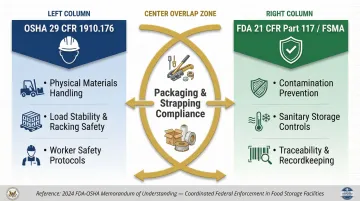
A 2024 Memorandum of Understanding between FDA and OSHA formalized cross-agency referrals when inspectors observe violations of the other agency's standards. In practice, a strapping failure observed during an OSHA inspection can now generate an FDA referral — and vice versa.
Environmental Challenges Unique to Food Storage
Food and beverage warehouses face environmental conditions that place extraordinary demands on packaging materials:
- Temperature cycling in cold chain and frozen storage causes material expansion and contraction
- Moisture exposure from refrigeration units and condensation
- Hygiene protocols requiring frequent washdowns and sanitization
- Pest control pressures demanding sealed, contamination-free packaging
Strapping materials that perform reliably in a dry ambient warehouse — standard polypropylene, for instance — can lose significant tensile strength in cold, wet, or chemically sanitized environments.
Third-Party Audit Scrutiny
SQF, BRC, and AIB auditors increasingly scrutinize packaging and strapping practices as part of food safety assessments. Compliance gaps that might go unnoticed in general warehouses become documented audit findings in food facilities, potentially voiding certifications and disqualifying you from major retail supply chains.
Key Regulatory Standards That Govern Strapping and Packaging in Food Warehouses
OSHA 29 CFR 1910.176: Materials Handling and Storage
OSHA 1910.176(b) requires that storage areas remain free from hazards and that materials be "stacked, blocked, interlocked and limited in height so that they are stable and secure against sliding or collapse." This performance standard applies directly to how strapped pallets are stored, positioned, and secured.
Key requirements include:
- Materials must not create hazards for workers
- Stacked loads must be stable and secured against movement
- Passageways and working areas must remain clear
- Aisles and exits must be kept accessible
FDA Current Good Manufacturing Practice (cGMP) Regulations
21 CFR Part 117 requires that packaging materials used in or around food storage areas must not contribute to contamination. That covers primary food packaging and secondary materials alike — strapping, stretch wrap, and anything else that contacts product cases.
Section 117.93 covers warehousing directly, requiring storage and transportation conditions that protect against allergen cross-contact and biological, chemical, and physical contamination.
FSMA Section 204: Food Traceability Rule
The Food Traceability Rule requires facilities handling Food Traceability List (FTL) items to maintain Key Data Elements (KDEs) at Critical Tracking Events (CTEs). For warehouses, the primary CTEs are Receiving and Shipping.
Warehouses must provide electronic sortable spreadsheets containing traceability information to FDA within 24 hours of a request. Labeling, case markings, and packaging documentation must stay accurate and legible from receipt through shipment — packaging integrity is a traceability compliance requirement, not a secondary concern.
ANSI/RMI MH16.1 Racking Standards
Pallet racking systems in food warehouses are subject to ANSI/RMI MH16.1 standards, which treat racks as structural elements requiring verified load ratings, seismic zone calculations, and regular inspections. The 2024 International Building Code adopted MH16.1-2023, introducing stricter seismic and stability methodologies.
Managers who source "quick-ship" racks without verifying these standards risk non-compliance. Key installation requirements include:
- Displaying Load Application and Rack Configuration (LARC) plaques on all rack systems
- Updating load capacity calculations to reflect MH16.1-2023 seismic and stability methods
Third-Party Certification Requirements
Facilities pursuing SQF (Safe Quality Food) or BRCGS certification must maintain documented procedures for packaging materials management. Auditors will look for:
- Written policies for selecting, storing, and disposing of strapping and wrapping materials
- Regular equipment inspections and calibration records
- Supplier approval documentation for all packaging materials
Missing any of these during an SQF or BRCGS audit will result in a non-conformance finding — a direct risk to certification status.
Choosing the Right Strapping Materials for Food Safety Compliance
Comparing Polypropylene, Polyester, and Steel Strapping
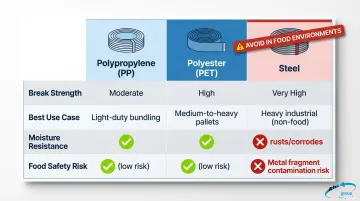
| Material | Break Strength | Best For | Food Safety Considerations |
|---|---|---|---|
| Polypropylene (PP) | 120-600 lbs | Light to medium loads, dry goods, short-term storage | Economical but loses tension over time; 20-40% elongation recovery |
| Polyester (PET) | Up to 4,000 lbs | Heavy beverage pallets, refrigerated storage, long-distance shipping | Superior tension retention; 70% elongation recovery; moisture-resistant |
| Steel | Up to 8,200 lbs | Extreme loads (non-food applications) | High contamination risk—avoid in food environments |
The Steel Strapping Contamination Risk
FDA Compliance Policy Guide Sec. 555.425 classifies hard or sharp foreign objects measuring 7mm to 25mm as adulteration hazards. Steel strapping produces exactly these types of fragments when cut or broken, and untreated steel exposed to warehouse humidity can rust and corrode.
Critical guidance: Steel strapping should be avoided in open-product environments. Polypropylene and polyester are preferred because they don't rust and produce larger, more visible fragments if they fail.
Strap Tension Calibration
Getting tension wrong in either direction creates compliance and safety problems:
- Over-tensioning crushes packaging, compromising primary container integrity and barrier function
- Under-tensioning leaves loads unsecured and vulnerable to shifting—one documented incident involved 26 pallets of energy drinks shifting due to torn wrap
Automated strapping machines with adjustable tension controls (typically 300-800 N or 67-180 lbs) help maintain consistent, compliant tension levels across different product types.
Alliance Packaging Group supplies polypropylene and polyester strapping alongside the sealers and tensioners needed to apply them correctly—so food and beverage warehouses can source the right materials and the right equipment in one place, at factory-direct pricing.
Safe Stacking Practices and Height Limits in Food and Beverage Warehouses
The "Maximum Height" Myth
Critical clarification: OSHA does not mandate a specific universal pallet stacking height limit. Instead, 29 CFR 1910.176(b) requires facilities to establish safe stacking heights based on load stability, pallet condition, rack load ratings, and ceiling clearance.
What OSHA does mandate:
- 18-inch minimum clearance below sprinklers (29 CFR 1910.159)
- Materials must be "stable and secure" (performance standard)
- NFPA 1 limits idle (empty) pallet stacks to 15 feet maximum
The commonly referenced 6:1 height-to-depth ratio applies specifically to rack-supported storage systems per RMI guidelines, not floor stacking. Food and beverage warehouses must layer these baseline rules with product-specific constraints that vary by what's on the pallet.
Food-Specific Stacking Considerations
These factors go beyond what OSHA requires:
- Manufacturer stack limits on temperature-sensitive products reflect compressive strength—not guesswork
- Glass bottles and cartons need shorter stacks or protective dunnage between layers to prevent breakage
- Heavy beverage pallets demand verified floor load ratings before any tiered stacking
- Cold storage degrades cardboard strength and pallet integrity faster than ambient conditions
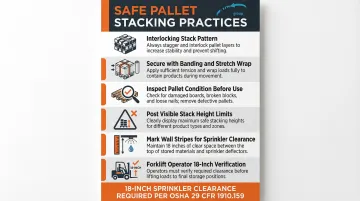
Safe Stacking Techniques
These practices reduce collapse risk and keep your facility inspection-ready:
- Use interlocking or block stacking patterns for stability
- Secure completed stacks with banding or stretch wrap before storage
- Inspect pallet condition before stacking—damaged pallets are a leading cause of collapses
- Post clear, visible stack height limits in each storage zone
- Paint wall stripes indicating maximum heights relative to sprinkler clearance
- Train forklift operators to verify the 18-inch clearance before placing top loads
Packaging Best Practices for Load Integrity and Traceability in Food Warehouses
The Stretch Wrap Plus Strapping Approach
Best practice combines both methods in sequence:
- Stretch wrap applied first unitizes the load and provides moisture and dust protection
- Strapping applied over stretch wrap provides primary restraint force to prevent load shifting
This two-layer approach supports both OSHA load securement requirements and FDA packaging integrity standards. The stretch wrap protects against environmental contamination while the strapping provides structural stability.
Integrating Labeling for FSMA Traceability
FSMA traceability requirements demand that lot numbers, production dates, and product identifiers remain legible through storage and shipping. Your strapping and wrapping practices must support this:
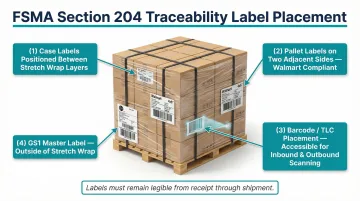
- Label placement: Position case labels between layers of stretch wrap or in areas clear of strapping bands
- Pallet labels: Walmart requires pallet labels on at least two adjacent sides, preferably between stretch wrap layers
- Barcode accessibility: Ensure inbound and outbound scanning can capture Traceability Lot Codes (TLCs) before pallets are broken down
- Master labels: GS1 guidelines require master labels on the outside of wrapping when pallets are physically joined by straps or shrink-wrap
Documented Procedures as Audit Readiness Strategy
Maintain comprehensive documentation to support third-party audits:
- Written SOPs for how each product category is strapped, wrapped, and labeled
- Equipment inspection records documenting strapping tool wear and calibration
- Materials documentation including supplier approvals and food-safety certifications
- Training records showing personnel understand proper tension settings and label placement
- Procurement consistency — sourcing strapping, stretch wrap, and labels from a single supplier simplifies documentation trails and supplier approval records
Third-party food safety auditors and retail customer compliance programs now review this documentation as a standard part of facility assessments.
Frequently Asked Questions
What are the proper stacking practices and height limits in a food and beverage warehouse?
OSHA does not set a universal height limit. Facilities must define safe limits based on product type, pallet condition, rack specifications, and the mandatory 18-inch sprinkler clearance. Food products with compressive strength limits or fragile containers may require shorter stacks than general goods.
What are the safety and compliance requirements for a food and beverage warehouse?
Food warehouses operate under dual compliance: OSHA 29 CFR 1910.176 governs materials handling and storage safety, while FDA's cGMP regulations (21 CFR Part 117) and FSMA govern food safety practices. Third-party certifications like SQF and BRCGS layer on additional documentation and audit requirements beyond federal mandates.
What strapping materials are considered food-safe for warehouse environments?
Polypropylene and polyester strapping are preferred in food environments because they don't rust or shed metal fragments. Steel strapping should be avoided in open-product areas due to FDA contamination risk from 7mm–25mm metal fragments, which must be documented under HACCP protocols.
Does FSMA affect how food products must be strapped and packaged in a warehouse?
Yes. FSMA's Food Traceability Rule (Section 204) requires that product labels and case markings remain intact and legible throughout storage and distribution. Packaging and strapping practices must not obscure or damage traceability information, including lot codes and product identifiers required for 24-hour FDA reporting.
What is the difference between polypropylene and polyester strapping for food and beverage applications?
Polypropylene is lighter and lower-cost, suited for lighter loads in dry environments. Polyester offers greater tensile strength (up to 4,000 lbs), better elongation recovery (70% vs. 20–40%), and superior moisture resistance, making it the better fit for heavier beverage pallets or cold storage conditions.
How often should strapping equipment be inspected in a food and beverage warehouse?
Inspect strapping tools and machines before each shift for wear, calibration, and cleanliness. Full documented maintenance cycles should run at least monthly, and any equipment with grease contamination or mechanical failure must be pulled from service immediately.