Introduction
Warehouse packaging is far more than putting products in boxes—it directly affects product safety, shipping costs, order accuracy, and customer satisfaction. In 2024, 85 million packages arrived damaged, a 30% year-over-year increase costing the industry an estimated $4 billion in losses. Inefficient packaging wastes money through excess materials, oversized boxes, and dimensional weight penalties imposed by carriers.
Even worse, it costs customers their trust: 85% of consumers say damaged goods negatively impact their perception of a brand, and 51% won't repurchase after receiving a damaged product.
This guide covers the definition of warehouse packaging, the three protective levels, essential materials, and the step-by-step packing process. It also addresses best practices for efficiency and cost-optimization strategies that reduce waste and protect your bottom line.
TLDR:
- Warehouse packaging protects products through three levels: primary (direct contact), secondary (shipping boxes), and tertiary (palletizing)
- Right-sized packaging cuts dimensional weight charges by 10–15% and reduces void fill waste
- WMS with barcode scanning raises order accuracy from 92% to 99.7%, eliminating costly reshipments
- Standardizing box assortments and packing SOPs prevents the inconsistent packing that causes 1 in 10 packages to arrive damaged
What Is Warehouse Packaging?
Warehouse packaging is the set of processes used to prepare, protect, and secure goods for storage, transport, and delivery. Unlike product design packaging—which focuses on marketing and shelf appeal—warehouse packaging serves a purely operational and logistical function: getting products from your facility to customers intact and cost-effectively.
The Three Core Sub-Operations
Warehouse packaging consists of three distinct activities:
- Individual packaging - Containing the product in its first protective layer (bottles, blister packs, pouches)
- Packing - Grouping items into a shipping unit (selecting boxes, adding void fill, sealing cartons)
- Load securing/wrapping - Stabilizing unit loads for transport (palletizing, stretch wrapping, strapping)
Why Warehouse Packaging Has Become Mission-Critical
The rise of e-commerce has transformed warehouse packaging from a basic necessity to a direct factor in customer retention and order accuracy. U.S. parcel volume reached 22.37 billion shipments in 2024, a 3.4% increase over 2023, with projections pointing to 30 billion by 2030. Smaller, more frequent orders mean warehouses now face constant pressure to pack faster, more accurately, and at lower cost per shipment.
The North American e-commerce packaging market was valued at $18.98 billion in 2025 and is forecast to grow at a CAGR of 8.9% through 2033. That growth reflects a real operational challenge — modern warehouses must simultaneously manage:
- Speed — meeting same-day and next-day fulfillment windows
- Cost — controlling materials spend across thousands of SKUs
- Protection — preventing damage across varying product dimensions and fragility levels
- Sustainability — reducing waste and meeting customer and regulatory expectations
The Three Levels of Warehouse Packaging
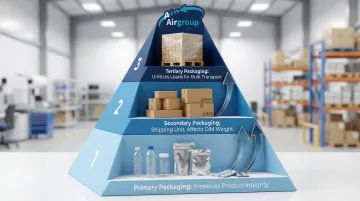
Packaging operates as a hierarchy: primary, secondary, and tertiary, where each layer serves a distinct protective and logistical function. Choosing the wrong level or skipping a layer leads to product damage or wasted material. Each level compounds the one beneath it — a failure at any point, whether a wrong box size or inadequate pallet wrap, cascades into damages, returns, and added costs.
Primary Packaging
Primary packaging is the first layer directly in contact with the product. This includes bags, blister packs, bottles, pouches, and shrink wrap for individual items. Its core functions are preserving product integrity, preventing contamination, and maintaining shelf life and safety.
This layer is most critical for food, pharmaceutical, and medical products where contamination risks are highest. If it fails, no amount of secondary or tertiary protection can prevent product degradation.
Secondary Packaging
Secondary packaging groups multiple primary packages into a single shipping or retail unit. Corrugated boxes, cartons, and trays fall into this category. This is the level most visible to warehouse packing staff and the one that determines box selection, void fill requirements, and labeling.
Secondary packaging directly affects shipping costs through dimensional weight pricing. The average package contains approximately 40% wasted space, inflating carrier charges. Right-sized secondary packaging reduces both material costs and freight expenses while improving packing station throughput.
Tertiary Packaging
Tertiary packaging is the outermost level used to unitize secondary packages for bulk handling and transport. This includes palletizing, stretch wrapping, and strapping. Its role is protecting loads during transit and enabling efficient forklift and conveyor handling throughout the warehouse.
Corrugated container bulging can destabilize pallet loads, causing stretch wrap tears and collapsed unit loads in transit. Proper tension, overlap, and material selection at this level prevent those failures and ensure loads arrive intact.
Essential Warehouse Packaging Materials and Types
Selecting the right packaging material depends on product weight, fragility, dimensions, transit conditions, and industry requirements. Warehouses that stock a wide variety of box sizes and materials gain a measurable operational edge.
Alliance Packaging Group, for example, maintains over 10,000 products in stock — including more than 1,000 box sizes ranging from 3x3x3 inch literature mailers to 60x32x48 inch industrial boxes — all available for immediate shipment nationwide. That depth of inventory means matching products to packaging without delays or substitutions.
Corrugated Boxes and Cartons
Corrugated cardboard boxes are the most widely used warehouse packaging material — a dominance reflected in the numbers. The U.S. corrugated and paperboard packaging market was valued at approximately $47 billion in 2024, with 381 billion square feet of corrugated material shipped that year alone.
Wall Construction Types:
- Single-wall - Suitable for light parcels up to 65 lbs; accounts for 89.8% of corrugated production
- Double-wall - Handles heavier items (65-80 lbs) and provides added crush resistance
- Triple-wall - Designed for heavy industrial goods and export shipments requiring maximum protection
Box size selection directly affects dimensional weight shipping charges. Effective August 18, 2025, FedEx and UPS mandate rounding all package dimensions up to the nearest whole inch, which can increase billable weight by approximately 20% for certain package sizes.
Void Fill and Cushioning Materials
Protective fill balances product protection with material cost and sustainability:
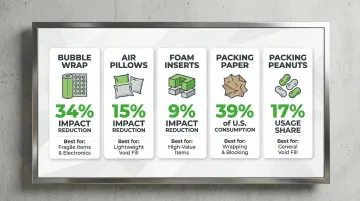
- Bubble wrap - Reduces impact acceleration by 34% (5/16" thickness); ideal for fragile items and electronics
- Air pillows - Lightweight space-filling that reduces impact acceleration by 15% and minimizes product bouncing
- Foam inserts - Custom-fit protection for high-value items; 1/2" viscoelastic foam reduces impact by 9%
- Packing paper - Paper-based void fillers comprise 39% of U.S. consumption; used for wrapping and blocking
- Packing peanuts - Account for 17% of protective packaging usage; effective but less sustainable
Excessive void space allows product movement during transit, significantly increasing damage rates. As a rule of thumb, a package should have no more than 2 inches of movement in any direction when shaken.
Stretch Wrap and Strapping
Stretch wrap and strapping are essential tools for tertiary packaging:
Stretch Wrap:
- Hand stretch film - For manual application; stretches 250-700% with gauges from 59 to 120
- Machine stretch film - For automated operations; available in 5,000-foot rolls with enhanced puncture resistance
When loads require rigid bundling rather than wrapping, strapping provides a firmer hold:
Strapping:
- Polypropylene - Cost-effective; suitable for lighter loads with minimal stretch
- Polyester - High tension retention; 1/2" width handles 650 lbs break strength, 5/8" width handles 800 lbs
Insufficient wrapping is one of the leading causes of pallet load failures in transit. For most standard pallets, a minimum of 3 overlapping wrap layers at the base and 2 layers at the top provides the tension needed to survive forklift handling and truck vibration.
Poly Bags, Mailers, and Specialty Packaging
E-commerce Solutions:
- Poly bags and padded mailers for lightweight goods
- Recyclable kraft mailers and all-paper bubble mailers for sustainable shipping
Specialty Options:
- Anti-static bags - Protect sensitive electronics from electrostatic discharge
- Temperature-controlled packaging - Insulated mailers for food and pharmaceutical cold chain logistics
- Moisture-barrier bags - FDA/USDA-approved heavy-duty bags for industrial parts and food packaging
How the Warehouse Packing Process Works
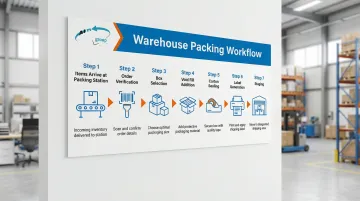
The standard packing workflow follows seven sequential steps:
- Items arrive at packing station - Picked items are delivered from storage locations
- Order verification - Operators verify contents against the packing list using barcode scanners
- Box selection - Appropriate container is selected based on product dimensions and weight
- Void fill addition - Protective material is added to secure the product and eliminate movement
- Carton sealing - Box is sealed with appropriate tape or adhesive
- Label generation - Shipping labels and documentation are printed and applied
- Staging - Packed orders move to outbound staging or loading dock area
The Role of the Packing Station
The packing station is a purpose-built workstation designed for ergonomics and throughput. Key elements include:
- Access to multiple box sizes organized by frequency of use
- Tape dispensers and void fill dispensers within arm's reach
- Label printers integrated with WMS
- Barcode scanners for verification
- Adjustable work surfaces to reduce musculoskeletal strain
Station design directly affects packing speed and error rates. According to the Bureau of Labor Statistics, musculoskeletal disorders from material handling account for 34% of non-fatal injuries involving days away from work in U.S. private industry. Ergonomic interventions — adjustable workstations, automated taping — measurably reduce reported pain symptoms and associated downtime.
How WMS and Barcode Scanning Streamline Packing
Warehouse Management Systems (WMS) with barcode scanning integration are proven to raise order accuracy. One 3PL reported improving accuracy from 92% to 99.7% after deploying mandatory scan-verification, cutting annual mispicks from 40,000 to just 1,500. That shift alone cuts deep into the hidden costs of returns and reshipments.
A well-integrated WMS handles the decision-making burden at every step:
- Guides operators to the correct box size for each order
- Verifies item accuracy in real time via barcode scan
- Automates label printing and applies correct documentation
- Transmits shipment data to carriers instantly
The result: reduced human error, throughput gains of up to 20%, and order processing time cut by as much as 30%.
Warehouse Packaging Best Practices
Standardize Your Box Assortment
Carrying too many box sizes creates decision fatigue and slows packing. Too few forces oversized boxes and wasted void fill. The optimal approach is selecting a curated range of high-frequency sizes based on SKU data.
Analyze your order history to identify the 10-15 box sizes that cover 80% of your shipments. A supplier offering an extensive box size inventory—like Alliance Packaging Group's 1,000+ ready-to-ship options—supports right-sizing without custom order delays. This eliminates the typical 2-4 week lead time for custom corrugated orders.
Right-Size Every Package
Right-sized packaging means using the smallest box that safely contains the order. Done consistently, it cuts costs across three areas:
- Reduces void fill cost — less empty space means less protective material required
- Cuts dimensional weight charges — smaller boxes can reduce freight costs by 10-15%
- Minimizes corrugated waste — less material used, lower disposal costs
Carriers charge dimensional weight based on box size, not just product weight. The formula is (Length x Width x Height) / 139 for FedEx domestic shipments. With the August 2025 rounding rule change, a box measuring 12.1" x 10.3" x 8.2" now calculates as 13" x 11" x 9", increasing billable weight significantly.
FedEx applies "Additional Handling" surcharges for packages exceeding 10,368 cubic inches and "Oversize" charges for those exceeding 17,280 cubic inches. Right-sizing keeps you below these costly thresholds.
Standardize Packing Procedures and Train Staff
Inconsistent packing is a leading cause of transit damage and customer returns. Your SOPs should cover:
- Box selection criteria based on product dimensions and weight
- Seal quality standards (tape length, overlap requirements)
- Label placement specifications
- Void fill requirements by product category
Regular training reinforces these standards — and the numbers make a strong case for it. The average e-commerce return rate reached 16.9% in 2024, with damaged products accounting for 20% of returns. Separately, 62% of logistics workers report witnessing mishandling due to time pressure.
Inspect Package Integrity Before Dispatch
Implement a final quality-check step before orders leave the packing station:
- Verify seal integrity (no gaps, proper tape coverage)
- Confirm correct labeling (address, carrier barcode, special handling instructions)
- Perform basic compression test (package should not collapse under moderate pressure)
Replacing a damaged item costs businesses between $10 and $20 in operational expenses per incident, excluding the product cost itself.
Track Packing Performance Metrics
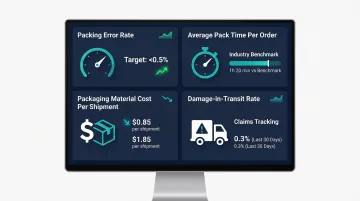
Monitor KPIs to identify bottlenecks and drive continuous improvement:
- Packing error rate - Target: <0.5% (achievable with WMS and scan-verification)
- Average pack time per order - Benchmark against industry standards for your order profile
- Packaging material cost per shipment - Track trends to identify waste or inefficiency
- Damage-in-transit rates - Monitor carrier damage claims to assess packaging effectiveness
Use this data to refine box assortments, adjust void fill usage, and identify training needs. Warehouses that track these metrics typically see 15-25% improvement in packing efficiency within six months.
Sustainability in Warehouse Packaging
Sustainable warehouse packaging cuts material and shipping costs — and it directly shapes how customers perceive your brand. 78% of companies have adopted sustainability initiatives, with 82% citing consumer preference as a primary driver.
Four Key Strategies for Reducing Environmental Impact
1. Right-Sizing to Eliminate Excess Waste The average package contains 40% wasted space. Right-sizing eliminates excess corrugated and void fill waste while reducing freight costs. Amazon's 2024 data reveals avoidance of 4.2 million metric tons of packaging material since 2015 through right-sizing and material innovation.
2. Switching to Recyclable or Recycled-Content Materials The recovery rate for old corrugated containers (OCC) has held near 90% for the past decade. Choosing corrugated with recycled content and paper-based cushioning over foam cuts landfill waste at the source. Alliance Packaging Group's EarthKraft™ Recyclable Padded Mailers carry 75% post-consumer content, and their honeycomb sheets use 100% recyclable compressed paper.
3. Eliminating Single-Use Plastics Where Alternatives Exist All-paper bubble mailers, recyclable kraft mailers, and paper-based void fill provide protection without traditional plastic materials. Amazon reduced global single-use plastic delivery packaging by 16.4% in 2024, demonstrating that high-volume operations can achieve significant plastic reduction.
4. Reusing Materials Inside Your Facility For undamaged, clean materials, reuse slip sheets, dunnage, and protective packaging for internal operations. Over 5 billion pounds of returned e-commerce packages end up in landfills annually. Reusing materials within your facility reduces both waste and procurement costs.
These strategies also address a cost you may not be tracking: reverse logistics. Returns generate 15 million tons of carbon emissions annually in the U.S. Sustainable packaging that reduces damage rates cuts those emissions directly by preventing unnecessary returns and reshipments.
Frequently Asked Questions
What is the difference between packaging and packing in a warehouse?
Packaging refers to the materials and containers used to contain and protect products (boxes, bags, wrap, cushioning). Packing is the active operational process of assembling, securing, and preparing orders for shipment using those materials. Packaging is the "what," packing is the "how."
What are the three levels of warehouse packaging?
The three levels are primary (direct product contact like bottles or blister packs), secondary (grouping for shipping like corrugated boxes), and tertiary (palletizing and unitizing for bulk transport like stretch wrap and strapping). Primary preserves product integrity, secondary enables handling, and tertiary stabilizes full pallet loads.
What packaging materials are most commonly used in warehouses?
The most common materials include:
- Corrugated boxes — 381 billion square feet shipped in 2024
- Stretch wrap — hand and machine film for pallet loads
- Void fill — bubble wrap, air pillows, foam, or packing paper
- Poly bags and mailers — for soft goods and lightweight shipments
- Strapping tape — for bundle and carton reinforcement
Material choice depends on product weight, fragility, and transit conditions.
How does right-sized packaging reduce shipping costs?
Carriers charge dimensional weight based on box size, not just product weight, using the formula (Length x Width x Height) / 139. Using a box that closely fits the product avoids DIM weight surcharges (which can add 20% to shipping costs) and reduces void fill needed. Right-sizing typically yields 10-15% in freight savings.
What are the most important best practices for warehouse packaging efficiency?
The top efficiency drivers are:
- Standardize your box assortment to 10-15 high-frequency sizes
- Train staff on packing SOPs with written procedures
- Run quality checks before dispatch to catch errors early
- Track KPIs like error rate and pack time per order
- Use right-sized packaging to cut material waste and freight costs
How do I choose the right packaging for my warehouse operations?
Start by evaluating your product dimensions, weight, fragility, and transit conditions. Match those requirements to the right material types — corrugated wall construction, void fill, or specialty bags. A single-source distributor like Alliance Packaging Group simplifies this by offering over 10,000 products and 1,000+ box sizes with nationwide just-in-time delivery and expert consultation.