This guide covers strapping material selection, packaging types, part-specific requirements, OEM compliance basics, and common mistakes that cause costly damage and delays in automotive supply chains.
Key Takeaways
- Automotive parts require packaging matched to weight, shape, and fragility — one approach does not fit all
- Steel, polyester, and polypropylene strapping serve different applications; wrong choices increase damage risk
- OEM customers (GM, Ford, Toyota) mandate specific packaging standards; non-compliance triggers chargebacks
- AIAG-compliant barcode labeling is required for tier-1 and tier-2 automotive suppliers
- VCI films, foam dunnage, and returnable containers each address distinct protection and handling needs
Why Packaging Compliance Matters in Automotive Shipping
Just-In-Time Delivery Models Demand Zero Tolerance for Errors
Automotive supply chains operate on just-in-time (JIT) delivery models where damaged or delayed parts can halt assembly lines. The financial impact is staggering: according to Siemens' 2024 True Cost of Downtime report, unplanned downtime in automotive manufacturing costs up to $2.3 million per hour. A single shipment of improperly packaged components can be the trigger.
OEM customers frequently audit supplier packaging and issue chargebacks or Discrepant Material Reports (DMRs) for non-conforming shipments. Those chargebacks typically cover:
- Third-party sorting and inspection fees
- Operator downtime at the receiving facility
- Premium freight for expedited replacement shipments
- Material handling labor charges
- Production line down charges
Combined, these costs can reach five or six figures per incident.
Carrier Liability Is Limited—Shippers Absorb Most Losses
The Carmack Amendment (49 U.S.C. § 14706) imposes near-strict liability on motor carriers for cargo damage during interstate transport, but carriers legally limit their liability through tariff provisions. SAIA limits liability for used automotive parts to $0.10 per pound (maximum $10,000 per shipment), while Old Dominion caps new commodity liability at $5.00 per pound ($50,000 maximum). If your packaging is inadequate, carriers will deny claims under the "act or default of the shipper" exception, leaving you to absorb the full loss.
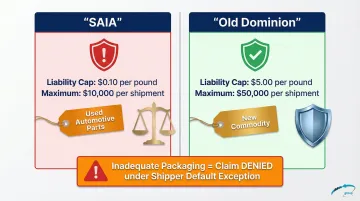
With proper packaging and handling, freight damage rates for automotive parts average 1% to 3%. Getting it right at the source is the only reliable way to avoid costly damage claims and chargebacks.
Types of Packaging in the Automotive Industry
Expendable (One-Way) Packaging
Expendable packaging includes corrugated boxes, wooden crates, and foam-lined cartons designed for single-trip use. These are standard for:
- Smaller parts like sensors, fasteners, and filters
- Aftermarket distribution
- Long-distance shipments where container return is impractical
- Service parts destined for repair shops or dealerships
Expendable packaging typically costs less upfront but adds up to higher total costs across high-volume, repeated shipments.
Returnable Packaging Systems
Returnable packaging includes reusable plastic containers (RPCs), metal racks, and dunnage trays used in closed-loop OEM supply chains. Ford Motor Company increased in-house ownership of returnable packaging by 30% to 50% to gain control over asset quality, optimize freight density, and eliminate supplier packaging costs from piece prices.
Benefits include:
- Cost savings over high-volume shipments—one Nefab circular packaging project saved nearly 50% in total costs while reducing CO2 emissions by 175 tons
- Standardized dimensions and load capacities
- Reduced waste and environmental impact
- Consistent quality and performance across shipments
Returnable systems require infrastructure for tracking, cleaning, and reverse logistics, making them most practical for in-plant or closed-loop shipments.
Pallet and Skid Packaging
When loads shift to heavier subassemblies — transmissions, axle assemblies, bulk fastener shipments — standard and custom wooden or plastic pallets take over. These loads require:
- Corner boards extending the full height of the load
- Stretch wrap in addition to strapping to secure the load to the pallet
- Blocking and bracing for flatbed or LTL shipments
Alliance Packaging Group maintains over 10,000 packaging products in stock, including strapping materials and pallet accessories, with nationwide just-in-time delivery programs that support automotive suppliers' production schedules.
Specialty Packaging for Sensitive Parts
Certain automotive components need packaging engineered around their failure modes — corrosion, vibration, and surface damage being the most common.
| Packaging Type | Best For | Key Specification |
|---|---|---|
| VCI Poly Bags & Papers | Bare metal components | Parts within 12 in. of VCI material; ≥1 sq. ft. VCI per cu. ft. void space; protects up to ~3 years |
| Foam-in-Place / Die-Cut Foam | Precision machined parts | Prevents vibration damage and surface marking in transit |
| A-Frame Crates / Purpose-Built Racks | Body panels and automotive glass | Foam cushioning required at every contact point |
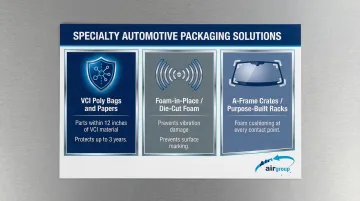
In practice, most tier-1 suppliers combine these systems: returnable containers for in-plant loops, expendable or specialty packaging when parts ship further down the distribution chain.
Choosing the Right Strapping Material for Automotive Parts
Three Main Strapping Materials
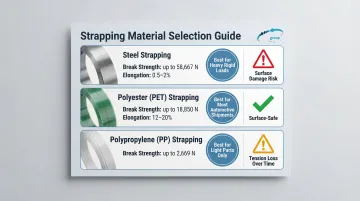
The choice between steel, polyester (PET), and polypropylene (PP) strapping depends on load weight, rigidity, transit distance, and surface sensitivity.
Steel Strapping:
- Break strength: 3,500 N to 58,667 N (650 lbs to 13,200 lbs)
- Elongation: 0.5% to 2% (minimal stretch)
- Best for extremely heavy, rigid loads like steel coils, engine blocks, or large castings
- Sharp edges can mark finished surfaces and pose safety hazards during handling
Polyester (PET) Strapping:
- Break strength: Up to 18,850 N (4,237 lbs)
- Elongation: 12% to 20% with elastic memory
- Best for most heavy automotive shipments—matches steel's tensile strength, maintains tension over long transit, absorbs impact without breaking, and won't damage finished surfaces
- Cummins' Global Packaging Standard mandates recyclable polyester strapping with a minimum 0.75" width and strictly prohibits steel banding
Polypropylene (PP) Strapping:
- Break strength: 120 lbs to 600 lbs (524 N to 2,669 N)
- Best for lighter automotive parts — trim pieces, small boxed components, bundled hoses
- Low retained tension and susceptibility to tension loss over time make it unsuitable for palletized heavy assemblies
Quick Selection Guide
With those specs in mind, here's how to match material to shipment type:
| Scenario | Recommended Material |
|---|---|
| Heavy, rigid loads (over 150 lbs) with long transit or multiple handling events | Polyester or steel |
| Light loads (under 150 lbs), close-proximity shipping, cost-sensitive | Polypropylene |
| Surface-sensitive finished components | Polyester only — never steel |
For high-volume automotive programs, Alliance Packaging Group stocks polyester strapping with factory-direct pricing and nationwide just-in-time delivery to keep production lines moving.
Strapping and Packaging Requirements by Automotive Part Type
Different part types fail in different ways during transit — sheet metal scratches, electronics discharge, rubber deforms under compression. The right strapping and packaging approach depends entirely on what's inside the box.
Heavy Mechanical Assemblies (Engines, Transmissions, Axles)
- Heavy-gauge steel or wide polyester strapping on reinforced wooden skids
- Minimum two straps in each direction
- Corner protectors mandatory to prevent strap cutting into packaging edges
- Blocking and bracing required for flatbed or LTL shipments
FedEx requires single pieces over 150 lbs to be banded on all sides to a forkliftable base using heavy-duty metal or break-resistant plastic banding. Transmissions and engines must be drained of fluids, placed in a plastic bag with absorbent padding, and securely banded to the pallet.
Sheet Metal and Body Panels
- Edge protectors or foam padding under all straps
- Polyester preferred over steel to eliminate scratch risk
- Panels interleaved with kraft paper or foam sheeting
- Secured in custom racks or formed cardboard to prevent shifting
Body panels are extremely surface-sensitive. A single scratch can render a part unusable, triggering chargebacks and production delays.
Glass and Windshields
- Specialized A-frame wooden crates or purpose-built racks
- Foam cushioning at all contact points
- Strapping must not contact glass surfaces directly
- FedEx requires windshields to be braced off a corrugated wrap inside a 275# BC flute corrugated container
Most carriers treat automotive glass packaging as a coverage condition — not a recommendation. Shipments that don't meet specified containment requirements are typically excluded from carrier liability claims.
Small Precision Parts and Electronics (Sensors, ECUs, Connectors)
- ESD-protective bags or trays inside corrugated master cartons
- Light PP or PET strapping at carton level
- Compliance with ANSI/ESD S20.20-2021 for parts susceptible to discharges of 100 volts or more
- Moisture-sensitive devices require dry-packing per IPC/JEDEC J-STD-033 using Moisture Barrier Bags, desiccant, and Humidity Indicator Cards
For electronics, strapping holds the outer carton together — but ESD bags, desiccant, and vibration-dampening cushioning are what protect the component itself. Both layers matter; neither substitutes for the other.

Rubber and Composite Components (Hoses, Gaskets, Seals)
- Controlled strapping tension to prevent compression damage
- Battery-operated or pneumatic tools with tension settings recommended over manual tools
- Bundling with PP strapping at correct tension is standard
Over-tightening rubber parts causes permanent deformation that isn't always visible until the part is installed. Use tensioning tools with adjustable settings — manual tensioning is inconsistent across operators and shipments.
OEM Standards, Labeling, and Compliance Basics
AIAG Packaging Standards
Many OEMs require suppliers to follow AIAG (Automotive Industry Action Group) guidelines or customer-specific packaging manuals. These dictate:
- Approved container types
- Maximum stack weights
- Pallet dimensions
- Strapping specifications
AIAG RC-9 defines performance test methodology for returnable containers, covering drop testing, vibration resistance, and stacking strength.
AIAG-Compliant Labeling Requirements
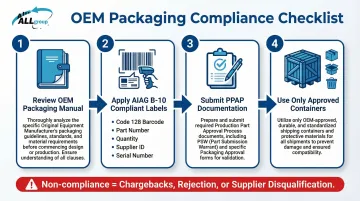
OEMs typically require a standardized bar-coded shipping label on automotive shipments, following the AIAG B-10 standard. Required data fields include:
- Part Number
- Quantity
- Supplier Identification
- Serial Number
Non-compliant labels frequently trigger shipment rejection at OEM receiving docks. AIAG B-10 mandates Code 128 barcode symbology for scanning accuracy and data integrity.
PPAP (Production Part Approval Process)
Tier-1 suppliers receive a Packaging Requirements Manual from each OEM customer and must submit packaging approval documentation as part of PPAP. Ford requires PPAP submissions for service parts suppliers, while General Motors requires Part Submission Warrants (PSW) submitted electronically via the GM SQMS system.
Failing to meet these submission requirements carries real costs: chargebacks, shipment rejection, or removal from the supplier base entirely.
Common Automotive Packaging Mistakes to Avoid
Physical Packaging Failures
Under-strapping heavy pallets — Using narrow straps (1.5"–2") on heavy LTL loads concentrates pressure, causing corner crush and strap failure. Wrong strap width or too few straps for load weight leads to part damage, carrier claim denial, and line stoppage.
Substituting polypropylene for polyester — PP loses tension over time and cannot maintain load integrity during long-haul transit. The result: load shift, component damage, and chargebacks for non-conforming packaging.
Skipping edge and corner protection on rigid loads:
- UPS requires corner boards extending the full height of the load on all corners to increase vertical stacking strength
- Missing edge protection causes strap cutting and compression damage, and freight claims get denied under the "act or default of the shipper" exception
Ignoring vibration during long-haul transit — ASTM D4169 truck profile testing uses 0.73 Grms vibration intensity to simulate distribution hazards. Resonant vibration causes fatigue failure in corrugated structures, product migration, and loose closures on precision components.
Documentation and Labeling Failures
Omitting AIAG B-10 compliant labels — Non-compliant labels cause dock rejection, re-labeling chargebacks, and administrative penalties. This is a preventable delay that holds up production.
Missing lot traceability information — OEMs require full traceability for quality audits and recalls. A missing lot number can trigger a DMR and, in repeat cases, supplier disqualification.
Submitting non-approved containers:
- Containers must match those specified in the OEM packaging manual
- Using unapproved containers leads to 3rd-party sorting charges and potential line-down penalties
Physical packaging and documentation failures carry equal weight with OEM customers — getting one right while neglecting the other still results in chargebacks, delays, or lost supplier standing.
Frequently Asked Questions
What are the types of packaging in the automobile industry?
Automotive packaging falls into four main categories:
- Expendable packaging: corrugated boxes, wooden crates (one-time use)
- Returnable packaging: reusable plastic containers, metal racks
- Specialized protective packaging: VCI bags, foam-in-place
- Unitized loads: pallet and skid-based systems
Each type serves different supply chain segments based on volume, distance, and cost.
Can FedEx ship car parts?
Yes, FedEx and other major parcel carriers ship car parts, but heavy or oversized components (engines, transmissions) typically require LTL or freight shipping. Carrier packaging requirements must be met to qualify for damage claims—FedEx explicitly states it may reject parts packaging that doesn't meet minimum standards.
What strapping material is best for heavy automotive parts like engines and transmissions?
Polyester (PET) or heavy-gauge steel strapping is recommended for high-weight, rigid loads. Polyester offers the advantage of retained tension without sharp-edge risk, making it the preferred choice for most automotive applications. Cummins explicitly mandates polyester strapping and prohibits steel banding.
What is AIAG packaging compliance and do I need to follow it?
AIAG sets packaging and labeling standards widely adopted across the North American automotive supply chain. Compliance is typically mandatory if you ship to an OEM or tier-1 customer that specifies it in their supplier quality requirements. Non-compliance triggers chargebacks and shipment rejection.
How do I protect metal automotive parts from corrosion during shipment?
Use VCI (Volatile Corrosion Inhibitor) poly bags, papers, or foam for bare metal parts—especially for ocean or long-haul shipments where humidity is a factor. Keep metal parts within 12 inches of the VCI material; properly applied, VCI protection lasts approximately 3 years under normal warehouse conditions.
What is the difference between returnable and expendable packaging in automotive?
Returnable packaging—reusable containers and racks—works best for high-volume OEM supply chains where reverse logistics are already in place. Expendable (one-time-use) packaging is the practical choice for aftermarket, service parts, or long-distance distribution where returning containers isn't feasible. Most suppliers use both, depending on the application.