Introduction
Packaging decisions are no longer just operational — they're strategic. Products making sustainability-related claims averaged 28% cumulative growth over five years, outperforming products without such claims, which means eco-friendly packaging has become both a compliance requirement and a genuine competitive edge.
Seven U.S. states have enacted Extended Producer Responsibility (EPR) laws that shift waste management costs directly to packaging producers, with compliance deadlines running through 2029. On the demand side, 74% of consumers will pay more for sustainable packaging — nearly 25% accept a 10% price premium without hesitation.
Here's what you need to know about the six main recyclable packaging materials — what sets each apart, how to match them to your operations, and where businesses commonly go wrong in the switch.
Key Takeaways
- Recyclable packaging reduces waste, lowers disposal costs, and strengthens brand loyalty with eco-conscious buyers
- The six main types are corrugated cardboard, kraft paper mailers, compostable plant-based packaging, mushroom (mycelium) packaging, recycled plastic (LDPE), and cellulose/glassine
- Each type differs in curbside accessibility, protective strength, and cost — so the right choice depends on your product and customers
- Select based on product fragility, shipping volume, and your customers' local recycling access
- Always include clear disposal instructions — customers can't recycle what they don't know how to handle
What Is Recyclable Packaging?
Recyclable packaging refers to materials specifically designed to be collected, processed, and reused in manufacturing new products rather than ending up in landfills or incinerators. According to the FTC Green Guides, a product can only be marketed as "recyclable" if it can be recovered through an established recycling program available to at least 60% of consumers where the item is sold.
Key Distinctions
Recyclable vs. Compostable vs. Biodegradable:
- Recyclable: Processed through mechanical or chemical recycling to create new products
- Compostable: Breaks down into organic matter under specific composting conditions (industrial or home)
- Biodegradable: Degrades naturally over time but without defined timeframes or facility requirements
The distinctions matter more than most businesses realize. A compostable claim requires scientific evidence that the material breaks down within roughly the same timeframe as natural matter. On the recyclability side, if any component significantly limits recyclability—such as a non-recyclable coating on an otherwise recyclable box—an unqualified "recyclable" claim is considered deceptive under FTC guidelines.
Why Recyclable Packaging Matters for Your Business
The transition to recyclable materials is driven by three converging forces: consumer economics, state legislation, and operational costs.
Consumer Willingness to Pay
Sustainability directly impacts purchasing decisions. Products with sustainability claims saw 28% cumulative growth over five years, compared to 20% for those without. Nearly three-quarters of consumers will pay more for sustainable packaging, with younger demographics and higher-income groups leading that preference.
Expanding EPR Compliance Requirements
Seven states have enacted comprehensive packaging EPR laws with staggered compliance deadlines:
- Maine: Program operations begin 2027
- Oregon: Producer fees and enforcement started July 2025
- Colorado: Producer dues required starting January 2026
- California (SB 54): PRO membership required by January 2027; plastic recycling rates must reach 30% by 2028 and 65% by 2032
- Minnesota: PRO membership required by July 2025
- Maryland: PRO membership or individual plans due July 2026
- Washington: PRO membership required by July 2026
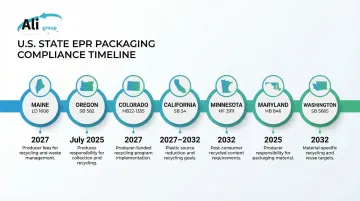
These laws shift waste management costs from municipalities to producers — making recyclable materials and reduced packaging volume a financial priority, not just an environmental one.
Business Benefits Beyond Compliance
Beyond compliance, the operational case is strong:
- Reduced material costs over time through volume pricing and material efficiency
- Stronger brand loyalty with environmentally conscious customers
- Lower landfill disposal fees
- Alignment with corporate sustainability reporting goals (ESG metrics)
- Tax incentives available in select states for businesses adopting sustainable practices
6 Types of Recyclable Packaging Materials
No single recyclable material works for every shipment. The right choice depends on what you're shipping, what level of protection it needs, what recycling infrastructure your customers can actually access, and where your sustainability priorities sit. Here's a practical breakdown of the six most common options.
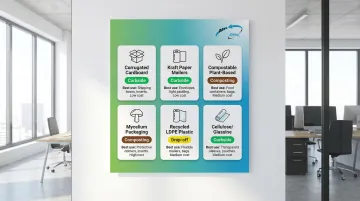
| Material | Recycling Pathway | Best For | Relative Cost |
|---|---|---|---|
| Corrugated Cardboard | Curbside | All shipment sizes | Low–Medium |
| Kraft Paper / Mailers | Curbside | Soft goods, apparel | Low |
| Compostable Plant-Based | Industrial composting | Food, eco-brands | Medium–High |
| Mycelium Packaging | Home composting | Premium, low-volume | High |
| Recycled LDPE Plastic | Store drop-off | High-volume e-commerce | Low–Medium |
| Cellulose / Glassine | Curbside (uncoated) | Food, luxury retail | Medium |
Corrugated Cardboard Packaging
Corrugated cardboard is the most widely recycled packaging material in the U.S. It consists of layered paper with a fluted inner core that provides structural strength while staying lightweight. The average corrugated box already contains 52% recycled content, made from a combination of virgin and recycled paper pulp.
Strengths:
- Accepted by virtually every curbside recycling program (79% of Americans have access)
- Recycling rate of 69–74% in 2024, with over 33 million tons recycled
- Versatile across box sizes, from small e-commerce parcels to large industrial shipments
- Customizable with branding and printing
- Cost-competitive at volume with factory-direct pricing
Alliance Packaging Group stocks over 1,000 box sizes for immediate shipment, including single-wall (ECT-32), double-wall (ECT-44/ECT-48), and triple-wall (ECT-90) options for varying protection requirements.
Limitations:
- Not suitable for moisture-heavy environments without additional coatings
- Wax-coated or heavily treated corrugated variants are not recyclable—they contaminate the repulping process
- Though wax-coated boxes represent only 3–5% of the total stream, they cause disproportionate issues at paper mills
Kraft Paper and Paper-Based Mailers
Kraft paper is an unbleached, strong paper product made from wood pulp using the kraft process. Paper-based mailers—including padded versions with paper cushioning—are fully recyclable when both the outer envelope and interior padding are paper-based.
Strengths:
- 100% curbside recyclable in most regions
- Lightweight, reducing shipping costs
- Printable for branding; naturally biodegradable even if it misses the recycling stream
- Ideal for soft goods, apparel, and lightweight products
- Life Cycle Assessments show paper has a recycling potential of roughly 81% compared to plastic film's high likelihood of ending up in landfills
Limitations:
- Limited protective strength for fragile or heavy items
- Mailers that combine paper exterior with plastic bubble padding are not directly recyclable as a single unit—components must be separated first, which most consumers skip
- Hybrid mailers frequently contaminate recycling streams when components aren't separated
Alliance Packaging Group offers EarthKraft™ Recyclable Padded Mailers made from natural kraft paper (curbside recyclable) and TerraBoard™ mailers with 75% post-consumer content.
Compostable Plant-Based Packaging
This category covers cornstarch (PLA), sugarcane bagasse, and wheat starch—bio-based materials that break down into organic matter under composting conditions. Common applications include void fill (compostable packing peanuts), food containers, and protective wrapping.
Strengths:
- Eliminates fossil fuel-derived plastics from the packaging chain
- Compostable packing peanuts dissolve in water, making disposal easy
- Well-suited for food and beverage businesses or brands targeting eco-conscious buyers
- Certified industrially compostable materials achieve at least 90% biodegradation within 180 days under ASTM D6400 standards
Limitations:
- Requires industrial composting facilities—home compost typically can't reach the necessary 55–60°C
- Only 35.9% of the U.S. population has access to composting programs, and just 18.1% have access to programs that accept compostable packaging
- Generally more expensive than conventional plastic alternatives
- A 2023 survey found 29% of food waste composting facilities reject compostable packaging due to contamination concerns
- Clear disposal labeling is essential—customer confusion is common
Mushroom (Mycelium) Packaging
Mycelium packaging is grown from agricultural waste—hemp hurds, corn stalks—bound together by mushroom root structures. It's cultivated into custom shapes within days, producing a rigid, foam-like material that's 100% compostable at home.
Strengths:
- Home-compostable in most cases, unlike PLA which requires industrial conditions
- Highly customizable to product shape
- Significantly lower carbon footprint than EPS—one Life Cycle Assessment found mycelium bio-foam produced 1.32 kg CO₂ eq vs. 3.35 kg CO₂ eq for EPS in TV packaging
- Credible sustainability differentiator for premium brands shipping lower-volume, high-value products

Limitations:
- Higher per-unit cost than corrugated or plastic alternatives
- Better suited for premium, lower-volume shipments than high-volume bulk operations
- Less widely available through standard packaging distributors
- Can be heavier than EPS, which may increase transportation emissions
Recycled Plastic Packaging (LDPE-Based)
Poly mailers and bubble wrap fall under low-density polyethylene (LDPE), recycling code #4. These materials are recyclable but not accepted in curbside programs—they require drop-off at designated plastic film collection points, typically grocery store bins.
Strengths:
- Lightweight and durable with good moisture resistance
- Cost-effective for high-volume e-commerce fulfillment
- Mailers made with post-consumer recycled LDPE reduce environmental impact compared to virgin plastic
- LCAs show recycled LDPE creates less burden than virgin plastic across energy use and global warming potential
Limitations:
- The recycling pathway is far less accessible than paper—most consumers don't know drop-off is required
- Only 23% of consumers use store drop-off programs vs. 72% for curbside recycling
- Plastic bags and films tangle sorting machinery when placed in curbside bins
- Without printed disposal instructions on the mailer itself, actual recycling rates drop sharply
Cellulose and Glassine Packaging
Cellulose is derived from plant fiber and used for wraps, trays, and food-safe packaging. Glassine is a smooth, semi-transparent paper resistant to grease and moisture. Uncoated versions of both move through standard paper recycling streams.
Strengths:
- Excellent for food packaging, bakery goods, medical packaging, and delicate product wrapping
- Glassine offers a premium tactile experience suited to retail and luxury goods
- Derived from renewable plant sources; uncoated glassine is curbside recyclable and naturally biodegradable
- Glassine's grease resistance makes it one of the few paper-based options viable for direct food contact
Limitations:
- Not suited for heavy-duty protective packaging
- Coated versions with moisture barriers may not be accepted by all paper recyclers—two-side silicone coated glassine liners are rated "Not Recyclable" because the hydrophobic surface blocks repulping
- Verify with local recycling processors before committing to coated variants at scale
How to Choose the Right Recyclable Packaging for Your Business
The "best" recyclable packaging is the one that balances product protection, customer convenience of disposal, operational volume, and total cost—not simply the material with the highest eco-credibility.
Factors to Evaluate
Product Type and Fragility
- Heavy or irregularly shaped items need structural integrity (corrugated, mycelium)
- Soft goods or apparel suit kraft mailers or poly mailers
- Fragile electronics benefit from double or triple-wall corrugated combined with paper-based cushioning
Recycling Accessibility for Your Customers
- Prioritize materials accepted by curbside programs (corrugated, kraft paper) when your end customers are individual consumers
- Drop-off-only materials (LDPE) work better in B2B closed-loop systems where you control the disposal channel
- Consider regional infrastructure—composting access varies widely by location
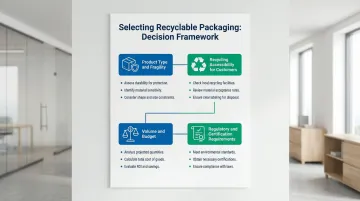
Volume and Budget
- High-volume operations benefit from corrugated or recycled plastic at competitive pricing
- Specialty materials like mushroom packaging are better reserved for premium or lower-volume product lines
- Volume pricing often offsets perceived premiums for sustainable materials
Regulatory and Certification Requirements
- Food-grade packaging must meet FDA safety standards regardless of sustainability—verify material compliance
- Pharmaceutical packaging must meet rigorous standards (e.g., USP <661>)
- EPR laws in California, Oregon, and other states are beginning to eco-modulate fees, potentially making non-recyclable virgin plastics more expensive for producers
Once you've mapped your requirements across these four dimensions, sourcing becomes the next practical step. Alliance Packaging Group stocks over 10,000 packaging products—including corrugated, kraft, and specialty eco-friendly formats—with factory-direct pricing and nationwide just-in-time delivery, so switching to a greener packaging mix doesn't mean managing a longer vendor list.
Common Mistakes to Avoid When Switching to Recyclable Packaging
Even well-intentioned packaging transitions can fall short. These are the most common pitfalls businesses encounter—and how to sidestep them.
Choosing Innovation Over Practicality
Selecting a premium material like mushroom packaging when corrugated cardboard would better serve the product, customer, and budget at scale is a frequent misstep. Specialty materials have their place, but not every shipment requires complex solutions. Match the material to the use case, not the trend.
Failing to Communicate Disposal Instructions
A recyclable material that ends up in the trash delivers no environmental benefit. Include clear labeling or packaging inserts explaining how to recycle or compost each material. Consumers are least accurate when disposing of "Store Drop-Off" items, which makes explicit on-pack instructions especially important for those materials.
Overlooking the Full Supply Chain
Switching the outer box to recycled cardboard while keeping non-recyclable void fill, tape, or labels undermines the sustainability effort. Assess all packaging components together—not in isolation.
One detail that catches many operations off guard: recyclable materials must be clean and dry. Food residue or moisture can render items non-recyclable and contaminate entire batches at the facility.
Frequently Asked Questions
What is the most eco-friendly packaging material?
Corrugated cardboard is widely considered the most accessible and eco-friendly option due to its 69-74% recycling rate and broad curbside program acceptance. However, the "best" material depends on the specific product and use case—fragile items may require specialized cushioning, while food products need moisture barriers.
What are the five main types of recyclable materials?
The five commonly recognized recyclable material categories are paper/cardboard, glass, metals (aluminum and steel), plastics (with code-specific recyclability), and organics (compostables). In packaging, these translate to corrugated boxes, glass containers, metal cans, rigid plastic bottles (#1 PET, #2 HDPE), and compostable plant-based materials.
What are the 7 types of packaging?
The seven types span three structural levels—primary (direct product contact), secondary (groups primary packages), and tertiary (bulk/transport)—plus four functional subtypes: protective, flexible, rigid, and semi-rigid. For recyclable packaging specifically, paper-based and metal options tend to score highest across all three structural levels.
Is recyclable packaging more expensive than traditional packaging?
Upfront costs can be slightly higher for some eco-friendly materials, but volume pricing, reduced waste disposal fees, potential tax incentives, and customer retention benefits often offset the difference. Regulatory pressure is also narrowing the cost gap, making recyclable alternatives increasingly competitive.
How do I know if my packaging is recyclable?
Check for the resin identification code on plastic packaging and confirm paper-based materials are uncoated or minimally coated. The How2Recycle label system is the most reliable guide—it designates packages as "Widely Recyclable," "Check Locally," or "Store Drop-Off" based on actual program acceptance.
What recyclable packaging is best for shipping fragile products?
Corrugated cardboard (double or triple-wall with ECT-48 or ECT-90 ratings) combined with paper-based cushioning or compostable packing peanuts is the most widely available and effective recyclable solution for fragile goods. Honeycomb sheets made from compressed paper provide excellent cushioning strength and are 100% recyclable and compostable.