Introduction
Industrial buyers face a difficult balancing act in 2026. On one side, sustainability mandates from regulators and customers are intensifying—driven by the EU's Packaging and Packaging Waste Regulation (PPWR) and emerging Extended Producer Responsibility (EPR) frameworks in seven U.S. states. On the other, the core job of strapping—securing heavy loads through real-world transit—has zero margin for failure. A snapped strap can mean damaged goods, liability claims, and lost customer trust.
The central question: have biodegradable strapping materials finally become reliable for industrial use, or are they still a work in progress? The answer depends heavily on your load type, environment, and how much performance risk your operation can absorb.
Key Takeaways
- Paper and cellulose fiber strapping work well for light-to-medium bundling in food & beverage, retail, and e-commerce
- Bio-based polypropylene exists but faces scalability and cost challenges
- Heavy-duty applications aren't yet served reliably by biodegradable alternatives
- Machine compatibility, moisture sensitivity, and total cost are the biggest barriers to wider adoption
- Verdict: biodegradable strapping is ready for targeted industrial use—not universal replacement
The Regulatory and Market Pressure Driving Change in 2026
Compliance Mandates Are Intensifying Across Borders
The European Union's Packaging and Packaging Waste Regulation (PPWR) entered force in February 2025, reshaping packaging requirements. The EU officially exempted pallet wrappings and straps from the 100% reuse requirement in February 2026 due to disproportionate adaptation costs. Even so, the regulation still mandates that all packaging be recyclable in an economically viable way by 2030.
In the United States, seven states have enacted Extended Producer Responsibility (EPR) packaging laws as of 2025–2026: Maine, Oregon, Colorado, California, Minnesota, Maryland, and Washington. These laws require producers to register with a Producer Responsibility Organization and pay fees based on packaging volume and recyclability. Sales restrictions for non-compliant producers took effect in Oregon and Colorado on July 1, 2025, with California following January 1, 2027.
Supply Chain Pressure from Downstream Customers
Large retail and e-commerce customers now treat sustainability benchmarks as procurement requirements. Walmart has set an ambition to transition to 100% reusable, recyclable, or industrially compostable packaging by 2025. Suppliers failing to meet these material restrictions risk losing distribution contracts.
The Hidden Operational Cost: Waste Stream Separation
Beyond compliance, companies face practical disposal challenges. Conventional plastic strapping must be sorted out from cardboard recycling, adding cost and complexity. Worse, industrial strapping acts as a "tangler" in Material Recovery Facilities (MRFs), wrapping around disc screens and sorting equipment, causing severe downtime and requiring hazardous manual removal. For non-bottle rigid plastics, MRF sorting loss rates can reach up to 35%.
Paper-based strapping eliminates this problem entirely—it can be recycled in the same stream as corrugated cardboard.
Types of Biodegradable Strapping Materials Available in 2026
Paper and Cellulose Fiber-Based Strapping
This is the most commercially available and proven biodegradable strapping category as of 2026. Made from plant-based fibers or cellulose pulp, these straps are fully repulpable and recyclable alongside corrugated cardboard.
Key products:
- Signode LEVEX: Available in 5, 9, and 12 mm widths with break strengths between 180 N and 430 N
- Mosca Paper-Strap: Three-layer construction with breaking strengths from 245 N to 539 N
New-generation cellulose straps are engineered for improved tensile strength. They're available in both hand and machine grades, and run on compatible strapping equipment without extensive retrofits.
Bio-Based Polypropylene (Bio-PP) Strapping
Bio-PP uses renewable feedstocks—corn, sugarcane, cellulose, or even used cooking oil—instead of fossil fuels, offering a reduced carbon footprint while maintaining the familiar handling properties of conventional PP strapping.
Bio-PP is bio-sourced but not necessarily biodegradable — an important distinction buyers often miss. Signode's Dylastic Bio is manufactured from a minimum of 40% bio-based raw materials; Braskem's WENEW Bio-Circular PP is derived from used cooking oil. Both must be mechanically recycled just like conventional plastic — neither breaks down in compost or landfill. "Bio-based" (renewable feedstock) and "biodegradable" (breaks down naturally) are not the same thing.
PLA (Polylactic Acid) and Plant-Derived Polymer Strapping
PLA-based strapping is derived from fermented plant starch (typically corn) and is genuinely biodegradable under industrial composting conditions. However, current formulations face serious challenges:
- Heat vulnerability: PLA has a glass transition temperature of just 55–60°C, meaning it softens and loses strength in summer heat
- Brittleness: PLA is inherently brittle with very low elongation at break (typically 4-6%), making it unsuitable for loads that shift during transit
- Disposal requirements: It only breaks down in industrial composting facilities operating at 55–60°C, not in landfills or backyard compost bins
In practice, PLA strapping is limited to light-duty, climate-controlled applications — fresh produce packaging and retail display are the most viable fits today.
Recycled-Content Strapping (PET from Post-Consumer Waste)
While not biodegradable, recycled PET strapping is frequently grouped in sustainability discussions and is the most practical high-strength eco-upgrade available at scale in 2026.
Key products:
- Signode TENAX: Break strengths up to 18,850 N — suitable for heavy industrial and unitizing applications
- Teufelberger TYCOON: 100% recycled content PET verified by TÜV Austria's OK Recycled certification
Comparison Summary
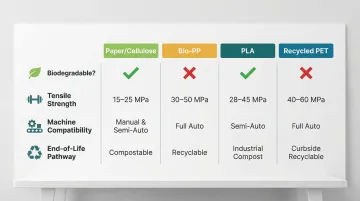
| Material Type | Biodegradable? | Tensile Strength | Machine Compatibility | End-of-Life Pathway |
|---|---|---|---|---|
| Paper/Cellulose | Yes | 180–539 N | Some machines; may require adjustment | Repulpable with cardboard |
| Bio-PP | No (bio-sourced only) | Up to ~6,000 N | Drop-in replacement | Mechanical recycling |
| PLA | Yes (industrial composting) | Low/Brittle | Limited | Industrial composting only |
| Recycled PET | No | Up to 18,850 N | Drop-in replacement | Mechanical recycling |
Industrial Performance: How Biodegradable Strapping Measures Up
Tensile Strength and Load Security
Paper and cellulose strapping has improved significantly—it's now competitive with light-to-medium duty polypropylene strapping for bundling and carton securing applications. Break strengths of 180–539 N are adequate for e-commerce packages, corrugated bundling, and light logistics.
However, it does not match the high-tensile performance of polyester or steel strapping needed for heavy pallet loads or dense unit loads in manufacturing. For context, recycled PET strapping can achieve 18,850 N—more than 30 times stronger than the best paper strapping.
Moisture and Environmental Sensitivity
Paper and cellulose-based strapping are vulnerable to moisture, which can reduce holding strength in:
- Humid storage environments
- Refrigerated facilities
- Outdoor staging areas
- Non-climate-controlled shipping containers
Some manufacturers offer coated or treated variants to improve moisture resistance, but buyers should verify performance thresholds for their specific environment before switching.
Machine Compatibility
Paper strapping is compatible with some existing machines, but not all—particularly older high-speed automatics calibrated for plastic strap tension and feed profiles. Signode's LEVEX is engineered as an "out of the box" solution for their SGP 3330/5330 and SMB machines. Mosca's Paper-Strap runs on Mosca machines equipped with SoniXs ultrasonic sealing units.
Before switching, confirm compatibility with your equipment—some facilities will need to adjust tension settings or upgrade machines, adding upfront cost.
End-of-Life and Disposal Advantages
Paper and cellulose strapping can be recycled in the same stream as corrugated cardboard, eliminating the sorting step required for plastic strapping. This reduces waste handling cost and supports uncontaminated recycling streams—a tangible operational benefit for facilities that ship with corrugated packaging.
Carbon and Water Footprint
Manufacturer-reported lifecycle data shows meaningful CO2 reductions compared to standard polypropylene strap (3,586 kg CO2 per ton):
| Product | CO2 per Ton | Reduction vs. Standard PP |
|---|---|---|
| Signode LEVEX paper strap | 2,100 kg | ~41% |
| Signode Dylastic Bio strap | ~1,793 kg | ~50% |
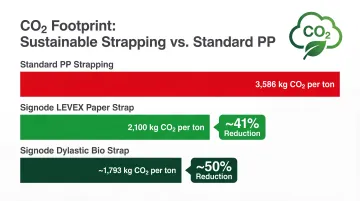
These figures come from manufacturer-provided data. Before using them in sustainability reporting, ask suppliers for third-party verified lifecycle assessments with clearly defined system boundaries—not all LCA methodologies are directly comparable.
Industry-by-Industry Readiness: Where It Works and Where It Doesn't
Food & Beverage, Retail, and E-Commerce: Ready Now
These sectors typically use strapping for light bundling, carton securing, and display packaging where load weights are manageable and product turnover is fast. Paper and cellulose strapping performs reliably here and aligns with sustainability commitments these sectors are already making publicly.
Typical applications:
- Corrugated carton bundling
- Display unit securing
- Light pallet bundling (under 500 lbs)
- E-commerce package reinforcement
Electronics and Consumer Goods Manufacturing: Ready Now
Bundling of components, cable management, and unit packaging in controlled indoor environments are well-suited to biodegradable fiber strapping, provided moisture exposure is limited. Several fiber strapping products are already seeing commercial use in these environments.
Typical applications:
- Component bundling and kitting
- Cable and wire management
- Finished unit packaging
- Indoor pallet consolidation
Heavy Manufacturing, Construction, and Steel/Lumber: Not Yet Ready
These applications require extreme tensile strength, weather resistance, and load retention that biodegradable strapping materials cannot yet match. Steel and high-tensile polyester strapping remain the only viable options for:
- Loads that shift or settle during transit
- Outdoor exposure during storage or shipping
- Heavy unit loads (over 1,000 lbs)
- Construction materials (lumber, steel, bricks)
Medical & Pharmaceutical and Specialty Distribution: Emerging Opportunity
Controlled environments, lighter loads, and strong sustainability reporting requirements make this a sector to watch for early adoption. However, product safety and traceability requirements require qualification testing before biodegradable strapping can be approved.
What to Consider Before Switching to Biodegradable Strapping
Conduct a Load Profile Audit Before Committing
Before testing any alternative material, map your actual strapping applications by:
- Load weight and dimensions
- Transit environment (indoor vs. outdoor, humidity levels)
- Strapping machine type and age
- Typical transit duration and handling conditions
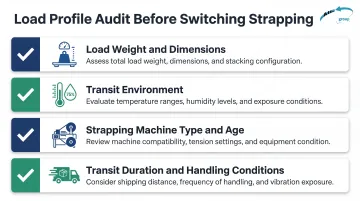
A mismatch between material capability and application is the most common cause of transition failure. Paper strapping that works perfectly for dry corrugated bundling will fail catastrophically on outdoor lumber loads.
Factor in Total Cost of Ownership, Not Just Unit Price
Biodegradable strapping options—particularly paper and bio-based materials—may carry a higher per-unit cost than commodity polypropylene. However, buyers should weigh this against:
- Reduced waste disposal costs (single recycling stream)
- Potential EPR compliance savings (lower eco-modulation fees)
- Business value of meeting customer sustainability requirements
- Reduced MRF contamination and sorting costs
For many operations, the total cost of ownership is comparable or even favorable when these factors are included.
Work with a Packaging Partner Who Can Source and Evaluate Options
Transitioning to sustainable strapping requires expertise across material types, machine compatibility, and supply chain continuity. Alliance Packaging Group helps buyers assess their current setup, test alternatives, and maintain supply continuity—without juggling multiple vendors.
With over 10,000 products available for immediate shipment, APG can coordinate strapping changes alongside corrugated packaging, void fill, and other materials. That means a single transition plan covers your entire disposal and recycling workflow.
Frequently Asked Questions
What biodegradable alternatives exist for plastic strapping used in industrial applications?
The main categories are paper/cellulose fiber strapping, bio-based polypropylene, and PLA-based strapping. Paper strapping is the most commercially available and field-proven option for industrial bundling today, with break strengths of 180–539 N and full repulpability alongside corrugated cardboard.
Is paper strapping strong enough for heavy industrial loads?
Modern cellulose and paper strapping is competitive with light-to-medium duty PP strapping but does not match the tensile performance of polyester or steel strapping. It's suitable for carton securing and bundling applications under 500 lbs, but not for heavy pallet or unit load restraint where break strengths above 1,000 N are required.
Can biodegradable strapping be used with existing strapping machines?
Compatibility varies. Paper strapping works with some semi-automatic and automatic machines but not all. Buyers should verify machine specifications and adjust tension settings or upgrade equipment before switching. Bio-PP and recycled PET are drop-in replacements for conventional plastic strapping machines.
What industries are best suited for biodegradable strapping in 2026?
Food & beverage, retail, e-commerce, and electronics manufacturing are the best fits today — all share lighter load profiles, controlled storage environments, and sustainability mandates that align well with paper and cellulose strapping performance.
How does the cost of biodegradable strapping compare to plastic strapping?
Biodegradable options carry a higher upfront material cost than conventional PP. Total cost of ownership narrows considerably once you factor in reduced waste disposal costs, EPR compliance savings, and the value of meeting customer sustainability requirements.
What certifications or standards should I look for when buying biodegradable strapping?
Look for repulpability certifications (TAPPI UM 213) for paper strapping used alongside corrugated, and industrial composting certifications (EN 13432 or ASTM D6400) for PLA-based materials. Verify that "bio-based" claims are backed by recognized standards such as ISO 16620 or ASTM D6866 — bio-based does not automatically mean biodegradable.