Introduction
Every pallet wrap decision starts with one number: gauge. Choose too thin, and loads shift in transit, driving freight claims that average $1,511 per incident. Choose too thick, and you're quietly overpaying across thousands of wraps per year with nothing to show for it.
Gauge controls containment force, puncture resistance, and film cost in a single spec. Understanding how it maps to real load requirements — and where each range hits its limits — is what separates a reliable wrapping operation from one that guesses and absorbs the losses.
Key Takeaways
- Gauge measures film thickness: 1 gauge = 0.254 microns; higher gauge means thicker, stronger film
- 80-gauge is the industry standard, suitable for most pallet loads up to 2,200–2,400 lbs
- True-gauged, equivalent, and pre-stretched films with identical gauge numbers perform differently — film type matters as much as the spec
- Wrong gauge selection cuts both ways: too thin risks load failure, too thick wastes material cost with no added benefit
- Match gauge to load weight, shape, wrapping method (hand vs. machine), and shipping conditions for best results
What Gauge Means in Stretch Film
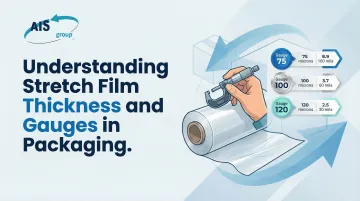
Gauge is a unit of thickness measurement used in the stretch film industry. 1 gauge equals 0.254 microns (or 0.01 mil), meaning an 80-gauge film is 80 × 0.254 = 20.32 microns thick. This is a design specification, not a performance guarantee on its own.
Gauge functions as both a material input (how much resin is used per roll) and a performance constraint — covering puncture resistance, elongation, and containment force before failure. The number defines the ceiling on what the film can do. Actual performance depends on how it's applied and what it's applied to.
Three Major Film Types Share Gauge Designations But Behave Differently
True-gauged film measures exactly what the gauge number states — a 60-gauge film is 15.2 microns at every point. This type offers the highest stretch potential and the most predictable performance.
Equivalent or hybrid film uses stiffer resin formulas and multi-layer technology to match the load-holding capacity of a thicker true-gauged film, despite measuring thinner. A 47-gauge equivalent film, for example, can match the containment strength of a 60-gauge true film for loads up to roughly 1,800 lbs.
Pre-stretched film is factory-stretched to near maximum elongation before winding onto rolls, typically starting from 80-gauge stock and finishing at 37 gauge. It applies at lower tension, but its elastic reserve is largely consumed in manufacturing — which limits how much it can stretch further during application.
Factors That Affect Real-World Gauge Performance
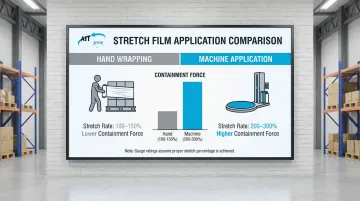
The same gauge film delivers very different containment results depending on the stretch percentage applied during wrapping. A true 80-gauge film applied at 150% stretch behaves differently than the same film applied at 250% stretch. Machine-applied films can be stretched more consistently (200-300%) than hand-applied films (100-150%), maximizing containment force.
Environmental and operational variables degrade effective gauge performance:
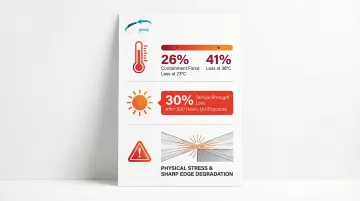
- Temperature extremes: Cold makes film brittle; heat softens it. Research shows stretch film can lose 41% of its containment force at 38°C (100°F) and 26% at 23°C (73°F) over 30 days. Most of that loss occurs within the first two hours of application.
- UV exposure: Without inhibitor additives, polyethylene films can lose up to 30% of tensile strength after just 500 hours of UV exposure.
- Sharp pallet edges or product corners create stress concentration points that puncture or tear film prematurely.
Stretch Film Gauge Ranges and Their Load Applications
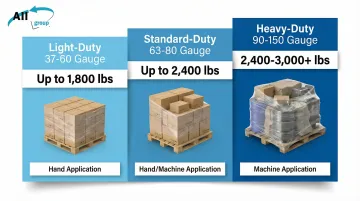
Gauge selection is bounded by three zones—light-duty, standard-duty, and heavy-duty—each defined by load weight, shape regularity, and wrapping method. Operating at the boundary between zones requires additional evaluation.
Light-Duty Range (37–60 Gauge)
37 gauge is a pre-stretched 80-gauge film suitable for loads under 800 lbs. It requires minimal application force, making it ideal for light uniform loads and bundling operations.
47 gauge (equivalent/hybrid) handles loads up to approximately 1,800 lbs for uniform box-and-case wrapping. Its stiffer characteristic reduces stretch demand on the applicator but limits puncture resistance on sharp-edged loads.
60 gauge (true) is accurate to micrometer measurement and suitable for loads up to approximately 1,800 lbs. It offers the best elongation in this range and works well for both banding and standard hand/machine pallet wrapping.
Standard-Duty Range (63–80 Gauge)
63 gauge (16 microns) provides meaningfully better puncture resistance than 47-gauge equivalents and handles loads up to approximately 2,200 lbs. It is the most common machine film for standard boxed pallets.
80 gauge is the industry standard, handling loads from approximately 2,200–2,400 lbs. It dominates because it balances material cost, availability, application ease (hand and machine), and containment strength across the widest range of distribution and warehouse operations. Both hand and machine formats are widely available, making it the default starting point for most operations.
Heavy-Duty Range (90–150 Gauge)
Films in this range are built for demanding loads that lighter gauges cannot reliably contain.
90–115 gauge films are appropriate for loads from approximately 2,400–3,000+ lbs. Hand application at 100 gauge and above demands maximum exertion to achieve proper stretch rates, making machine application the practical choice at this range.
150 gauge is the heaviest standard cast machine film, reserved for irregular, sharp-edged, or extreme-weight loads. It is not typically manufactured in hand-roll format. The cost and material-per-roll implications are considerably higher than lighter gauges.
Key Performance Properties Controlled by Gauge
Gauge controls more than film thickness. It sets the ceiling for three linked performance properties — puncture/tear resistance, load containment force, and cling/film cohesion — and adjusting gauge shifts all three at once.
Property 1: Puncture and Tear Resistance
Puncture resistance scales with gauge because a thicker cross-section of film requires more force to penetrate. Irregular or sharp-edged loads (metal components, lumber, angle iron) demand higher gauge specifically for this reason, not just weight.
ASTM D5748 is the standard test method for measuring protrusion puncture resistance of stretch wrap film. It measures the energy required for a probe to penetrate the film under biaxial stress, simulating sharp objects protruding from a pallet. Blown films typically offer superior puncture resistance compared to cast films of the same gauge due to their manufacturing process.
Property 2: Stretch, Elongation, and Load Containment Force
Stretch film secures loads through tension—the film is applied under stretch and its elastic memory creates inward containment force. Heavier gauge films can sustain higher applied tension without necking or tearing, which directly increases containment force per wrap.
Higher gauge films have a higher maximum stretch ceiling, but reaching it requires more force — which is why machine application (with consistent mechanical tension) is critical for 90-gauge and above. Pre-stretched films deliver lower containment force at application because their elastic reserve is already consumed during manufacturing.
Research shows that molecular chains align optimally within the quasi-elastic region at 150-250% pre-stretch, increasing tensile modulus (stiffness) and stored elastic energy. Beyond 300% pre-stretch, neck-in (narrowing of the film width) and thinning limit further gains in containment force.
Property 3: Cling and the Interaction With Film Type
Cling — the film's ability to bond to itself without adhesive — depends partly on gauge but more on film formulation and extrusion method. Cast films dominate 70-80% of the market, favored for machine wrapping due to their transparency and quiet unwind. Blown films are tougher and more tear-resistant at equivalent gauge, making them the better choice for cold storage and heavy or irregular loads.
| Feature | Cast Stretch Film | Blown Stretch Film |
|---|---|---|
| Clarity | High transparency, glossy | Hazy, duller finish |
| Tear Resistance | Moderate | Excellent |
| Cling | One cling side, one non-cling side | Both sides, superior bond |
| Noise | Quiet unwind | Noisy unwind |
| Best Use | Machine wrapping, barcode scanning | Heavy/irregular loads, cold storage |
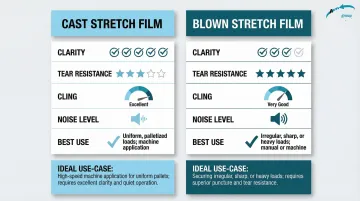
Two films at the same gauge number from different processes should not be treated as interchangeable—their performance profiles differ fundamentally.
How Stretch Film Gauge Is Specified, Measured, and Validated
Gauge is both a procurement specification (what you order) and an operational verification point (what you receive and how it performs).
Specification and Documentation
Gauge is stated on product datasheets and roll labels. The key distinction is between "rated gauge" (the manufacturer's nominal spec) and "measured gauge" (a micrometer reading taken at multiple points across the roll width).
Equivalent films will measure thinner than their rated gauge by design. Buyers should confirm whether a film is true-gauged or equivalent before comparing load ratings.
Alliance Packaging Group documents load capacities across its hand and machine film range—59 gauge up to 1,600 lbs, 80 gauge up to 2,500 lbs, 120 gauge up to 4,000 lbs—so buyers can match spec to operational need directly.
Measurement and Verification
To verify gauge in the field, use a micrometer or thickness gauge following ASTM D6988-21 — the standard guide for measuring plastic film thickness using dead-weight micrometers. A proper check covers multiple points across the roll width:
- Sample at the center and both edges (die variation causes edges to differ from center)
- Take at least 3-5 readings per cross-web position
- Compare averaged readings against the rated spec, not a single point
Field measurements on equivalent films will read lower than the rated number — this is expected, not a quality defect. What matters is load-containment performance, not whether the film measures to the gauge number exactly. High-quality films typically hold a thickness tolerance of ±5%; premium specifications may require ±1%.
What Happens When Gauge Is Mismatched to the Load
Under-Specification Consequences
Using too low a gauge introduces several failure points:
- Film necking (narrowing under tension) reduces effective wrap coverage
- Tearing during application or in transit leaves loads unprotected
- Reduced containment force allows load shifting
- Pallet collapse becomes a real risk on longer or rougher hauls
The financial exposure is real. Studies indicate that up to 11% of unit loads arrive at distribution centers with some degree of damage, and freight damage costs businesses roughly $1,511 per incident—adding up to over $1 billion in annual losses across U.S. operations. A TT Club analysis found that 65% of cargo damage claims stem from poorly packed or inadequately secured cargo.
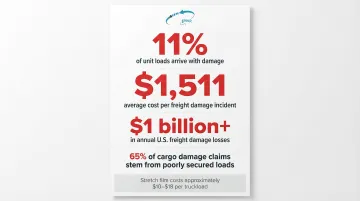
The cost of stretch film (approximately $10–$18 per truckload) is negligible compared to potential damage claims, making proper specification a critical financial safeguard.
Over-Specification Consequences
Thicker isn't always better. Using unnecessarily high gauge creates its own set of problems:
- Higher per-roll material cost without proportional performance gains
- Heavier rolls increase operator fatigue in hand-wrap operations
- Fewer wraps per roll means more frequent roll changes
- Machine tension errors if equipment isn't calibrated for the thicker film
The right gauge is the one matched to your load—not the heaviest one available.
Safety and Compliance Impact
Proper gauge selection isn't only a cost issue—it carries compliance weight as well. In regulated industries (food & beverage, pharmaceutical, medical devices), stretch film specifications may need to be documented as part of packaging validation.
Using a non-specified gauge can create compliance gaps even if the load physically holds. ISTA (International Safe Transit Association) and EUMOS 40509 provide protocols for validating load stability under acceleration/deceleration forces.
Common Gauge Misinterpretations to Avoid
Treating All Films of the Same Gauge Number as Equivalent
A true 80-gauge cast film, an 80-gauge equivalent film, a pre-stretched 80-gauge film (which wraps at ~37 gauge), and an 80-gauge blown film are four fundamentally different products. They share a label number but differ in actual thickness, stretch rate, containment force, and application requirements. This is the single most common source of performance disappointment when switching suppliers.
Ignoring the Interaction Between Gauge and Application Method
Gauge ratings and load-weight recommendations in supplier charts assume proper stretch percentage is achieved during application. A 90-gauge film applied by hand without hitting its rated stretch percentage will underperform a machine-applied 80-gauge film — gauge selection cannot be separated from the wrapping method.
Stretch rates vary significantly by application type:
- Hand wrapping typically achieves 100–150% stretch
- Machine application consistently reaches 200–300% stretch
That gap directly affects containment force and load stability, regardless of what gauge number is printed on the roll.
Conclusion
Gauge is an active performance parameter: it sets the ceiling on puncture resistance, containment force, and elongation, but only when correctly matched to load weight, shape, application method, and shipping environment. It is not a simple "heavier load = higher number" equation.
Three decisions drive the difference between optimized operations and ones absorbing preventable costs:
- Distinguish between true-gauged, equivalent, and pre-stretched films before purchasing
- Verify specifications at procurement rather than relying on label claims
- Align gauge to process requirements, not just product weight
Get these right and you reduce both film waste and damage claims. Get them wrong and you pay for it in both.
Stretch film selection gets more complex as operations scale — more load types, more application methods, more variables. Alliance Packaging Group carries a full range of gauges and film types with factory-direct pricing and nationwide availability. With over 10,000 products in stock and a technical team that works through the spec-matching process with buyers, it's a practical resource for operations looking to standardize film selection across their facilities.
Frequently Asked Questions
What does gauge mean in stretch wrap?
Gauge is a unit of thickness measurement where 1 gauge equals 0.254 microns. A higher gauge number means a thicker, stronger film. However, the number alone does not tell you the film type (true-gauged, equivalent, or pre-stretched), which also affects performance.
How thick is 120 gauge plastic?
120 gauge converts to approximately 30.5 microns (120 × 0.254) or 1.2 mil. 120-gauge films are used for heavy-duty machine wrapping of irregular or high-weight loads, typically supporting loads up to 4,000 lbs.
What is the standard gauge for stretch wrap?
80 gauge is the industry standard for general-purpose pallet wrapping, suitable for loads up to approximately 2,200–2,400 lbs. It is available in both hand and machine formats, balancing cost, availability, and containment strength for most operations.
What is the difference between hand stretch film and machine stretch film gauge?
Hand and machine films are not interchangeable even at the same gauge number. Machine films are engineered for high-tension, high-speed application and often deliver better containment at equivalent or lower gauge, while hand films are designed for ease of use with lower required stretch force.
What happens if you use stretch wrap that is too thin for your load?
Under-gauged film will neck, tear, or fail to maintain containment force during transit, resulting in load shifting, product damage, and potential freight claims. Studies show freight damage costs businesses approximately $1,511 per incident.
Is higher gauge stretch film always better?
No. Higher gauge is only better when the load requires it. Over-specifying increases material cost, reduces wraps per roll, and can cause equipment calibration issues without delivering proportional containment improvement.