Introduction
A snapped strap mid-transit. A pallet shifted across a trailer floor. A cargo damage claim that wipes out the margin on the entire shipment. Most of these incidents trace back to one avoidable mistake: selecting strapping without calculating the required break strength first.
Under-specified strapping fails under load. Over-specified strapping wastes budget. Both errors are common across warehousing and distribution operations.
The base formula — load weight divided by number of straps — is only the starting point. Real-world calculations also involve safety multipliers, strap type, load dynamics, and material compatibility. Getting any one variable wrong changes the required break strength, and the result is either a failed load or an over-engineered one.
This guide walks through the exact step-by-step calculation process, explains the variables that shift the result, and shows how to match that number to the right strap material.
Key Takeaways
- Required break strength = (Load Weight × Safety Multiplier) ÷ Number of Straps
- Static palletized loads use a 1.5× safety multiplier; dynamic loads require 2× or higher
- Break strength and Working Load Limit (WLL) are not the same—WLL is only one-third of break strength
- Strap material determines achievable break strength at a given width and gauge
- Always verify against the manufacturer's rated break strength, never estimate
How to Calculate Strap Break Strength by Load Weight
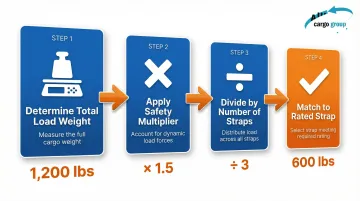
Break strength calculation follows a repeatable four-step process. The example below uses a 1,200 lb palletized shipment secured with three straps — follow along and substitute your own numbers at each step.
Step 1: Determine Your Total Load Weight
Weigh the fully loaded pallet—include the pallet weight itself, packaging materials, and any overhang or protrusions that add mass. Guessing load weight is the most common starting-point error in strap selection.
Key considerations:
- Use a calibrated scale for accuracy
- Account for stacked loads that concentrate stress
- Note uneven weight distribution that affects strap tension
- Include multi-tier packaging that may shift during transport
Step 2: Apply the Safety Multiplier
The safety multiplier accounts for forces beyond static weight. The industry standard for static, palletized loads is 1.5×, meaning you multiply the load weight by 1.5 to determine the total break strength needed across all straps.
When to increase the multiplier:
- Flatbed transport (2× or higher)
- Loads subject to vibration or shifting
- Irregular-shaped bundles
- High-value or fragile goods
- Carton reinforcement applications (3× multiplier)
- Unitizing and bundling where strap acts as the package (5× multiplier)
For our 1,200 lb example with standard palletized conditions: 1,200 lbs × 1.5 = 1,800 lbs total break strength required — that's what all three straps combined must be rated to handle.
Step 3: Divide by the Number of Straps
Formula: Required Break Strength per Strap = (Total Load Weight × Safety Multiplier) ÷ Number of Straps
Using our example: 1,800 lbs ÷ 3 straps = 600 lbs break strength required per strap
Straps must be distributed to share load evenly. A strap placed at an edge or at an angle to the load direction absorbs disproportionate force and may need a higher individual rating than the formula suggests. Always position straps perpendicular to the load direction for maximum efficiency.
Step 4: Match the Result to a Rated Strap
Cross-reference your calculated break strength (600 lbs in our example) against manufacturer-published break strength specs for the strap size and material you're considering. The rated break strength must equal or exceed your calculated requirement.
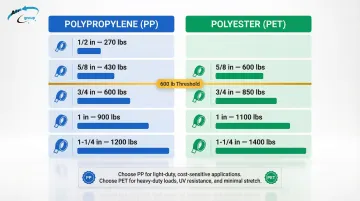
Polypropylene (PP) Break Strength by Size:
| Strap Size | Average Break Strength |
|---|---|
| 1/2" × .015" | 950 lbs |
| 1/2" × .020" | 1,220 lbs |
| 3/4" × .020" | 1,810 lbs |
| 3/4" × .023" | 2,050 lbs |
| 1-1/4" × .031" (High Tensile) | 5,500 lbs |
Polyester (PET) Break Strength by Size:
| Strap Size | Average Break Strength |
|---|---|
| 1/2" × .020" | 600 lbs |
| 3/4" × .025" | 2,800 lbs |
| 1-1/4" × .040" | 3,200 lbs |
| 1-1/4" × .050" | 4,000 lbs |
For our 600 lb requirement, both a 1/2" × .015" polypropylene strap (950 lbs rated) and a 1/2" × .020" polyester strap (600 lbs rated) meet the minimum. The polypropylene option carries 350 lbs of additional headroom — worth considering for loads that shift or stack unevenly during transit.
Key Variables That Affect Your Break Strength Calculation
The formula produces a baseline number. These four variables determine whether that number is accurate for your specific application or needs adjustment.
Load Type: Static vs. Dynamic
Static loads (pallets in a warehouse or contained truck) generate predictable downward force. Dynamic loads (flatbed transport, vibrating machinery, stacked unstable goods) generate lateral and oscillating forces that increase effective strain on straps.
The Federal Motor Carrier Safety Administration (FMCSA) requires securement systems to withstand 0.8 g deceleration forward, 0.5 g rearward, and 0.5 g laterally. These forces far exceed static weight.
Failing to account for dynamic load forces is the leading cause of in-transit strap failure. The standard 1.5× multiplier may need to increase to 2× or higher for dynamic applications.
Strap Angle and Geometry
A strap running perpendicular to the load direction carries force efficiently. Any angle introduces a vector component that reduces effective holding strength — and the standard formula assumes perpendicular placement.
If straps must run at an angle due to load shape or anchor point location, required break strength per strap increases. Compensate by:
- Adding an additional strap to distribute the load
- Selecting a strap with a higher break strength rating
- Repositioning anchor points where the load geometry allows
Strap Condition and Reuse
Break strength ratings on strap labels reflect new, undamaged strapping.
UV exposure, abrasion, chemical contact, and repeated tensioning cycles all degrade actual break strength below the rated value. A 2025 Fraunhofer IMWS study found plastic strapping should never be reused — tensile strength dropped by up to 60% in welding areas after initial use. UV exposure causes polypropylene tensile strength to decline by approximately 59% after 625 days of exposure.
Used or visually compromised strapping should never be selected based on its original rated break strength. Disqualify any strap showing:
- Cuts or nicks in the strap body
- Fraying at edges or joints
- Discoloration or fading from UV exposure
- Deformation or permanent stretching
Joint Efficiency (Sealed vs. Buckle Connections)
The break strength of the seal or buckle joining strap ends is always lower than the strap body's rated value. Most plastic strapping joints achieve 50–80% joint efficiency, meaning the effective assembly break strength falls short of what the label states.
| Connection Type | Joint Efficiency |
|---|---|
| Friction/heat welds (PP/PET) | Up to 80% |
| Metal seals — double-notch (steel) | 75% |
| Metal seals — single-notch (steel) | 45% |
| Cordstrap composite buckles | Up to 90% |
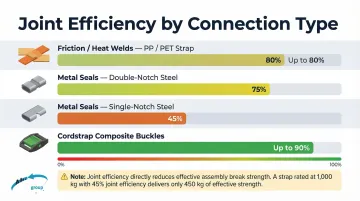
When calculating required break strength, the rated value must be achievable at the joint — not just in the strap body. Confirm whether the manufacturer rates joint efficiency separately and adjust your selection accordingly.
What You Need Before Running the Calculation
Having the right inputs and reference materials before starting prevents errors and avoids recalculating partway through strap selection.
Equipment and Reference Materials
- Calibrated scale for accurate pallet weight
- Manufacturer break strength specification sheets or published break strength table for strap types being considered
- Number of straps per pallet established by your packaging standard or line supervisor
- Load securement requirements from customer specifications or regulatory standards
Strap Specifications and Compliance Checks
Confirm the strap type being evaluated (polypropylene, polyester, or steel) is compatible with the load surface and environment. Consider whether you need food-safe, chemical-resistant, or metal-edge-contact-compatible options.
Regulatory compliance: Check whether DOT, OSHA, or customer-specific requirements govern minimum break strength or strap type for your application. The FMCSA requires an aggregate working load limit of at least 50% of the weight of the article. Regulatory minimums may supersede the formula result.
Once you know your required break strength, confirm you can source a strap that meets it. Alliance Packaging Group stocks a broad range of polypropylene, polyester, and steel strapping options across widths and break strength ratings, so you can match your calculated requirement to an in-stock product without delay.
When to Reassess or Adjust Your Strap Selection
The calculation is not a one-time exercise. Any change in load weight, shipment mode, strap placement, or strap brand requires recalculating to confirm the selected strap still meets required break strength.
Specific triggers for reassessment:
- Switching strap suppliers or product SKUs (different specs)
- Changing the number of straps per pallet to reduce cost
- Adding or removing packaging layers that alter total load weight
- Shifting from enclosed truck to flatbed or intermodal transport
- Replacing damaged or degraded strapping inventory
When your calculated break strength falls between two available strap specifications, always select the higher-rated option. Rounding down is not an acceptable trade-off: the marginal cost difference between strap grades is negligible compared to the cost of a load failure or product damage claim.
Common Mistakes When Calculating Strap Break Strength
Three errors account for most miscalculations in the field:
Treating WLL as Break Strength
Many operators use the Working Load Limit as their selection number. WLL is roughly one-third of break strength — it includes a 3:1 safety factor to cover sudden braking, sharp corners, and rapid acceleration. Using WLL in place of break strength either over-specifies the strap (wasting money) or dangerously under-specifies it. Always calculate against break strength directly.
Ignoring Joint Efficiency
A strap may have the right body break strength, but the seal or buckle joint often tests weaker. If that joint isn't verified to match the body rating, the assembly fails at a point that never appeared in the calculation. Check the manufacturer's joint efficiency rating — not just the strap's listed break strength.
Assuming Equal Load Distribution
Applying the formula with equal load spread across all straps ignores real-world geometry. Load shape, center of gravity, and strap placement can cause one or two straps to carry significantly more force than the others. Before finalizing your break strength calculation, validate strap placement physically to confirm even load sharing and perpendicular strap alignment to the load direction.
Conclusion
Get the load weight, safety multiplier, strap count, and manufacturer-rated break strength right — and strapping selection stops being a guessing exercise.
This calculation protects more than the load. Under-specified strapping creates liability, compliance risk, and damage costs that far exceed the cost of selecting the correct strap from the start. TT Club reports that two-thirds of cargo damage claims are caused or exacerbated by poor packing practices, including inadequate cargo securing.
The formula itself is straightforward — what separates a secure load from a failed one is whether each variable gets the attention it deserves before the strap is ever applied.
Frequently Asked Questions
How to calculate strap load?
Strap load calculation uses the formula: (Total Load Weight × Safety Multiplier) ÷ Number of Straps = Required Break Strength per strap. The standard safety multiplier is 1.5× for most palletized loads, increasing to 2× or higher for dynamic applications.
What is the difference between break strength and working load limit for strapping?
Break strength is the maximum force the strap can withstand before failure. WLL (Working Load Limit) is typically one-third of break strength and represents the safe working limit for regular use. Always select straps based on the required break strength from your calculation, not the WLL.
How many straps do I need to secure a pallet?
The number of straps depends on load weight and the break strength of available strap. Typical palletized loads use 2-4 straps positioned perpendicular to the load direction, spaced to ensure even load distribution.
Does strap width affect break strength?
Yes, wider and thicker strapping materials have higher break strength ratings. For example, a 1/2" × .020" polypropylene strap has 1,220 lbs break strength, while a 3/4" × .023" strap has 2,050 lbs. Always confirm the exact value against the manufacturer's published break strength table.
What safety factor should I use when selecting packaging strapping?
A 1.5× safety multiplier is standard for static palletized loads. Dynamic loads, flatbed transport, or high-risk applications may warrant a 2× multiplier or higher. Always cross-check against regulatory requirements or customer shipping standards that specify minimum safety factors.
When should I use polyester strapping instead of polypropylene?
Use polyester strapping for heavier loads (typically over 1,500 lbs), non-compressible loads, or when polypropylene has previously failed. Polyester delivers higher break strength per equivalent width, holds tension better on rigid loads, and resists load shifting more reliably during transport.