
This post covers what an arch strapping machine is, how it works, how it differs from archless models, and the operational signals that tell you it's time to invest in one.
Key Takeaways
- Arch strapping machines use a fixed guide frame to automatically loop, tension, seal, and cut plastic strapping around packages
- Fully automatic models complete 30–70 straps per minute—far faster than manual methods
- Best suited for high-volume operations with uniform package sizes and conveyor integration needs
- Arch openings typically range from small parcel size up to pallet scale, accommodating a wide variety of package dimensions
- Widely used in manufacturing, warehousing, e-commerce fulfillment, and food and beverage industries
What Is an Arch Strapping Machine?
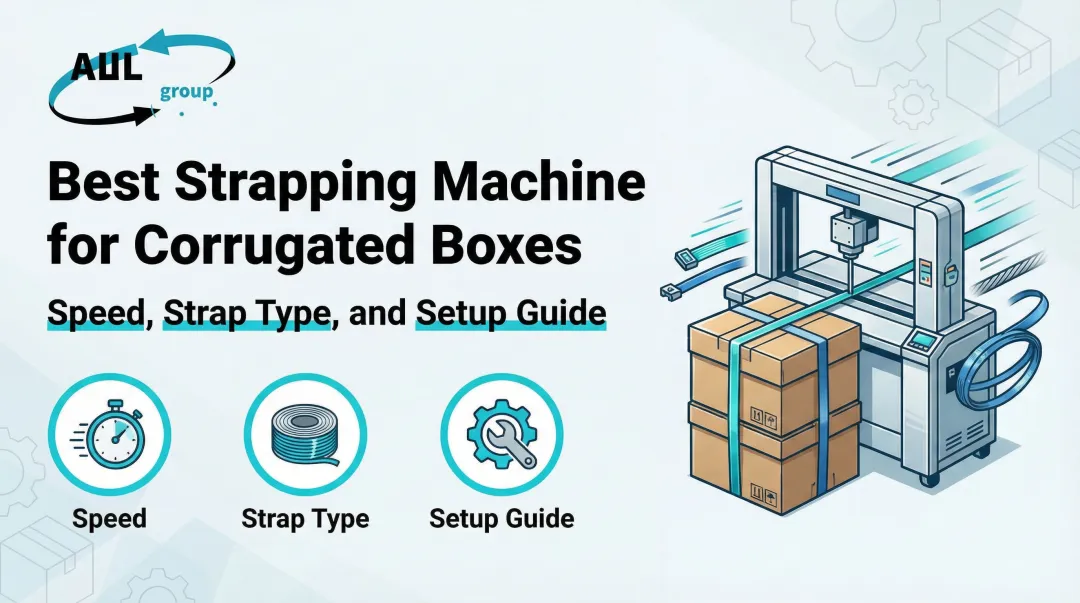
An arch strapping machine is a semi-automatic or fully automatic packaging device that uses a physical arch—also called a guide frame or loop—to route plastic strapping completely around a package before tensioning and sealing it. The strap material is typically polypropylene (PP) or polyester (PET).
The Role of the Arch
The arch is a rectangular or square frame through which the strap is threaded and guided in a closed loop around the package. This is the defining feature that separates arch machines from archless and handheld alternatives — no operator threading required.
Key Components
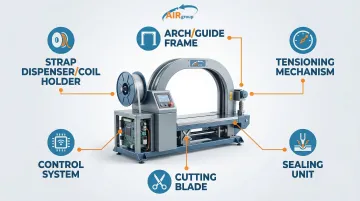
Every arch strapping machine includes:
- Strap dispenser/coil holder - Feeds material into the system
- Arch/guide frame - Routes the strap around the package
- Tensioning mechanism - Pulls the strap tight to preset levels
- Sealing unit - Fuses strap ends using heat, friction, or ultrasonic welding
- Cutting blade - Severs the strap cleanly after sealing
- Control system - Coordinates timing and package detection via sensors and a control board
Automation Levels
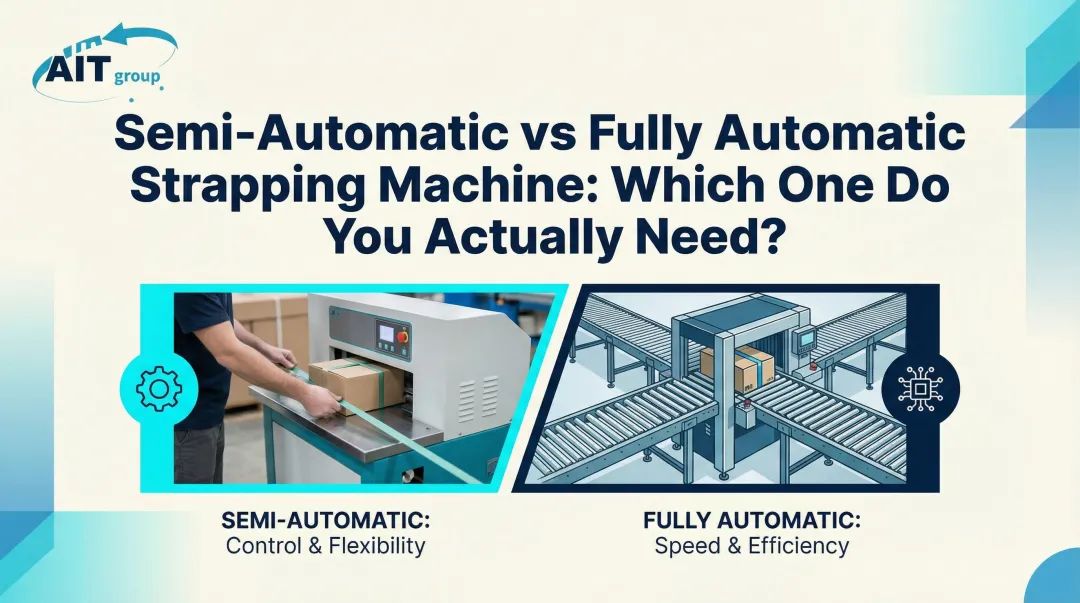
Semi-automatic models require the operator to position the package on the worktable. From there, the machine handles strap feeding, tensioning, sealing, and cutting on its own.
Fully automatic models go further — photocell sensors on the conveyor detect each package and trigger the full cycle with no operator input, making them the right fit for high-speed, uninterrupted production lines.
Strap Materials
| Property | PP (Polypropylene) | PET (Polyester) |
|---|---|---|
| Best for | Light loads, carton bundling | Heavy or compression-sensitive loads |
| Elongation | 18–34% | 10–12% |
| Break strength | Standard | Up to 1,500 lbs |
| Cost | More economical | Higher, but replaces steel strapping |
| Tension | Adjustable | Adjustable |
PP is the go-to for compressible, everyday shipments. PET is the better choice for rigid or dense loads where sustained tension matters — making it a direct alternative to steel strapping for rigid loads.
How Does an Arch Strapping Machine Work?
The operational cycle follows a precise mechanical sequence that takes seconds to complete.
Step 1: Product Positioning
The operator places the carton, box, or bundle on the machine's worktable or conveyor. On fully automatic models, photocell sensors detect the package and trigger the strapping cycle automatically—no manual button press required.
Step 2: Strap Feeding and Loop Formation
Strap feeds from the dispenser through the arch guide frame, wrapping in a complete loop around the package. From there, the strap end returns to the sealing area, forming a closed loop ready for tensioning. Because the arch guides the strap along a fixed path, placement stays consistent across every cycle.
Step 3: Tensioning and Sealing
The tensioning system pulls the strap tight to a preset level—adjustable based on package type and fragility. Once the strap reaches proper tension, the sealing unit fuses the overlapping ends together.
Sealing methods include:
- Heat welding (55-65% joint efficiency): a heated element melts the strap interface
- Friction welding (75-85% efficiency): mechanical rubbing generates the heat needed to fuse
- Ultrasonic welding (85%+ efficiency, smoke-free): high-frequency vibration melts the interface for the strongest bond
Friction and ultrasonic welding both outperform manual strapping with metal seals, which typically yields only 60% joint efficiency — well below what either machine method delivers.
Step 4: Cutting and Reset
After sealing, the machine cuts the strap cleanly and automatically resets for the next cycle. On fully automatic conveyor-integrated models, the strapped package moves forward while the next package enters the arch—enabling continuous high-speed throughput with no interruption between packages.
Arch Strapping Machine vs. Archless: What's the Difference?
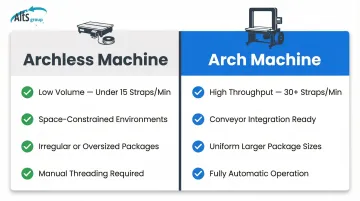
Archless strapping machines (also called table-top or low-profile models) sit at conveyor height and require the operator to manually thread the strap under the package. That hands-on step makes them well suited for low-volume operations or facilities where a vertical arch frame would create clearance issues.
By contrast, arch machines handle larger, heavier, or more varied package sizes without any manual threading — the arch physically accommodates each package as it passes through the frame. That makes them the preferred choice when conveyor integration and higher throughput are the priorities.
Quick Decision Guide
Archless is the right fit if:
- Volume is low (under 10-15 straps per minute)
- Space is tight and a vertical arch would create clearance issues
- Package sizes are highly irregular or oversized
- Budget is limited and manual involvement per cycle is acceptable
An arch machine makes sense when:
- Throughput is high (30+ straps per minute required)
- Package sizes are larger but relatively uniform
- Conveyor integration is needed for inline operation
- Minimizing operator involvement per cycle is a priority
When Do You Need an Arch Strapping Machine?
Five operational triggers signal it's time to evaluate an arch strapping machine investment.
Trigger 1: Volume Threshold
Manual or tabletop strapping maxes out at 10-15 straps per minute. When production lines require continuous strapping or exceed this threshold, the bottleneck justifies the investment in an arch machine capable of 30-70 straps per minute.
Cost justification benchmark: If your facility applies more than 600 straps per shift (approximately 10 per minute over a 60-minute hour), automation becomes cost-justified when you factor in labor costs, injury risk, and throughput constraints.
Trigger 2: Labor and Ergonomic Costs
Repetitive manual strapping is a documented source of workplace strain injuries affecting the wrist, shoulder, and back. The CDC reports that manual material handling contributes to over 500,000 musculoskeletal disorder (MSD) cases annually in the U.S.
Businesses seeing rising workers' compensation claims or high operator fatigue during strapping tasks should evaluate automated arch machines to:
- Reduce injury risk through engineering controls
- Reallocate labor to higher-value tasks
- Lower long-term workers' compensation costs
Trigger 3: Inconsistent Strapping Quality
When straps are applied at uneven tension—leading to damaged goods in transit or loads shifting on pallets—an arch strapping machine's preset, repeatable tension settings eliminate human variability. Manual tensioning relies on operator strength and technique, which varies shift to shift and person to person.
Trigger 4: Conveyor Line Integration
If your packaging or shipping line already uses a conveyor system, a fully automatic arch strapping machine can be integrated inline, eliminating the need to remove packages from the line for manual strapping.
Alliance Packaging Group designs custom conveyor systems that work inline with arch strapping machines, supporting continuous operation without interrupting the line.
Trigger 5: Shipping Compliance and Load Security
For industries where loads must meet carrier or regulatory requirements for containment, consistent strap tension and seal strength from an arch machine provides documented, repeatable load security that manual strapping cannot reliably deliver.
Federal regulations (49 CFR 393.102) require cargo securement systems to withstand 0.8g deceleration forward and 0.5g acceleration laterally and rearward. Major LTL carriers require palletized freight to be secured with banding or strapping to prevent shifting and compression damage during transit.
If any of these triggers apply to your operation, an arch strapping machine is worth a serious look.
Industries That Rely on Arch Strapping Machines
Manufacturing and Industrial
Manufacturing facilities—automotive parts, metal fabrication, building materials—use arch strapping machines to secure bundles and palletized loads before internal transfer or outbound shipping. In these environments, a failed strap means damaged inventory, production delays, or safety hazards on the warehouse floor.
Warehousing, Distribution, and E-Commerce Fulfillment
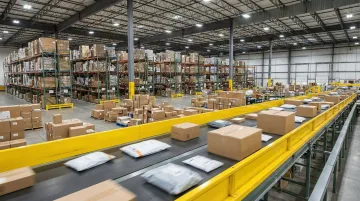
High-volume distribution centers and e-commerce fulfillment operations use fully automatic arch strapping machines integrated with conveyors to keep pace with order volumes. The global strapping machine market is estimated at $5.52 billion in 2025 and projected to grow to $8.15 billion by 2033, driven primarily by e-commerce expansion and the need to reduce manual labor costs.
These operations benefit from:
- Lower labor cost per package
- Consistent output regardless of shift or operator
- Faster throughput to meet same-day and next-day shipping commitments
Food, Beverage, and Pharmaceutical
These industries require hygienic, tamper-evident, and reliable packaging. Arch strapping machines deliver consistent seal quality that supports product safety standards and regulatory requirements for load integrity.
For facilities with strict hygiene requirements, specialized configurations are available:
- Stainless steel construction with washdown-rated components
- Ultrasonic sealing heads that eliminate smoke and residue
- Configurations built to GMP and food-grade sanitation standards
Frequently Asked Questions
What is the use of a strapping machine?
Strapping machines wrap and secure plastic or metal straps around products, cartons, or pallets to hold them together during shipping and storage. They prevent load shifting, product damage, and separation in transit.
What is the daily checklist for a strapping machine?
Run through these checks at the start of each shift:
- Inspect the arch guide frame for strap jams or debris
- Check strap coil supply and current tension settings
- Verify the sealing element is clean and functioning
- Confirm sensor operation on automatic models
- Look for worn cutting blades or loose components
What is the difference between an arch strapping machine and an archless strapping machine?
An arch machine uses a fixed guide frame to loop the strap automatically around the full package, while an archless machine requires the operator to manually thread the strap beneath the product. Arch machines are better suited for high-volume or automated conveyor-integrated lines.
What strapping material is used in arch strapping machines?
Most arch strapping machines use PP (polypropylene) for general carton bundling or PET (polyester) for heavier or compression-sensitive loads. Strap width and thickness are selected based on package weight and tension requirements.
Can an arch strapping machine handle different package sizes?
Most arch strapping machines accommodate a range of package sizes within the arch opening dimensions. Fully automatic models with adjustable settings handle varying sizes with minimal changeover, though extreme size variation may require manual adjustment.
How fast can an arch strapping machine strap packages?
Fully automatic arch strapping machines on conveyor lines can reach 60–70 straps per minute. Semi-automatic models run at 10–15 straps per minute, depending on operator cycle time and manual positioning.
Ready to automate your strapping operations? Alliance Packaging Group carries strapping equipment and custom conveyor integration solutions for manufacturing, distribution, warehousing, and shipping operations — with over 10,000 products in stock and nationwide just-in-time delivery. Reach us at 770-309-1012 or sales@apg-go.com.