Introduction
Packaging operations lose thousands of dollars annually when corrugated boxes shift during transit, arrive crushed at the destination, or fail structural integrity tests—triggering damage claims and costly reshipments. The root cause is almost always improper or inconsistent strapping: too much tension crushes the fluting; too little lets loads shift.
Solving that starts with the right equipment. This guide walks through how to evaluate strapping machines for corrugated box applications—covering strap material compatibility, cycle speed relative to your line throughput, and setup calibration. It also reviews five leading models across manual and automatic categories, with a step-by-step setup framework to ensure strap integrity without compromising box structure.
Key Takeaways
- Strapping machines come in three configurations (handheld, semi-automatic, and fully automatic), each matched to a different production volume
- PP strapping suits standard corrugated boxes; PET holds tension longer on heavy loads above 400 lbs
- Machine speed must match line output: semi-automatic units typically deliver 10-15 straps/minute, while automatic systems reach 30-65 straps/minute
- Friction weld seals are standard for PP on corrugated boxes, eliminating metal seals that can snag or tear board surfaces
- Tension calibration is critical—start low and test to avoid crushing corrugated fluting
What Makes a Strapping Machine Right for Corrugated Boxes
A strapping machine secures corrugated boxes for palletizing, shipment, or warehouse stacking by wrapping and tensioning a strap around the package, then sealing the ends to keep the load secure.
Corrugated boxes aren't forgiving of guesswork. Too much tension crushes the fluting and reduces stacking strength; too little lets boxes shift and contents settle during transit. Getting that balance right starts with choosing the correct machine type.
Three machine types address different operational scales:
- Manual handheld tools: Battery-powered tensioners and sealers for low-volume operations under 100 boxes/day, or mobile applications where a fixed station isn't practical
- Semi-automatic tabletop units: Operator positions the box and triggers the cycle; suited for 100–500 boxes/day with consistent throughput
- Fully automatic inline systems: Conveyor-integrated machines that detect boxes via sensors and complete the strap cycle hands-free; built for 500+ boxes/day
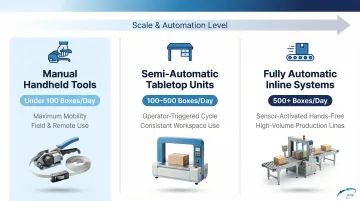
Each category is evaluated below on arch dimensions, strap compatibility, cycle speed, and setup requirements — the four factors that most directly affect performance on corrugated box lines.
Best Strapping Machines for Corrugated Boxes
Each machine below was evaluated against criteria that matter most for corrugated box applications:
- Arch size range and box dimension compatibility
- Strap material support (PP and/or PET)
- Speed rating for the intended volume level
- Setup ease and operator training requirements
Signode BXT3-19
Signode is one of the most widely deployed strapping equipment brands in North American distribution centers and manufacturing facilities. The BXT3-19 is a battery-powered handheld combination tool—not a tabletop or arch machine—designed for mobile corrugated box strapping applications where bringing boxes to a fixed station isn't practical.
Why it works for corrugated boxes:
- Cordless mobility allows flexible placement anywhere on the warehouse floor or production line
- Tool-free strap threading reduces setup time and operator training requirements
- Adjustable tension ranges (Standard: 1300–4500 N; Soft: 400–1600 N) prevent crushing corrugated fluting while maintaining secure load containment
- Friction weld sealing eliminates metal seals, cutting consumable costs and preventing snags on corrugated surfaces
| Specification | BXT3-19 |
|---|---|
| Strap Type Compatibility | PP and PET, 15–19 mm (5/8"–3/4") width |
| Tension Range | Standard: 1300–4500 N (290–1000 lbs); Soft: 400–1600 N (90–340 lbs) |
| Speed | 0–120 mm/s tensioning; up to 800 cycles per battery charge (low tension) |
| Arch/Box Size Range | N/A (handheld tool—no fixed arch) |
Fromm P327
Fromm is a Swiss-engineered brand with a strong global presence in corrugated packaging lines, particularly in e-commerce fulfillment and retail distribution. The P327 is a battery-powered manual plastic strapping tool designed for operators who need portability combined with high cycle capacity.
Key differentiators:
- Compact, handheld design enables strapping in tight spaces or on irregular box configurations
- Adjustable tension dial (600–3500 N) lets operators fine-tune tension for different corrugated grades without switching tools
- High battery capacity delivers up to 450 strap cycles per charge, reducing downtime during shifts
- Friction weld sealing produces clean, flush seals that won't catch on conveyor systems or stacking equipment
| Specification | P327 |
|---|---|
| Strap Type Compatibility | PP and PET, 16–19 mm (5/8"–3/4") width |
| Tension Range | 600–3500 N (135–790 lbs) |
| Speed | 55–130 mm/s tensioning; up to 450 cycles per battery charge |
| Arch/Box Size Range | N/A (handheld tool—no fixed arch) |
Mosca RO-M Fusion Automatic Strapping Machine
For operations running high-volume conveyor lines, fixed arch machines offer throughput that handheld tools can't match. Mosca builds high-speed automated strapping systems for industrial packaging environments, and the RO-M Fusion is its inline automatic arch strapper designed for corrugated box operations integrated with conveyor systems.
Key differentiators:
- High cycle speed up to 55 straps/minute keeps pace with fast-moving production lines
- Gentle strap placement and adjustable tension via potentiometer minimize risk of box surface damage or fluting compression
- Optional E-package includes automatic strap release via light sensor, enabling single or continuous strapping modes for hands-free operation
- Multiple frame sizes (600×500 mm, 800×600 mm, 1250×600 mm) accommodate a wide range of corrugated box dimensions
| Specification | RO-M Fusion |
|---|---|
| Strap Type Compatibility | PP, 5–12 mm width, 0.47–0.55 mm thickness |
| Speed | Up to 55 straps/minute (600×500 mm frame size) |
| Arch/Box Size Range | Frame sizes: 600×500 mm, 800×600 mm, 1250×600 mm (W×H); working height 800–905 mm |
| Seal Type | Adjustable tension via potentiometer; conveyor integration available |
Strap Types for Corrugated Boxes: PP, PET, and Steel Compared
Polypropylene (PP) Strapping
PP strapping is the dominant choice for corrugated box packaging due to its low cost, light weight, and gentle surface contact that avoids crushing corrugated fluting under normal tension levels. It's available in widths from 5–19 mm with a range of break strengths, making it adaptable to most box sizes and weights.
One real drawback: PP loses roughly 50% of applied tension within an hour, and heat accelerates that decay. For loads sitting in warehouses or moving through multi-day transit, this can allow boxes to shift or straps to go slack.
Polyester (PET) Strapping
PET strapping is stronger than PP and maintains tension over extended periods, making it the preferred choice for heavy corrugated cases that may shift or settle during long-distance transit. According to manufacturer guidelines, PET strapping can sustain loads between 185 and 580 kg depending on strap width.
Key advantages:
- Lower elongation and better recovery properties than PP
- Superior creep resistance—holds tension over days or weeks without loosening
- Available in versions made from 100% recycled PET bottle flakes
When to choose PET: Use PET for corrugated boxes weighing over 185 kg, loads that will remain strapped for more than 48 hours, or shipments exposed to temperature fluctuations that would accelerate PP tension loss.
Steel Strapping
Steel strapping is rarely used directly on corrugated boxes. Its rigidity concentrates force into a narrow band that can crush or cut corrugated board — industry packaging guidelines explicitly warn that strapping will damage corrugated fiberboard without corner protectors in place.
For very heavy industrial shipments where steel is the only option, laminated recycled paper edge protectors are mandatory — they distribute tension across the board surface and prevent damage at the strap contact points.
Practical Decision Guide
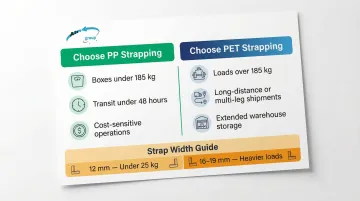
Choose PP for:
- Standard e-commerce and retail corrugated boxes under 185 kg
- Short-term storage or transit (under 48 hours)
- Cost-sensitive operations where strap material is a significant line item
Choose PET for:
- Heavy manufacturing or distribution cases over 185 kg
- Long-distance or multi-leg shipments
- Loads that will remain strapped for extended warehouse storage
Strap width selection: Match strap width to box weight. Twelve mm straps are standard for boxes under 25 kg; step up to 16–19 mm for heavier cases. Your strap supplier's break strength data sheet is the final authority — use it before committing to a width for a new application.
Speed and Throughput: Matching Your Machine to Production Volume
Strapping speed is measured in straps per minute (SPM) or cycle time (seconds per strap). Matching machine speed to your production line rate is critical: undersized equipment creates bottlenecks, while over-specifying automatic machines for low-volume lines increases capital cost and maintenance overhead without payoff.
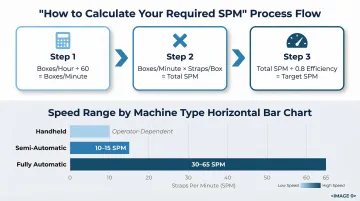
Calculating Required SPM
To determine the minimum machine speed your operation requires:
Convert boxes per hour to boxes per minute
Example: 1,200 boxes/hour ÷ 60 = 20 boxes/minuteMultiply by straps per box
Example: 20 boxes/minute × 2 straps/box = 40 straps/minuteDivide by efficiency margin (typically 0.8 for 80% uptime)
Example: 40 ÷ 0.8 = 50 SPM target
In this scenario, your strapping machine must be capable of at least 50 straps per minute to avoid slowing down the line.
Speed Benchmarks by Machine Type
- Manual/battery handheld tools: Speed depends entirely on operator dexterity and tensioning time; suited for operations under 100 boxes/hour
- Semi-automatic tabletop strappers: Typically deliver 10-15 straps per minute; ideal for mid-volume operations processing 100-400 boxes/day
- Fully automatic inline strappers: Deliver 30-65 straps per minute; designed for high-volume lines processing 500-5,000+ boxes/day
Example: The Mosca RO-M Fusion achieves up to 55 SPM, making it suitable for lines producing 1,500+ boxes/hour with dual strapping.
Cost of Speed Mismatch
A strapper that's too slow creates a production bottleneck: boxes queue up, operators stand idle, and downstream processes like palletizing and loading fall behind. On the other end, specifying a fully automatic machine for a line that only processes 200 boxes/day adds $10,000-$30,000 in capital cost and maintenance complexity with no ROI to show for it.
How to Set Up a Strapping Machine for Corrugated Boxes
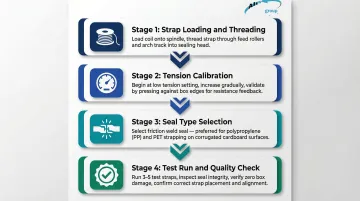
Step 1 — Strap Loading and Threading
Load the strap coil onto the machine's reel spindle, ensuring it unwinds in the correct direction (check the machine's threading diagram, typically located on the machine body). Thread the strap through the feed path in this sequence:
- Reel → Feed Rollers: Guide the strap through the first set of drive rollers that pull strap from the coil
- Feed Rollers → Arch Track: Route the strap into the arch guide track, ensuring it sits centered and flat
- Arch Track → Sealing Head: Thread the strap end into the sealing head mechanism where tension and sealing occur
Critical: Consistent strap path alignment prevents jams. If the strap twists or rides up against one side of the arch track, stop and re-thread before running production.
Step 2 — Tension Calibration for Corrugated
Set tension level appropriately for corrugated boxes—too high crushes fluting and weakens box integrity, too low allows the strap to slip or the box to shift. Most machines label tension in Newtons (N) or pounds (lbs).
Recommended starting point:
Begin at the lowest tension setting and run a test strap on a sample box. Gradually increase tension until the strap sits snug and flat against the box surface without deforming the corrugated board.
Validation: After strapping, press firmly on the box edges near the strap. If the corrugated fluting compresses or the box sidewalls bow inward, reduce tension. If the strap can be lifted more than 5 mm off the box surface, increase tension.
Step 3 — Seal Type Selection
Three common seal types exist for plastic and steel strapping:
- Heat/Friction Weld (PP and PET): Delivers 75-85% of strap tensile strength by melting the ends together — no metal seals required
- Metal Crimp Seal: A metal clip crimped over the strap overlap; adds per-strap cost and can snag on conveyors
- Push/Interlock Seal: Interlocking keys pressed into steel strap; not compatible with PP or PET
Recommendation for corrugated boxes: Friction weld is the standard and preferred seal type for PP and PET on corrugated applications. It delivers strong, clean seals without metal components that can tear box surfaces or catch on stacking equipment.
Step 4 — Test Run and Quality Check
With tension set and seal type confirmed, run 3-5 test straps on a representative corrugated box before starting full production:
- Check seal integrity: Pull the strap firmly with both hands—it should not separate at the seal
- Verify no box damage: Inspect the box surface for crushing, indentation, or fluting compression near the strap
- Confirm strap placement: The strap should sit flat, centered, and aligned parallel to the box edges
If any test fails, adjust tension, re-thread the strap, or check seal settings before proceeding.
Conclusion: Choosing the Right Strapping Machine for Your Operation
Three decisions drive the right strapping machine choice for corrugated boxes:
- Machine type: Match manual, semi-automatic, or fully automatic to your production volume
- Strap material: Choose PP or PET based on box weight and how long packages are in transit
- Arch size: Size for your full range of box dimensions, not just the average
Purchase price is only part of the equation. Three ongoing cost factors matter just as much:
- Consumable costs: PP strap is cheaper upfront but loses tension faster than PET
- Maintenance downtime: Automatic machines require regular calibration to stay accurate
- Parts availability: Confirm your supplier stocks replacement components before you commit
Alliance Packaging Group supplies strapping machines alongside a full range of consumables—PP, PET, edge protectors, and coils—with factory-direct pricing and nationwide just-in-time delivery. Whether you're setting up a new line or replacing aging equipment, their team can help match the right solution to your operation.
Contact Alliance Packaging Group at sales@apg-go.com or 770-309-1012 to discuss equipment and consumable needs together.
Frequently Asked Questions
What type of strapping is best for corrugated boxes?
PP strapping is the most common choice for standard corrugated boxes due to its low cost and gentle tension that won't crush fluting. PET is recommended for heavier loads over 400 lbs (185 kg) that require sustained tension over long transit distances or extended warehouse storage.
What is the difference between semi-automatic and fully automatic strapping machines?
Semi-automatic machines require the operator to position the box and press a button to initiate the strap cycle. Fully automatic machines integrate with conveyors and use sensors to detect boxes, completing the strapping cycle without manual intervention. This makes them the right fit for high-volume lines processing 500+ boxes/day.
What arch size do I need for my corrugated boxes?
The arch opening must be larger than the tallest and widest box dimension that will pass through it. Measure your largest corrugated box size and select an arch with at least 50-75 mm (2-3 inches) of clearance on each side to prevent jams and allow smooth box flow.
How do I prevent a strapping machine from crushing corrugated boxes?
The primary cause of box crushing is excessive tension. Start at the lowest tension setting and gradually increase until the strap sits snug without deforming the box. Use PP instead of steel strapping, and add corner protectors if higher tension is unavoidable for heavy loads.
How fast should a strapping machine be for a high-volume packaging line?
The machine's cycle speed (in straps per minute) must keep pace with your line's box output rate. Operations producing over 1,000 boxes per hour typically require a fully automatic strapper capable of 30-65 straps/minute to avoid bottlenecks.
Can I use a strapping machine for boxes of different sizes on the same line?
Most arch strappers accommodate a range of box sizes within their arch dimensions. However, automatic inline machines may require quick-change arch systems or programmable strap positioning for multi-size runs. Confirm this capability with the machine's spec sheet before purchase.