Introduction
Choosing between a semi-automatic and fully automatic strapping machine directly affects labor costs, packaging line efficiency, ROI timeline, and worker safety. Pick the wrong one and you're either paying for capacity you don't need or creating a bottleneck where you can least afford one.
According to PMMI Business Intelligence, 44% of contract packagers and manufacturers identify secondary packaging as a major operational bottleneck, with 19% specifically citing it as their greatest hindrance. Meanwhile, unplanned downtime costs average $36,000 per hour in FMCG operations and up to $2.3 million per hour in automotive manufacturing. This guide breaks down exactly how each machine type works, where each performs best, and the key decision factors that will point you toward the right choice for your operation.
Key Takeaways
- Semi-automatic requires an operator to position packages and trigger each cycle; fully automatic runs inline with conveyors, hands-free
- Fully automatic delivers higher throughput and lower labor cost per unit; semi-automatic costs less upfront and handles size variation better
- The right choice hinges on daily volume, package consistency, floor space, labor structure, and budget
- Under 400 packages per shift with mixed sizes? Semi-automatic. High-volume, uniform product flow? Fully automatic.
Semi-Automatic vs. Fully Automatic Strapping Machines: Quick Comparison
Use this table to compare the five factors that matter most when choosing between machine types.
| Factor | Semi-Automatic | Fully Automatic |
|---|---|---|
| Upfront Cost | $1,100–$2,500 base pricing | $16,000+ base pricing |
| Speed/Throughput | 10-15 straps/min (operator-limited) | 37-65 straps/min (machine-limited) |
| Labor Required | 1 operator per machine, continuous | Minimal supervision, line management only |
| Package Flexibility | Handles varied sizes and irregular shapes | Optimized for consistent dimensions |
| Floor Space | Compact: 570-1,430mm length footprint | Large: requires conveyor integration, 3,000mm+ |
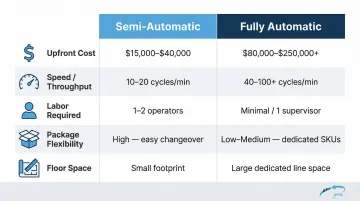
Note: Both machine types use the same strapping materials — polypropylene (PP) and polyester (PET). The decision comes down to workflow fit, not material compatibility.
What Is a Semi-Automatic Strapping Machine?
With a semi-automatic strapping machine, the operator manually positions the package at the strapping arch and activates the cycle via foot pedal or push button. The machine handles tensioning and sealing automatically — human placement is required for each cycle.
Core Operational Benefits:
- Entry-level pricing starts at $1,100–$2,500, compared to $16,000+ for fully automatic systems — making them accessible for smaller or growing operations
- Fewer moving parts mean lower maintenance complexity and a reduced total cost of ownership
- Most workers can operate one within minutes, with no specialized training or lengthy onboarding required
Key Variations:
- Tabletop strapping machines: Compact units (570–760mm footprint) for smaller packages, ideal for office environments and retail back-of-house operations
- Arch/loop strappers: The most common semi-auto format, accommodating packages up to 600x600mm, suitable for distribution centers and warehouses
- Portable semi-auto units: Mobile configurations for field strapping or facilities that rotate the machine between multiple workstations
Use Cases of a Semi-Automatic Strapping Machine
These machines work best when package dimensions vary too much for automated conveyor feeding — end-of-line packaging with mixed SKUs, seasonal volume spikes, and irregular loads are all common fits.
Industries where semi-automatic machines dominate:
- Small-to-mid-size distributors handling 100-400 cartons per day
- E-commerce fulfillment with mixed SKUs and irregular package dimensions
- Print and publishing (bundling magazines, catalogs, or documents)
- Building materials suppliers strapping lumber, pipe, or irregular loads
- Retail back-of-house operations preparing shipments to stores
Throughput Reality:
While semi-automatic machines advertise mechanical cycle rates up to 55 bundles per minute, actual output is limited by operator speed — typically 10–15 straps per minute in practice. At that rate, a single operator can realistically strap 400–600 packages per 8-hour shift under normal working conditions.
What Is a Fully Automatic Strapping Machine
Fully automatic strapping machines integrate directly with conveyor systems. Packages travel on the conveyor, sensors detect position, and the machine automatically feeds, tensions, seals, and cuts the strap—no operator action is required per cycle, though an operator may manage the line overall.
Core Operational Advantages:
- Machines like the Fromm FSM-50 reach 65 straps per minute; the Mosca MC-6 handles 46 packages per minute—enabling 2,400–3,900 packages per 8-hour shift
- Consistent strap tension reduces load shifting in transit, cutting damage claims and improving delivery outcomes
- Eliminates repetitive-motion injuries—overexertion and repetitive strain account for 32% of occupational injuries requiring days away from work
- Delivers meaningful labor cost savings at scale, most acutely in multi-shift operations where those costs compound quickly
Key Variations:
- Inline strappers (Mosca MC-6, Dynaric DF-11A) mount directly into the conveyor line for continuous, uninterrupted flow
- Side-seal vs. bottom-seal configurations differ in where the joint lands—side-seal applies straps horizontally, bottom-seal secures from underneath; the right choice depends on package type and stability needs
- Multi-head strappers apply 2–3 straps in a single pass, making them well-suited for large pallet loads or heavy-duty applications
These variations mean there's a fully automatic configuration for most production environments. The question is whether your volume and workflow actually warrant one.
Where Fully Automatic Strapping Makes Sense
Fully automatic machines fit high-volume production lines with uniform package sizes, multi-shift operations, pallet strapping at the end of automated fulfillment lines, and any environment where minimizing labor touchpoints is a primary operational goal.
Industries where fully automatic strapping is standard:
- Large-scale e-commerce and fulfillment centers processing 5,000+ packages daily
- Beverage and food processing lines with consistent case dimensions
- Newspaper and print distribution requiring high-speed bundling
- Heavy manufacturing (automotive, appliances) with pallet-load strapping
- Pharmaceutical logistics maintaining strict load integrity standards
Labor Hours Saved:
For operations processing 500,000+ packages annually, switching from semi-automatic to fully automatic can eliminate 1–2 full-time equivalent positions per shift.
At an average warehouse labor rate of $18–22/hour including benefits, that's $37,000–$91,000 in annual labor savings—often enough to justify the equipment investment within 18–24 months.
Which Type Is Right for Your Operation?
Five factors should drive your decision: (1) daily package volume and consistency, (2) package size variability, (3) available floor space and conveyor integration feasibility, (4) labor structure and cost, and (5) capital budget vs. ROI timeline.
Volume-Based Thresholds:
- 100-400 packages per shift: Semi-automatic is typically the better investment—lower upfront cost, adequate throughput, and flexibility for varied loads
- 500-5,000 packages per shift: Fully automatic reaches ROI faster—labor savings compound quickly at this volume, and consistent throughput eliminates bottlenecks
- 5,000+ packages per shift: Fully automatic is essential—manual feeding cannot sustain this volume without multiple machines and operators
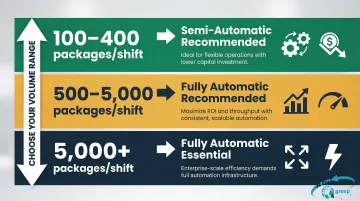
Situational Recommendations:
- If you're strapping fewer than 400 packages per shift with varied sizes → Semi-automatic wins on flexibility and cost-effectiveness
- If you're running consistent, high-volume lines across multiple shifts → Fully automatic delivers measurable ROI through labor savings and throughput gains
- If you're scaling rapidly and unsure → Start with semi-automatic to validate volume and package consistency, then upgrade to fully automatic when sustained volume justifies the investment
Hidden Cost Factors:
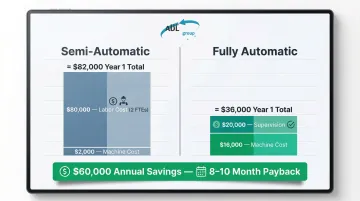
Semi-automatic's lower purchase price can be offset by ongoing labor costs. A $2,000 semi-automatic machine paired with a $40,000/year operator ($18/hour + benefits) costs $42,000 in year one. A $16,000 fully automatic machine that eliminates that operator position costs $16,000 in year one—a 62% difference that widens each subsequent year.
That said, fully automatic's higher upfront cost requires honest ROI modeling before committing. Run the numbers on:
- Current labor hours spent strapping per shift
- Labor rate including benefits
- Annual volume and growth trajectory
- Downtime risk and cost per hour
Example Scenario:
Operation strapping 800 packages per shift, 2 shifts per day, 250 days per year = 400,000 packages annually. Semi-automatic requires 1 operator per shift (2 FTEs total) at $80,000 combined annual cost. Fully automatic reduces this to 0.25 FTE for line supervision ($20,000 annual cost). Annual savings: $60,000. Equipment payback: 8-10 months.
Alliance Packaging Group stocks both semi-automatic and fully automatic strapping machines at factory-direct prices. If you're unsure which fits your operation, their team can work through the numbers with you—volume, floor space, labor structure—and point you to the right machine. Reach them at sales@apg-go.com or 770-309-1012.
Conclusion
Neither machine is universally superior. Semi-automatic strapping suits variable, lower-volume operations — it's more flexible, costs less upfront, and easier to run with a small crew. Fully automatic strapping is built for high-volume, uniform loads where throughput and labor efficiency matter more than adaptability.
Choosing correctly means reduced labor overhead, fewer load-shift incidents during transit, and a packaging line that scales with the business. Choosing poorly means either overspending on automation you can't fully use or under-investing and creating a bottleneck that limits growth.
Before committing to either machine, get clear on four things:
- Daily volume — how many packages are you actually strapping per shift?
- Package consistency — do your load dimensions stay the same, or vary constantly?
- Labor cost per package — what does your current process cost you in person-hours?
- Floor space — do you have room for a fully integrated inline system?
Answer those honestly, and the right choice will follow from the numbers — not from the spec sheet.
Frequently Asked Questions
Frequently Asked Questions
How many packages per shift do I need to justify a fully automatic strapping machine?
Industry benchmarks put the threshold at 500+ packages per shift for fully automatic machines to outperform semi-automatic on ROI. That said, labor cost per unit matters more than speed alone—operations with higher labor rates or multiple shifts may justify automation at lower volumes.
Can a fully automatic strapping machine handle irregular or oddly shaped packages?
Most fully automatic machines are optimized for consistent package dimensions and struggle with irregular shapes. Sensors require predictable package profiles to trigger strapping cycles correctly. Irregular shapes are better handled by semi-automatic machines where operators can manually adjust strap placement and tension.
What is the typical price difference between semi-automatic and fully automatic strapping machines?
Semi-automatic machines range from $1,100–$2,500, while fully automatic systems start at $16,000 and exceed $30,000 for multi-head configurations. For high-volume operations, total cost of ownership—including labor savings—can close that gap with payback periods as short as 8–12 months.
How much floor space does each type of strapping machine require?
Semi-automatic machines have a compact tabletop or standalone footprint (570-1,430mm length), fitting into tight spaces or existing workstations. Fully automatic machines require integration with conveyor systems and significantly more dedicated floor space—typically 3,000mm+ length plus conveyor approach and exit zones.
Can both machine types use the same strapping materials (PP and PET)?
Yes, both types are compatible with polypropylene (PP) and polyester (PET) strapping, though specific models vary on strap width and thickness (typically 3/8"–5/8" for PET, 1/2"–1" for PP). Always verify model specs before ordering consumables.
How do maintenance requirements differ between semi-automatic and fully automatic strapping machines?
Semi-automatic machines have fewer components and no PLC integration, making maintenance straightforward for most in-house teams. Fully automatic machines involve sensors, PLCs, and conveyor systems that typically require more technical expertise and scheduled preventive maintenance to avoid unplanned downtime.