Introduction
Operations managers face a persistent tension: manual strapping feels "good enough" until you actually run the numbers, and most never do. The upfront cost of strapping equipment seems high, while the labor cost of manual strapping stays invisible — buried in weekly payroll. That "low-cost" manual process is often costing thousands of dollars annually through hidden labor, material waste, and injury risk.
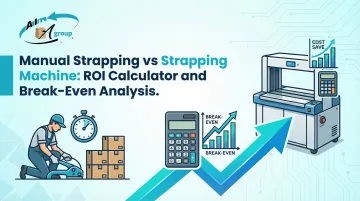
This post provides a practical ROI calculator framework and break-even analysis to help manufacturing, distribution, and warehousing teams make a data-driven decision, not just a features comparison. We'll walk through the real costs of manual strapping, what automation actually returns over time, and a step-by-step formula you can apply to your own operation today.
Key Takeaways
- Manual strapping carries hidden costs in labor burden, injury risk, and material waste that compound over time
- Strapping machines deliver measurable ROI through labor savings, material efficiency, and reduced product damage
- For mid-to-high-volume operations, break-even typically falls within 6–18 months
- ROI depends on machine cost, hourly labor rate, daily volume, and strapping material usage
- The calculator framework below lets you plug in your own numbers and see where you land
Manual Strapping vs. Strapping Machine: Quick Comparison
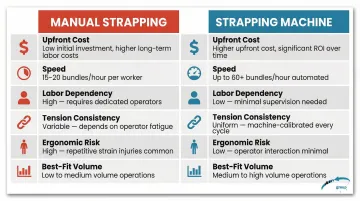
Here's how manual and machine strapping stack up across the factors that matter most to your operation.
| Factor | Manual Strapping | Strapping Machine |
|---|---|---|
| Upfront Cost | $150–$1,400 | $900–$20,000+ |
| Speed | 10–15 straps/min | 20–65 straps/min |
| Labor Dependency | High — continuous operator involvement | Low to none (semi-auto requires feeding; fully auto is hands-free) |
| Strap Tension Consistency | 60% joint efficiency (metal seals) | 80–85% joint efficiency (friction weld) |
| Ergonomic Risk | High — repetitive strain, manual tensioning | Minimal — automation eliminates manual pulling |
| Maintenance Complexity | Low (basic tool upkeep) | Moderate (preventive maintenance extends life 40–60%) |
| Best-Fit Volume Threshold | Under 50 units/day | 50+ units/day (semi-auto); 100+ units/day (fully auto) |
Where Each Method Fits
Manual strapping makes sense when:
- Daily volume stays below 30–50 units
- Operations are remote or mobile (portability required)
- Demand is seasonal or highly variable
- Budget constraints prohibit capital investment
- Backup strapping capability is needed
Strapping machines are justified when:
- Consistent daily output exceeds 75–100 units
- Labor costs are high or skilled operators are scarce
- Product damage from inconsistent tension is a recurring issue
- Conveyor line integration is on the roadmap
- Scaling production is a near-term goal
The True Cost of Manual Strapping
Manual strapping looks cheap on paper. Run the actual numbers, and labor alone often exceeds $10,000 per worker annually — before you factor in injuries, damage claims, and wasted material.
Calculate your annual labor cost:
(Hourly wage + burden rate) × hours spent strapping per day × working days per year
For example, if a packaging operator earns $17.05/hour (the mean wage for packers and packagers according to BLS May 2023 data), and benefits add 29.7% (BLS employer cost data), the loaded hourly cost is $22.11. If that worker spends 2 hours daily on manual strapping across 250 working days, the annual labor cost is $11,055 — just for strapping.
Labor is just the starting point. The downstream costs — damage, injuries, and wasted consumables — compound the problem further.
Inconsistent Tension: The Hidden Damage Tax
Manual strapping with metal seals achieves only 60% joint efficiency, meaning the strap joint is the weak point. Over-strapping damages products; under-strapping causes load shifting in transit. Packaging-related damage costs vary by sector, but the inconsistency itself is the liability — one that automated friction welding (80–85% joint efficiency) eliminates.
Ergonomic and Injury Costs
Manual strapping is physically demanding. Repetitive tensioning, bending, and pulling drive overexertion injuries — and the financial exposure is substantial:
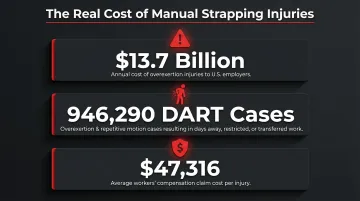
- Overexertion costs U.S. employers $13.7 billion annually (2025 Liberty Mutual Workplace Safety Index)
- The BLS reported 946,290 DART cases from overexertion and repetitive motion in 2023–2024
- The average workers' comp claim runs $47,316 (NSC Injury Facts)
Automating strapping removes the repetitive strain entirely.
Strap Material Waste
Because manual seals are weaker, operators often over-gauge (use thicker, more expensive strap) or apply redundant straps to compensate. Switching to machines with friction weld technology allows down-gauging to lighter, less expensive strap without sacrificing load stability — a material savings that compounds across thousands of units per month.
Opportunity Cost
Every hour spent manually strapping is an hour not spent on quality control, inventory management, or order fulfillment. At $22.11 loaded per hour, even one hour redirected daily adds up to nearly $5,500 in recaptured productive labor per year — per worker.
Strapping Machines: Investment and Long-Term Value
Total Cost of Ownership
Strapping machine TCO includes purchase price, installation, training, annual maintenance, and consumables.
Realistic price ranges:
| Machine Type | Purchase Price | Typical Useful Life |
|---|---|---|
| Semi-Automatic Tabletop | $900–$2,000 | 5–10 years |
| Fully Automatic Arch | $6,000–$10,000 | 10–15 years |
| Fully Automatic Inline/Conveyor | $15,000–$20,000+ | 10–15 years |
High-quality packaging machinery, when properly maintained, has an expected lifespan of 10–15 years. Manufacturers typically provide a one-year warranty.
Labor Savings Equation
One strapping machine can replace the equivalent output of multiple manual operators. Industry benchmarks show:
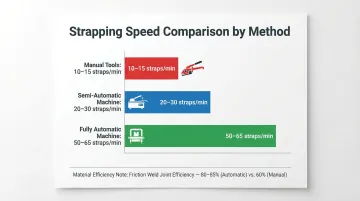
- Manual tools: 10–15 straps/min
- Semi-automatic machines: 20–30 straps/min
- Fully automatic machines: 50–65 straps/min
If a manual operator completes 12 straps/min and a semi-automatic machine completes 25 straps/min, the machine more than doubles throughput — effectively replacing two manual workers.
Material Efficiency Gains
Machines apply precise, calibrated tension every cycle. This reduces strap over-use and minimizes product damage. Friction weld technology achieves 80–85% joint efficiency, allowing operators to use lighter gauge strap. Over 12 months, consumable savings can reach thousands of dollars.
Scalability Factor
Manual strapping costs scale directly with labor — every additional unit requires additional time and headcount. Machine strapping doesn't work that way. The fixed cost spreads across every unit you run, so the per-unit expense drops as volume climbs.
Consider the difference at scale:
- 50 units/day — one manual operator can keep pace
- 200 units/day — labor costs multiply; a machine's fixed cost per unit falls to a fraction of the manual equivalent
This is where the ROI shift becomes hard to ignore. Higher volume accelerates break-even and extends the financial advantage of automation across the machine's full service life.
ROI Calculator and Break-Even Analysis
The ROI Framework
Variable Definitions:
- M = Machine Cost (purchase price)
- L = Annual Labor Savings
- S = Annual Material Savings
- C = Annual Maintenance Cost
Formulas:
- Annual Net Savings = L + S − C
- Break-Even Point (months) = M ÷ (Annual Net Savings ÷ 12)
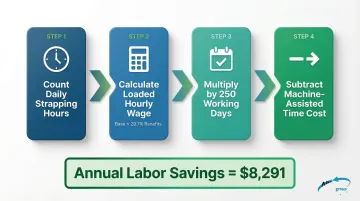
Step 1 — Calculate Your Annual Labor Savings
To find your current labor cost (L):
- Count hours per day spent on manual strapping
- Calculate loaded hourly wage (base wage + 29.7% benefits)
- Multiply by 250 working days/year
Example:
- 2 hours/day × $22.11/hour × 250 days = $11,055/year
If a semi-automatic machine reduces strapping time to 0.5 hours/day:
- 0.5 hours/day × $22.11/hour × 250 days = $2,764/year
Annual Labor Savings (L) = $11,055 − $2,764 = $8,291
Step 2 — Estimate Material and Damage Cost Savings
If manual operators use 10% more strap due to over-tensioning and redundant strapping, and annual strap cost is $3,000:
- Material savings = $3,000 × 10% = $300/year
If inconsistent tension causes 2 damaged shipments per month at $200 each:
- Damage savings = 2 × $200 × 12 = $4,800/year
Total Material and Damage Savings (S) = $300 + $4,800 = $5,100
Step 3 — Factor in Machine and Maintenance Costs
For a $6,000 fully automatic machine with a 10-year useful life:
- Annual amortized cost = $6,000 ÷ 10 = $600/year
Preventive maintenance extends machine life by 40–60%. Budget for routine service (sealer head replacements, annual belt and blade inspection):
- Estimated annual maintenance = $500/year
Annual Maintenance Cost (C) = $500
Alliance Packaging Group's factory-direct pricing typically reduces M by 15–20% compared to distributor markup — shortening break-even by 1–2 months at this volume. Call 770-309-1012 to get a machine quote with your specific M variable.
Step 4 — Calculate Break-Even and ROI
With L, S, and C now established, apply the formula:
- Annual Net Savings = L + S − C
- Annual Net Savings = $8,291 + $5,100 − $500 = $12,891
Break-Even Point (months) = M ÷ (Annual Net Savings ÷ 12)
- Break-Even = $6,000 ÷ ($12,891 ÷ 12) = 5.6 months
Worked Example Summary:
| Variable | Value |
|---|---|
| Machine Cost (M) | $6,000 |
| Annual Labor Savings (L) | $8,291 |
| Annual Material Savings (S) | $5,100 |
| Annual Maintenance Cost (C) | $500 |
| Annual Net Savings | $12,891 |
| Break-Even Point | 5.6 months |
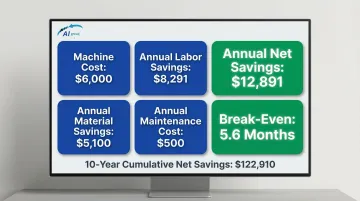
The machine pays for itself before the year is half over. Over a 10-year useful life, cumulative net savings reach $122,910 — roughly 20 times the original purchase price. For most mid-volume shipping operations, that return dwarfs any alternative use of that $6,000 capital.
Choosing the Right Solution: A Decision Framework
Volume-Based Decision Guide
- Fewer than 30–50 units/day: Manual tools remain defensible if demand is variable or budget is constrained
- 75–100 units/day: The ROI case for a semi-automatic machine is typically clear within 12 months
- 200+ units/day: Automation is reliably cost-justified; fully automatic machines deliver the fastest payback
Once you know where your volume falls, the situational fit usually becomes obvious.
Situational Recommendations
Manual strapping works best when:
- Portability is required (remote job sites, field operations)
- Budget constraints prohibit capital investment
- Volume is low or infrequent (seasonal operations)
- Backup strapping capability is needed
A strapping machine makes sense when:
- Labor costs are high or skilled operators are scarce
- Output consistency and product protection are priorities
- Injury risk and workers' comp claims are concerns
- Scaling production is a near-term goal
Run your own numbers using the framework above. For expert guidance and factory-direct pricing on strapping equipment, contact Alliance Packaging Group at 770-309-1012 or sales@apg-go.com.
Frequently Asked Questions
How long does a strapping machine take to pay for itself?
Break-even typically ranges from 6–18 months for mid-to-high-volume operations, depending on labor costs, daily strapping volume, and machine price. Operations strapping 100+ units/day tend to see the fastest payback.
What volume of packages per day justifies buying a strapping machine?
Most industry benchmarks put 75–100 packages/day as the threshold where labor and efficiency savings begin to clearly outweigh the investment. ROI strengthens significantly at higher volumes.
What are the hidden costs of manual strapping that most businesses overlook?
Several costs rarely show up on a manual strapping price tag:
- Labor burden: Benefits add ~30% on top of base wages
- Injury claims: Workers' comp averages $47,316 per ergonomic claim
- Material waste: Over-tensioning and inconsistent application burn through strap faster
- Product damage: Inconsistent tension leads to in-transit failures and returns
Does a strapping machine reduce workplace injuries?
Yes. Automated strapping significantly reduces repetitive strain injuries from manual tensioning, lowering workers' comp risk and reducing productivity loss from fatigue-related errors.
What factors most affect the ROI of a strapping machine?
Four variables drive the calculation: machine purchase price, hourly labor cost (including burden), daily strapping volume, and strap material savings. Of these, labor cost carries the most weight in most operations.
Is it worth upgrading to a fully automatic strapping machine vs. semi-automatic?
Fully automatic machines offer higher throughput and minimal operator involvement but carry a higher upfront cost. They're best suited for operations above 200 units/day or those integrating strapping into conveyor lines.