Introduction
Picture this: A refrigerated warehouse where carton seals peel open during overnight storage. A coastal packaging facility where labels slide off within hours. A food processing plant where HVAC duct tape delaminates, compromising temperature control and product safety.
These aren't hypothetical scenarios—they're costly operational failures that occur daily when facilities use the wrong tape in high-humidity environments. The financial impact shows up as lost product, unplanned downtime, rework labor, and compromised safety compliance.
Humidity is one of the most overlooked factors in industrial tape selection. Many procurement teams treat "industrial-grade" as a stand-in for moisture-resistant—but the two aren't the same.
Standard tapes, even heavy-duty packaging tapes, are engineered for controlled environments around 50% relative humidity and 73°F. Push beyond those conditions, and adhesive chemistry changes dramatically.
This guide covers:
- Why humidity degrades tape performance at the adhesive chemistry level
- What properties separate moisture-resistant tapes from standard options
- The best tape types for wet, cold, and high-humidity environments
- How to apply tape correctly for lasting bonds in challenging conditions
Key Takeaways
- Humidity above 50% RH weakens adhesive bonds by up to 96%, causing delamination and corrosion
- Prioritize acrylic or silicone adhesive chemistry, hydrophobic backings (PE, PVC, aluminum), and temperature stability
- Best tape types by use: butyl (waterproof sealing), acrylic (carton sealing), aluminum foil (HVAC), PVC (electrical), EPDM foam (gaps)
- Proper surface prep (clean, dry, primed) and 10-15 psi application pressure are non-negotiable
- Match tape to your application: food processing, cold storage, and outdoor environments each have distinct requirements
Why High Humidity Is the Enemy of Industrial Tape
Humidity doesn't just make surfaces damp—it fundamentally alters how adhesive tapes perform. Knowing exactly how moisture triggers failure points you toward the right tape before problems start.
The 50% Relative Humidity Threshold
Standard industrial tape testing occurs at controlled conditions: 23°C ±1°C (73°F) and 50% ±2% Relative Humidity. Environments exceeding 50% RH are technically "high humidity" relative to these performance benchmarks.
When humidity rises, the impact is severe. Research on acrylic adhesive systems shows that water exposure can reduce peel adhesion retention to as low as 4% to 63% depending on the substrate. Moisture plasticizes the adhesive, softening it and reducing cohesive strength.
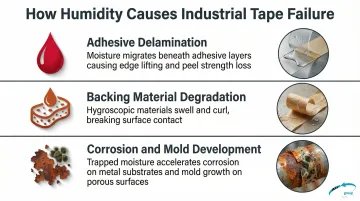
Three Primary Failure Modes
1. Adhesive Delamination Moisture migrates between the adhesive and substrate, creating a weak boundary layer. The result: edge lifting, "whitening" of the bond line, and dramatic loss of peel strength.
2. Backing Material Degradation Hydrophilic backings—standard paper or cloth—absorb airborne moisture, causing swelling and curling that physically breaks surface contact. The tape may look intact while the bond has already failed.
3. Corrosion and Mold Development On metal substrates, trapped moisture accelerates corrosion beneath the tape. On porous surfaces, the adhesive layer can harbor mold unless formulated with biocides—a critical concern in food processing and pharmaceutical facilities.
Understanding Protection Ratings
Protection ratings vary widely across industrial tape products. These three classifications define what a tape can actually handle:
- Moisture-Resistant: Withstands intermittent exposure to high humidity but not direct water contact
- Water-Resistant: Resists splashes and brief liquid water contact without immediate failure
- Waterproof: Provides complete barrier to liquid water and vapor, suitable for submersion or critical sealing (look for UL 181B-FX listings)
Key Properties to Look for in Humidity-Resistant Industrial Tape
Not all tapes fail the same way in humid conditions — and knowing why helps you avoid costly re-application. The right choice comes down to adhesive chemistry, backing material, and how well those two interact under sustained moisture exposure.
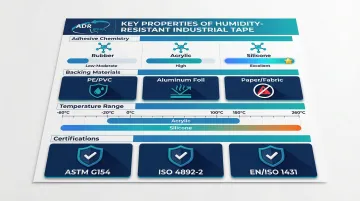
Moisture-Resistant Adhesive Chemistry
The chemical composition of the pressure-sensitive adhesive (PSA) dictates behavior in humid conditions:
| Adhesive Type | Humidity Resistance | Tack Profile | Best Use Case |
|---|---|---|---|
| Rubber-Based | Low to Moderate | High Initial Tack | Indoor stable environments; vulnerable to moisture degradation |
| Acrylic | High | Progressive Bond | Long-term humid applications; builds 90% strength in 24 hours, 100% in 72 hours |
| Silicone | Excellent | Low Initial Tack | Extreme temperature and humidity cycling (-100°F to 500°F) |
Acrylic adhesives exhibit "progressive bonding": they strengthen over time rather than degrading. This makes them the better choice for long-term durability in humid warehouses and distribution centers.
Hydrophobic Backing Material
The backing layer determines whether moisture penetrates the tape structure:
- Polyethylene (PE) & PVC: Inherently hydrophobic films that resist moisture absorption and maintain dimensional stability
- Aluminum Foil: Provides near-perfect moisture vapor barrier — the standard for HVAC applications
- Paper/Fabric: Unsuitable for high humidity unless heavily treated; these materials are hygroscopic and prone to swelling
Backing material handles surface moisture — but adhesive chemistry has to hold up through the temperature swings that often accompany it.
Temperature Stability in Humid Environments
High-humidity environments rarely stay at a steady temperature. Cold storage cycling, outdoor seasonal shifts, and steam in food processing all demand that the adhesive maintain cohesion without softening or embrittling.
Performance Ranges:
- Silicone adhesives: -60°F to 400°F (-50°C to 204°C)
- Acrylic adhesives: -20°F to 200°F (-29°C to 93°C)
- Standard PVC tapes: 32°F to 104°F (0°C to 40°C)
Thermal cycling causes condensation, which can freeze and expand within the bond line or act as a barrier to adhesion. Only high-performance acrylics or silicones maintain bond strength after repeated cycling.
Vapor Barrier and Anti-Corrosion Properties
For tapes applied to metal surfaces in humid environments — pipes, ducts, frames — vapor barrier functionality is critical. Trapped moisture under non-barrier tape accelerates surface corrosion.
Three things to confirm before specifying a tape for metal surfaces:
- UL 181B-FX listings on foil and butyl tapes validate the tape for sealing flexible air ducts and connectors
- Butyl rubber adhesives provide watertight, pressure-resistant seals that are also mold-resistant
- Product spec sheets should explicitly state "vapor barrier" or "moisture barrier" — not just "water-resistant"
UV and Ozone Resistance (Outdoor Applications)
Outdoor high-humidity applications — coastal warehouses, outdoor HVAC units, roofing — expose tape to UV degradation. Tapes that resist humidity but not UV will still fail prematurely outdoors.
Key certifications to verify:
- ASTM G154 (fluorescent UV testing)
- ISO 4892-2 (xenon arc weathering)
- EN/ISO 1431 (ozone resistance for rubber-based materials)
These standards simulate accelerated weathering to predict long-term performance in combined outdoor and humid conditions.
Best Industrial Tape Types for High-Humidity Conditions
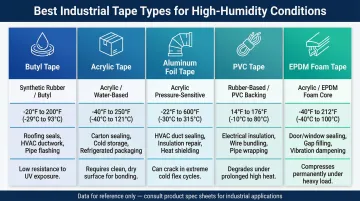
Use this as a quick reference for the most common humidity-resistant tape types, covering composition, performance specs, ideal applications, and limitations.
Butyl Tape
Composition: Rubber-butyl adhesive on flexible backing
Performance:
- Service temperature: -20°F to 200°F (-29°C to 93°C)
- Remains flexible and airtight under sustained moisture exposure
- Provides instant water-resistant grip
Ideal Applications:
- Roofing and flashing
- HVAC sealing
- Window and door perimeters
- Pipe wrapping
Limitations: Lower resistance to solvents; not suitable for high-temperature applications above 200°F
Acrylic-Based Tape (Including Double-Sided)
Composition: Acrylic adhesive on PE, PVC, or foam backing
Performance:
- Bond strength increases over 72 hours
- Resists moisture-induced softening
- Excellent resistance to oxidation and UV
Ideal Applications:
- Carton sealing in refrigerated distribution
- Panel bonding in food & beverage processing
- General packaging in high-humidity warehouses
Note: Rubber-based packaging tapes degrade in sustained humidity, while acrylic adhesives strengthen over time — making acrylic the most versatile choice for humid industrial environments.
Aluminum Foil Tape
Composition: Dead-soft aluminum backing with aggressive acrylic or butyl adhesive
Performance:
- Complete vapor barrier
- Resists corrosion
- Strong bond on irregular or textured metal surfaces
- UL 181B-FX listed options available
Ideal Applications:
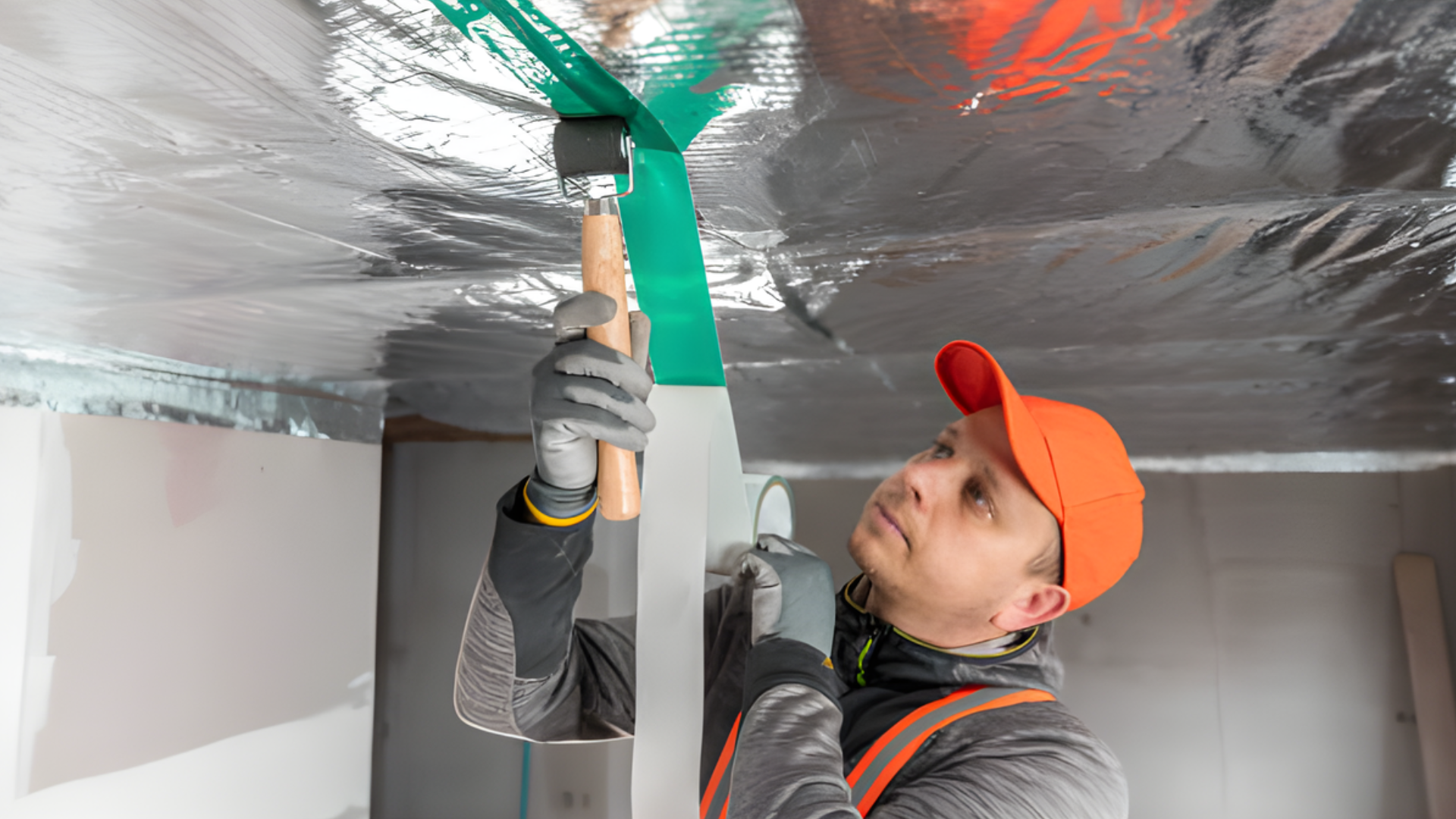
- HVAC duct sealing
- Pipe insulation jacketing
- Vapor barrier applications
- Heat shielding
Note: Acts as both a thermal and moisture barrier simultaneously, which makes it especially practical for HVAC and construction applications where both concerns overlap.
PVC Tape
Composition: Polyvinyl chloride backing with rubber or acrylic adhesive
Performance:
- Application temperature: 14°F to 176°F (-10°C to 80°C)
- Inherently hydrophobic backing
- Good for moderate humidity
Ideal Applications:
- Cable insulation
- Wire bundling
- Surface protection in damp industrial environments
Limitations: Can become brittle in cold weather; may lose adhesion at extreme temperature swings. Best for consistent-temperature humid settings.
EPDM Foam Tape
Composition: Ethylene propylene diene monomer closed-cell foam
Performance:
- Resists water, UV, and ozone
- Compresses to form weathertight seal
- Excellent compressibility on uneven surfaces
Ideal Applications:
- Window and door weatherstripping
- Automotive weatherproofing
- HVAC cabinet sealing
Note: The closed-cell foam structure prevents water absorption while conforming to irregular surfaces, a combination that rigid tape types can't replicate.
Alliance Packaging Group stocks humidity-resistant tapes from trusted brands including 3M and Intertape — covering all five types above — with nationwide just-in-time delivery for procurement teams sourcing from a single supplier.
Industry-Specific Tape Recommendations for Humid Environments
Food & Beverage and Cold Chain
Recommendation: Acrylic-based carton sealing tapes work best for refrigerated warehousing and food processing environments, where humidity from temperature cycling and wash-down procedures is constant.
Critical Compliance: Tapes used in direct or indirect food-contact environments must comply with FDA 21 CFR 175.105 standards. Verify compliance on the product's Technical Data Sheet — as the buyer or packaging manufacturer, confirming this falls on you, not the tape supplier.
Acrylic adhesives use progressive bonding — the seal strengthens over time as the adhesive cures against the surface — which reduces carton failure rates during cold chain transit and storage.
Manufacturing and Distribution Warehouses
Coastal facilities and warehouses without climate control regularly see elevated ambient humidity during summer months. Standard rubber-based tapes soften and lose tack above 70–80% RH, causing seal failures mid-transit.
Switching from rubber-based to acrylic-adhesive carton sealing tapes is often the highest-impact change a facility can make — reducing re-taping labor and cutting product damage claims without any process overhaul. Alliance Packaging Group works with distribution and manufacturing customers nationwide to match tape specifications to their environmental conditions.
HVAC, Construction, and Outdoor Industrial
The right tape depends on the specific application. Key recommendations:
- Waterproof sealing: Butyl tape for joints, seams, and penetrations
- Duct and insulation work: Aluminum foil tape with UL 181B-FX listing
- Gap sealing: EPDM foam tape for weatherstripping and enclosures
For outdoor coastal and tropical environments, verify UV-resistance ratings before sourcing. Combined sun and humidity exposure accelerates adhesive breakdown in standard variants — UV-resistant options are not optional in these conditions.
Application Best Practices for Maximum Performance in Humid Conditions
Even the best moisture-resistant tape will fail on a contaminated, wet, or oily surface. Getting the application right matters as much as choosing the right tape.
How to Prepare Surfaces Before Applying Tape
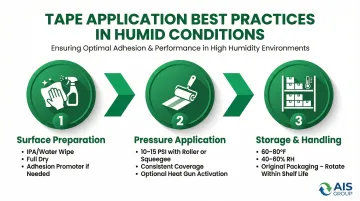
Surfaces must be cleaned, dried, and (if necessary) primed before tape application.
Step-by-step prep sequence:
- Wipe the surface with a 50:50 isopropyl alcohol (IPA) and water mixture
- Allow to dry fully — even invisible condensation prevents bonding
- Apply adhesion promoter for porous or heavily textured substrates, if needed
For oily surfaces, use heptane-based cleaner first, followed by IPA wipe.
Apply with Firm, Consistent Pressure
Air pockets between tape and substrate allow moisture to infiltrate and undermine the bond.
Application technique:
- Use a roller or squeegee tool to apply 10-15 psi of pressure across the full tape length
- Hand pressure is often inconsistent and insufficient
- For critical seals, apply heat using a heat gun to activate the adhesive more fully (where tape type permits)
Proper pressure application maximizes contact area, improving peel strength and sealing out moisture.
Storage and Handling of Tape Inventory
Correct application technique only matters if the tape itself is still good. Rolls stored in warm, humid conditions can partially cure, lose tack, or develop adhesive migration before they're ever used.
Standard storage conditions:
- Store between 60° and 80°F (16° to 27°C)
- Keep relative humidity between 40% and 60%
- Leave rolls in original packaging to protect edges from contamination
- Rotate stock and use within manufacturer's shelf life (typically 12–24 months)
When in doubt, test a small section of tape from an older roll before committing it to a critical seal.
Frequently Asked Questions
What is the best tape for high-moisture industrial environments?
Acrylic-based tapes and butyl tape are the top choices depending on application. Acrylic excels for carton sealing and bonding, while butyl is best for waterproof gap and joint sealing. Match tape to your specific substrate and exposure level.
Are there eco-friendly options for humidity-resistant tapes?
Standard water-activated kraft tape is not suitable for high-humidity environments without a reinforced, moisture-resistant variant. For humid conditions, acrylic tapes with recycled content backings offer the best balance of environmental impact and moisture performance.
How do I know if my current tape is failing because of humidity?
Common failure signs include lifting edges, cloudy or bubbled adhesive, tape sliding under light lateral pressure, or visible residue left on the surface after removal. If these occur consistently in humid areas but not in dry zones, humidity is the likely cause.
What is the difference between water-resistant and waterproof tape?
Water-resistant tapes handle brief or incidental moisture exposure but eventually fail with prolonged contact. Waterproof tapes (like butyl or aluminum foil) maintain a continuous moisture barrier even under standing water or submersion. The distinction matters for sealing vs. bundling applications.
Can standard packaging tape be used in humid warehouse conditions?
Standard rubber-based packaging tape is not recommended for sustained humidity above 70-80% RH. It softens, loses tack, and causes carton seal failures during transit. Acrylic-based carton sealing tape is the appropriate substitute for humid warehouses.
How should industrial tape rolls be stored to prevent moisture damage before use?
Keep tape rolls in their original packaging and store them within these conditions:
- Temperature: 60–80°F
- Humidity: 40–60% RH
- Away from direct sunlight
Improper storage can pre-cure adhesive or deform the backing before application.
Need help selecting the right humidity-resistant tape for your facility? Alliance Packaging Group's team can match you with the right tape for your environment and volume needs. Call 770-309-1012 or email sales@apg-go.com for recommendations and volume pricing.