Introduction
Most operations managers don't think about strapping machine lifespan until something breaks. By then, the cost isn't just a repair bill — it's unplanned downtime, expedited replacement orders, and a line that's standing still.
How long a strapping machine lasts depends on the machine type, how hard it runs, and how consistently it's maintained. Many operations either overestimate longevity without intervention or underinvest in maintenance until a breakdown forces a costly replacement. According to industry data, operator error accounts for 21.1% of packaging machine downtime — meaning human factors alone can significantly compress a machine's useful life.
This article breaks down expected lifespan by machine type, the variables that compress or extend that range, and the maintenance practices that have the greatest impact on longevity.
Key Takeaways
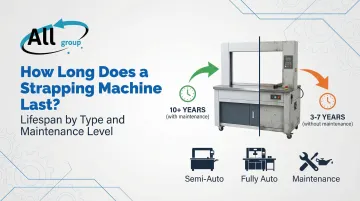
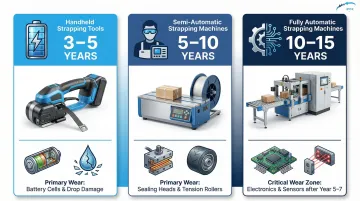
- Handheld strapping tools typically last 3–5 years; semi-automatic machines 5–10 years; fully automatic machines 10–15 years under normal conditions
- Maintenance level is the single biggest variable—a neglected machine can fail in half its rated lifespan
- Four factors compound wear beyond machine type: usage intensity, environment, operator behavior, and strap material compatibility
- Catching end-of-life warning signs early saves money; proactive parts replacement costs far less than emergency machine replacement
- Lifespan is always a range — design, duty cycle, and daily treatment determine where your machine lands within it
Expected Lifespan by Strapping Machine Type
The lifespan ranges below assume proper maintenance, appropriate duty cycles, and compatible strapping materials. Real-world results vary — these figures are a practical starting point, not a guarantee.
Handheld Strapping Tools
Handheld strapping tools typically last 3–5 years under normal operating conditions. This category has the shortest lifespan because portability means exposure to drops, variable environments, and more operator-dependent wear patterns. Battery-powered models face additional constraints from power system degradation.
Battery cells are often the first component to degrade. Lithium-ion batteries typically drop below 80% capacity after 300 to 500 full charge cycles. Replacing the battery pack often extends the tool's useful life without full replacement. For example, manufacturers recommend replacing 18V/4.0Ah Li-Ion batteries when capacity drops below approximately 60% (2.4 Ah).
Semi-Automatic Strapping Machines
Semi-automatic machines typically last 5–10 years under rated operating conditions. They're designed for moderate-volume, operator-assisted use — with components rated for intermittent cycles, not continuous production runs.
Key vulnerability: Semi-automatic machines are often pushed beyond their intended duty cycle in growing operations. Running a semi-automatic machine at volumes suited for a fully automatic model accelerates wear on:
- Sealing heads
- Tension rollers
- Feeding mechanisms
This compression pushes lifespan toward the lower end of the range. Alliance Packaging Group provides access to strapping machines across volume tiers, helping operations match equipment capacity to actual demand rather than running undersized machines into early failure.
Fully Automatic Strapping Machines
Fully automatic machines typically last 10–15 years under rated operating conditions. The longer lifespan reflects how these machines are built: heavier-gauge frames, redundant sensors, and component layouts designed for field servicing. They're rated for continuous, high-speed operation in ways semi-automatic models simply aren't.
High-speed capabilities:
| Manufacturer | Model | Rated Speed | Application |
|---|---|---|---|
| Signode | SGP Series | Up to 65 straps/min | High-volume distribution, food |
| PAC Strapping | SM65 | Up to 65 straps/min | E-commerce, logistics |
| Fromm | FSM-50 | Up to 65 straps/min | Graphics, printing |
| Dynaric | DF-11A | Up to 37 straps/min | Heavy-duty carton sealing |
Fully automatic machines tend to outlast their mechanical components — it's the electronics that shorten their service life. Sensor calibration drift and control system wear become the primary concerns after year 5–7, which is why maintenance shifts from mechanical to software and electronics-focused as these machines age.
What Determines How Long a Strapping Machine Lasts
Lifespan figures by machine type describe a potential range, not a guarantee. The actual outcome depends on several interacting variables that operators and procurement teams should understand before specifying equipment or building a maintenance schedule.
Machine Design and Build Quality
Machines with fewer moving parts, higher-grade sealing components, and modular architectures that allow field replacement of worn sub-assemblies inherently last longer—and the initial purchase price often reflects this.
Choosing equipment rated for your actual volume from a reputable supplier reduces the risk of running an undersized machine into early failure. Alliance Packaging Group provides access to a range of strapping machine types across volume tiers, including the Strapack SQ-800 fully automatic system designed for high-volume operations.
Operational Duty Cycle
Duty cycle refers to how many strapping cycles per shift, how many shifts per day, and whether the machine operates continuously or in bursts. A machine operating at 80% of its rated cycle capacity daily will age measurably faster than one operating at 40%.
Example: Machines rated for up to 65 straps per minute represent the mechanical maximum. Continuous operation at this speed accelerates wear on feed belts and tension wheels. Some heavy-duty models are specifically rated for 24/7 use, while entry-level models are not.
Strap Material Compatibility
Using strap materials incompatible with the machine's sealing and tensioning components causes accelerated wear. Running steel strapping through a machine designed for polypropylene or polyester will damage tension wheels and cutting blades rapidly.
Each machine specifies a compatible range of strap widths (typically 5.0mm to 15.5mm), thickness (0.35mm to 0.90mm), and break strength (47 kg to 580 kg).
Using strap materials outside the machine's specified range can result in strap breakage during tensioning or sealing problems. Alliance Packaging Group carries polypropylene and polyester strapping consumables, ensuring material consistency that reduces unnecessary wear on feeding and sealing systems.
Environmental Conditions
Where a machine operates directly shapes how long it lasts:
- Dust and particulates accumulate in feeding mechanisms and sealing heads
- High humidity accelerates corrosion on metallic components
- Temperature extremes affect lubricant viscosity and electronic component behavior
IP ratings indicate environmental protection:
- IP56-rated machines (like the Signode SGP Inox) are protected against high-pressure water jets and can operate in meat, poultry, and seafood processing
- IP20-rated stainless models offer rust resistance but are explicitly non-washdown units
The right IP rating for your environment determines baseline maintenance frequency. Machines in food processing, outdoor logistics, or dusty industrial settings need more frequent service intervals than those in climate-controlled facilities. Some manufacturers also recommend optional motor cooling fans when operating above 40°C (104°F).
Operator Behavior and Training
Operator behavior is one of the most overlooked lifespan variables. Research shows operator error accounts for 21.1% of packaging machine downtime.
Common operator-caused damage:
- Drops and impacts on handheld tools
- Forcing jammed mechanisms with tools instead of following proper clearing protocols
- Incorrect strap threading
Trained operators who follow jam-clearing protocols and thread strap correctly cause far less cumulative damage than untrained ones — manufacturers explicitly warn that forcing jammed mechanisms with tools damages sealing components and voids service agreements.
How Maintenance Level Directly Affects Lifespan
Maintenance is the primary lever operators have to influence machine lifespan. Two identical machines—one with a formal maintenance program, one without—can diverge by years in service life, with discipline accounting for most of that gap, not the hardware itself.
Daily and Weekly Maintenance Tasks
These tasks prevent the most common failure modes and take only minutes:
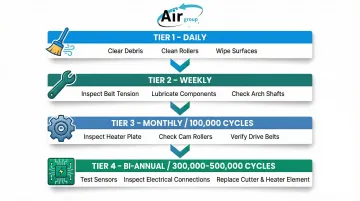
Daily:
- Clear strap dust and debris from cutters using compressed air
- Clean feeding rollers and strap guides
- Wipe down surfaces
- Remove plastic residue
Weekly:
- Inspect tension settings
- Lubricate frequently cycling components (front bars, press bars, rear bars)
- Check arch shafts
These tasks prevent jams that lead operators to force mechanisms. Forced mechanisms are where most mechanical damage starts, and it's almost always avoidable.
Monthly and Bi-Annual Maintenance Tasks
Deeper maintenance tasks appropriate to monthly and bi-annual intervals:
Monthly (or every 100,000 cycles):
- Inspect and clean both sides of heater plate with fine sandpaper
- Check cam rollers of sealing head for resistance
- Verify belt and gear condition
- Clean tension roller debris
Bi-Annual (every 300,000-500,000 cycles):
- Test all sensors for accuracy
- Perform electrical connection inspections
- Check/replace heater element
- Replace strap cutter in sealing head
- Inspect wiring connectors
Bi-annual deep-service inspections are particularly critical for fully automatic machines where electronic drift accumulates gradually and is not visible in daily use.
Why Preventive Maintenance Pays for Itself
A machine with no formal maintenance program versus one with a documented preventive schedule can see a lifespan difference of 2–4 years depending on machine type and usage intensity. That gap represents real capital: replacing a mid-range automatic strapper costs far more than the cumulative cost of routine service over the same period.
Cycle-based replacement example: Manufacturers mandate replacing needle free-wheelings on battery tools every 80,000 cycles to prevent motor shaft damage. This proactive replacement prevents catastrophic failure and extends overall tool life.
Using the Right Consumables and Replacement Parts
Timely replacement of worn components—sealing blades, tension wheels, heater elements—before they fail completely prevents cascading damage to adjacent components.
Heater plate maintenance: Too much debris on both sides of the heater plate directly causes sealing failures. Regular cleaning with fine sandpaper (once cooled) maintains seal integrity.
Using strapping material from a verified supplier ensures consistent dimensions and surface quality—inconsistent strap is a common source of feeding jams and accelerated wear on tension and sealing components. Alliance Packaging Group stocks polypropylene and polyester strapping to support consistent, reliable machine performance.
Warning Signs Your Strapping Machine Is Near End-of-Life
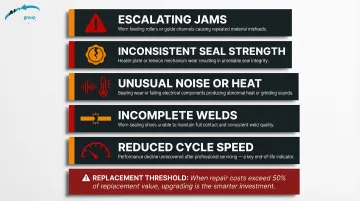
End-of-life rarely arrives without warning. Machines signal failure weeks or months in advance through escalating symptoms — catching them early means a planned replacement instead of unplanned downtime.
Key warning signs to monitor:
- Jams that were once rare become routine — worn feeding rollers or guide channels are usually the cause
- Seal strength drops or tension becomes inconsistent, pointing to heater plate or tension mechanism wear
- New noise, vibration, or heat from the motor or sealing head signals bearing wear or failing electrical components
- Incomplete welds or strap material squeezing out sideways, typically from worn sealing shoes
- Cycle speed falls below the machine's rated output and doesn't recover after servicing
The Repair-vs-Replace Decision
Industry standards provide clear guidance: equipment should be replaced when repair costs exceed 50% of replacement cost, or when multiple systems are failing simultaneously. Some frameworks use a 65% threshold for economical repairs.
Additional replacement triggers:
- Component obsolescence prevents parts sourcing
- Old PLCs or proprietary controllers are no longer supported
- Persistent breakdowns despite regular maintenance
Common Misconceptions About Strapping Machine Lifespan
Misconception 1: "The published lifespan is a guarantee"
Manufacturer lifespan figures assume rated operating conditions and consistent maintenance. They are not warranties. Standard warranties typically cover non-wear parts for 6 months to 2 years and explicitly exclude wear items like:
- Rollers and belts
- Heating elements
- Drive motors
Operating above rated duty cycle, skipping maintenance, or using incompatible strapping materials can cut actual lifespan to a fraction of the published figure.
Misconception 2: "More expensive machines always last longer"
Cost correlates with capability and build quality, but an over-specified machine that sits largely idle accumulates calendar-age degradation without the benefit of high cycle counts to justify the investment.
Calendar-age degradation includes:
- Lubricant breakdown
- Seal material aging
- Electronic component drift
Matching machine capacity to your actual throughput volume will extend service life more reliably than buying the highest-rated unit on the market.
Misconception 3: "If it's still running, it doesn't need service"
Many failure modes develop silently:
- Heater plate residue reduces seal integrity before it causes visible jams
- Bearing wear increases motor load before the motor fails
- Sensor drift affects accuracy gradually
Waiting for a visible malfunction means maintenance is reactive rather than preventive. By that point, secondary damage has usually set in — often to components more expensive than the original failure point.
Frequently Asked Questions
How long does a strapping machine last?
Handheld tools typically last 3–5 years, semi-automatic machines 5–10 years, and fully automatic machines 10–15 years. Maintenance level is the primary variable within those ranges—a well-maintained machine can exceed its rated lifespan, while a neglected one may fail in half the time.
What is the lifespan of a semi-automatic strapping machine?
Semi-automatic machines typically last 5–10 years under rated operating conditions. Running them above their rated duty cycle shortens that window considerably, with sealing heads and tension mechanisms showing wear first.
How can I extend the life of my strapping machine?
Follow a documented maintenance schedule covering daily cleaning, weekly lubrication and tension checks, monthly seal head inspection, and bi-annual deep service. Use manufacturer-recommended strapping materials and train operators on proper jam-clearing procedures to avoid avoidable mechanical damage.
What are the signs that a strapping machine needs to be replaced?
Key indicators include escalating jam frequency, declining seal strength or inconsistent tension, unusual noise or heat from motor components, and repair costs approaching 50% of replacement cost. Multiple simultaneous system failures or component obsolescence also signal replacement time.
How often should a strapping machine be serviced?
Clear debris daily, check tension and lubrication weekly, and inspect the seal head monthly. A full service—covering sensors, electrical connections, and component replacement—should happen twice a year. High-volume or harsh-environment operations warrant more frequent checks at each interval.
Does the type of strapping material affect machine lifespan?
Yes. Using incompatible strap materials—wrong type, width, or thickness for the machine's specifications—causes accelerated wear on tension wheels, cutting blades, and sealing components. Consistently using manufacturer-recommended materials within specified ranges is one of the simplest ways to protect machine longevity and prevent premature failure.