Introduction
Every warehouse and distribution manager faces a critical operational question: how fast does your strapping machine actually work, and is it keeping up with your line? The answer comes down to throughput—measured in pallets per hour—the single most actionable metric for matching strapping equipment to production demands. Run too slow and you bottleneck the palletizing line. Run faster than needed and you tie up capital that could work elsewhere.
Not all strapping machines are equal. Throughput varies dramatically — from fewer than 5 pallets per hour with manual handheld tools to 60+ with fully-automated inline systems. Choosing the wrong type creates labor inefficiencies and shipping delays that cascade into missed departure windows.
This guide covers each major strapping machine type with its realistic pallets-per-hour range, the variables that shift those numbers, and a straightforward framework for matching equipment to your actual volume.
Key Takeaways
- Strapping machine throughput ranges from 2–5 pallets per hour for manual handheld tools to 60+ for fully-automated inline systems
- Four main types exist: manual/handheld, semi-automatic, automatic, and fully-automated—each suited to different daily pallet volumes
- Real-world output varies by straps per pallet, operator speed, strap material, pallet size, and system integration
- Sizing to peak capacity without accounting for actual floor volume leads to either underuse or costly bottlenecks—match machine type to your realistic daily throughput, not your theoretical maximum
What Is a Strapping Machine and Why Does Throughput Matter?
A strapping machine is a packaging tool that applies plastic (polypropylene or polyester) or steel strapping around palletized loads to secure them for transport and storage. These machines range from handheld manual tools to fully-automated inline conveyor systems, and are used across manufacturing, distribution, warehousing, and logistics.
Material choice matters: polyester (PET) strapping offers comparable tensile strength to steel with superior shock absorbency, while polypropylene (PP) is lighter and more cost-effective for medium loads.
Throughput—pallets per hour—is the critical performance metric because it directly determines whether your strapping station keeps pace with upstream palletizing or creates a downstream bottleneck. Manufacturers publish specs in straps-per-minute, but you need to translate that into pallets-per-hour based on your straps-per-pallet requirements. A machine rated at 60 straps per minute sounds fast, but if each pallet needs 3 straps, your effective throughput drops to 20 pallets per hour—and that's before accounting for operator delays or conveyor indexing.
That gap compounds quickly when throughput is mismatched. Under-capacity machines create line stoppages and force overtime labor. Over-specified machines tie up capital unnecessarily. In the packaging sector, frequent short disruptions can cost $13,000 to $39,000 per hour in lost production—which is why getting your throughput target right before selecting a machine is worth the time investment.
Strapping Machine Types and Pallets-Per-Hour Benchmarks
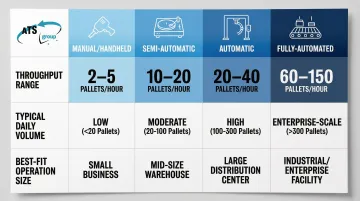
This is the core reference section of the guide. Throughput benchmarks below are based on typical operating conditions—actual numbers vary based on straps per pallet, operator proficiency, and integration setup.
| Machine Type | Throughput Range | Typical Daily Volume | Best-Fit Operation Size |
|---|---|---|---|
| Manual/Handheld | 2–5 pallets/hour | <50 pallets/day | Low-volume, seasonal, spot-strapping |
| Semi-Automatic | 10–20 pallets/hour | 50–200 pallets/day | Medium-volume, box strapping, wet environments |
| Automatic | 20–40 pallets/hour | 200–500 pallets/day | High-volume, variable heights, heavy loads |
| Fully-Automated | 60–150 pallets/hour | 500+ pallets/day | Continuous production, uniform products, conveyor-fed |
Manual and Handheld Strappers
Manual and handheld strappers require a worker to loop the strap around the pallet, tension it, seal it with a crimping or heat-seal tool, and cut. Every step is operator-dependent.
Battery-powered electric tools automate the tensioning and sealing steps, but strap placement remains manual throughout.
Realistic Throughput:
- Manual tensioners: Approximately 2–3 pallets per hour (roughly 20 pallets per 8-hour shift)
- Battery-powered electric tools: Approximately 4–5 pallets per hour (75–100 pallets per 8-hour shift)
Battery-operated handheld tools can handle up to 800 cycles per charge, but throughput remains limited by how fast operators can position straps and move between pallets.
Best-Fit Scenarios:
- Operations strapping fewer than 50 pallets per day
- Facilities with limited floor space or seasonal volume spikes
- Cardboard baling, spot-strapping, or supplemental use cases
- Businesses where equipment investment is hard to justify
Key Limitations:
- Operator fatigue leads to inconsistent strap tension
- Throughput ceiling is hard to increase without adding labor
- Repetitive manual material handling contributes significantly to musculoskeletal disorders, increasing injury risk as volume grows
- Manual strapping becomes operationally inefficient when volumes exceed 50 pallets per day
Semi-Automatic Strappers
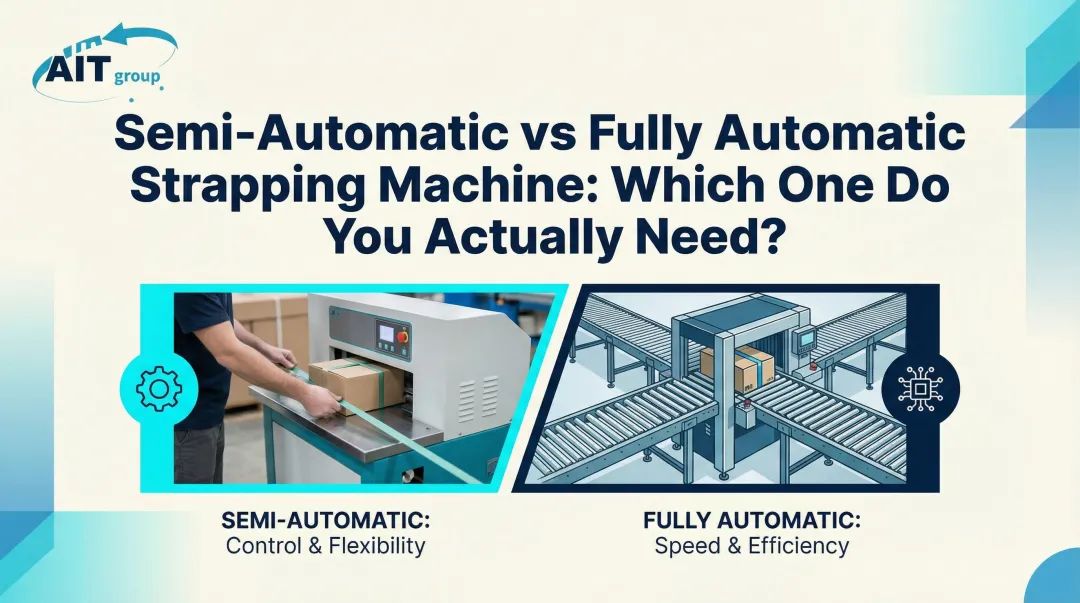
A semi-automatic strapper is a table-height machine that automates tensioning and sealing. The operator still feeds the strap through the arch or around the load manually before the machine fires.
Once triggered, the machine tensions, seals, cuts, and refeeds the strap for the next cycle. Strap placement remains manual; only the labor-intensive tension and seal steps are automated.
Realistic Throughput: Machines are rated at up to 11 straps per minute in ideal conditions. With typical 2–4 straps per pallet, this translates to:
- 10–20 pallets per hour depending on operator speed and straps-per-pallet count
- Daily capacity: 80–160 pallets per 8-hour shift
Best-Fit Scenarios:
- Operations running 50–200 pallets per day
- Box-strapping lines, direct mail, meat packing
- Wet environments where stainless steel tops provide durability
- Side-seal and ¾-arch variants for specialized load types
Key Limitations:
- Throughput is still tied to operator speed and strap placement accuracy
- Machines require the operator to stay at the station
- Customization options (arch configurations, side-seal) increase cost and complexity
- Routine maintenance is critical—daily cleaning, weekly tension checks, monthly sealing mechanism inspection
Automatic Strappers
An automatic strapper features a full arch that wraps, tensions, seals, and refeeds the strap with minimal operator input. The operator positions the package under the arch and triggers the cycle via button or foot pedal. From there, the machine handles the complete strap cycle, requiring only one person to load and unload.
Realistic Throughput: Machines are rated at up to 50–65 straps per minute. With typical 2–4 straps per pallet:
- 20–40 pallets per hour in real-world conditions
- Daily capacity: 160–320 pallets per 8-hour shift
- Operations processing over 100 products per day can easily justify this machine type
Best-Fit Scenarios:
- Operations packaging over 200 pallets per day
- Facilities with variable package heights (height-adjustable models accommodate different load sizes)
- Heavy or awkward loads requiring consistent high-tension strapping (awning manufacturers, building materials)
- Environments where labor reduction is a primary ROI driver
Key Limitations:
Higher upfront cost requires throughput volume to justify the investment. Side-seal variants suited for frozen food and wet environments push cost higher. Unlike base semi-autos, these machines are built for continuous operation and reward facilities that can commit to proper maintenance schedules.
Fully-Automated Strapping Systems
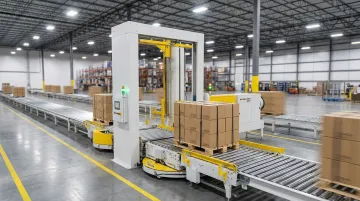
A fully-automated strapping system is an inline conveyor-fed system that requires no operator involvement during the strapping cycle. Pallets or packages are conveyed into the machine, strapped at programmed intervals, and conveyed out. Optional features include side compression, top compression (up to 2,500 kg), and multi-strapper simultaneous configurations.
Realistic Throughput:
- 60–150 pallets per hour for standard single-head systems
- Up to 300 pallets per hour for specialized end-sealing systems with 1–2 straps
- Top-seal systems: up to 120 pallets/hour
- Side-seal systems: up to 72 pallets/hour with double parallel straps
Best-Fit Scenarios:
- High-volume production environments requiring consistent output at scale (500+ pallets/day)
- Operations with uniform product dimensions fed via conveyor
- Manufacturers of long or heavy products (flooring, insulation, printing bundles, lumber)
- Facilities where labor elimination is the primary justification
Key Limitations:
- Highest upfront investment—base pricing starts around $16,000, with specialized automated systems exceeding $50,000
- Requires consistent product size and feed method
- Installation and commissioning complexity
- Every application requires individual assessment and authorized specialist quoting
- Customization — side compression, multi-head configurations — can push costs well above base pricing
What Affects Your Actual Pallets-Per-Hour Rate?
Manufacturer throughput specs represent ideal-condition maximums—real-world output is almost always lower. The throughput gap is why the number on the spec sheet rarely matches what operations teams measure on the floor. Four variables account for most of the difference.
Straps Per Pallet
Strap count per pallet is the most direct throughput multiplier. A machine rated at 30 straps per minute runs very differently when each pallet requires 2 straps versus 6.
Example: A machine rated at 60 straps/minute theoretically delivers 3,600 straps/hour.
- With 2 straps per pallet: 1,800 pallets/hour (theoretical maximum)
- With 3 straps per pallet: 1,200 pallets/hour
- With 6 straps per pallet: 600 pallets/hour
In reality, conveyor indexing and photo-eye delays reduce these numbers further, typically by 20–40%.
Operator and Integration Factors
- Semi-automatic machines: operator positioning and trigger speed cap throughput regardless of machine rating
- Fully automated systems: conveyor feed rate and spacing logic set the ceiling
- A fast machine paired with a slow feed process delivers semi-automatic results
Pallet and Load Variables:
- Pallet height, load stability, and strap positioning requirements all affect cycle time
- Unstable or irregular loads may require additional straps or slower tensioning
- Corner boards and edge protectors improve load integrity but add time to each cycle
Strapping Material:
- PP strapping is lighter and faster to apply
- PET strapping requires about 30% more sealing pressure and may slow cycle time
- Coil size affects changeover frequency and total hourly output
How to Choose the Right Strapping Machine for Your Throughput Needs
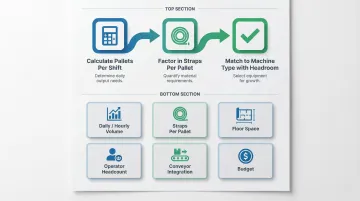
Choose based on your average daily volume and realistic hourly throughput requirement—not on peak-day numbers or aspirational future volumes. Here's a simple decision framework:
- Calculate current pallets per shift
- Factor in straps per pallet
- Match to the machine type whose realistic throughput benchmark fits with headroom to spare
Key Selection Factors:
- Daily and hourly pallet volume
- Number of straps per pallet (load type and stability requirements)
- Available floor space
- Operator headcount and ergonomic considerations
- Integration with existing conveyor or palletizing lines
- Budget for both upfront equipment and ongoing consumables
That framework works well for most standard operations. When your operation involves complex product mixes, non-standard load dimensions, or near-term volume growth, the right call is working with a packaging specialist before committing to equipment. Alliance Packaging Group's engineering team designs custom conveyor integration and strapping systems built around your specific throughput requirements—from single-machine setups to fully inline pallet strapping lines.
Mistakes to Avoid When Evaluating Strapping Machine Throughput
Specifying to peak capacity instead of average throughput. A machine sized for your busiest-ever shift will be underutilized most of the time, inflating cost-per-pallet. Right-sizing means building in a 15–25% buffer above your average volume — not matching the highest shift count on record.
Comparing spec sheets without translating to pallets-per-hour. Two machines with the same straps-per-minute rating perform very differently when load requirements differ. Always convert specs to pallets-per-hour for your specific strap count before drawing conclusions.
Upgrading the machine without fixing the workflow around it. A faster strapper won't close the throughput gap if feed method, operator movement, or consumables changeover are the real bottlenecks. Output is limited by the slowest repeatable point in the line — map the full strapping station workflow before specifying equipment.
Conclusion
Strapping machine throughput varies dramatically by type: from a few pallets per hour with manual tools to 60+ with automated inline systems. Matching the right machine to actual volume requirements is the foundation of an efficient pallet line.
Real-world output depends on more than machine type. Straps per pallet, operator workflow, load characteristics, and system integration all affect what you actually achieve—making it critical to evaluate throughput in context, not just from spec sheets.
Use the benchmarks and decision framework in this guide as a starting point. For complex or high-volume applications where machine selection, conveyor integration, and custom engineering factor in, consult a packaging solutions specialist who can assess your full production environment. Alliance Packaging Group's engineering team works with manufacturers, distributors, and warehouses nationwide to design systems that deliver the throughput your operation actually requires.
Frequently Asked Questions
How many straps are on a pallet?
The number of straps per pallet depends on load weight, height, stability, and product type—typically ranging from 2 to 6 straps for standard pallets. Heavier or taller loads require more straps to maintain stability. This number directly affects effective pallets-per-hour output from any strapping machine.
How many pallets per hour can a semi-automatic strapping machine handle?
Semi-automatic strappers rated at up to 11 straps per minute translate to approximately 10–20 pallets per hour, assuming 2–4 straps per pallet. Operator speed is the primary variable affecting where within that range a given operation will land.
What is the difference between an automatic and a semi-automatic strapping machine?
A semi-automatic machine requires the operator to manually position the strap around the package before the machine tensions and seals it. An automatic machine uses a full arch to apply, tension, seal, and refeed the strap with just a button press or foot pedal, enabling higher throughput and one-person operation.
What factors affect strapping machine throughput the most?
Straps per pallet, operator cycle time, pallet/load consistency, and machine-to-conveyor integration are the primary throughput variables. Machine speed specs represent best-case maximums, not guaranteed floor performance.
Can strapping machines be integrated with conveyor systems?
Yes, automatic and fully-automated strapping machines are designed for conveyor integration, enabling continuous inline operation without operator intervention at the strapping station. Verify integration requirements (conveyor height, feed spacing, and trigger logic) before equipment selection.
At what daily volume should I upgrade from a semi-automatic to an automatic strapping machine?
Operations processing 100–200+ packages or pallets per day typically justify upgrading to an automatic strapping machine. Labor costs, straps per pallet, and shift structure also factor into the upgrade decision.