Introduction
Metal coils and steel pipes rank among the most demanding load types in industrial shipping. Their weight, density, and surface sensitivity make strap selection a high-stakes decision for operations teams. A failed strap can mean thousands of dollars in damaged product, safety incidents, or rejected shipments.
Steel strapping has long been the default for heavy metal loads, but more operations teams are switching to polyester (PET) strapping. The shift comes down to four practical advantages: superior tension retention, better surface protection, improved worker safety, and lower total cost per foot.
This article breaks down why PET outperforms steel for most coil and pipe applications — and what to look for when making the switch.
Key Takeaways
- PET strapping holds tension through transit vibration and load settling; steel loses it the moment a load shifts
- At 80% lighter than steel, PET cuts freight costs and reduces handling injuries
- Steel strapping scratches and dents finished metal surfaces; PET does not
- For railroad-mandated shipments or extremely heavy loads with sharp edges, steel may still be required
- Most operations cut strapping costs 25–50% after switching to PET
Why Metal Coils and Pipes Are Difficult to Strap
The Physical Challenges
Metal coils and pipe bundles present unique securement challenges:
- Round, smooth surfaces shift easily during transport with minimal friction resistance
- High weight concentration — a 5,000 lb coil has a much smaller footprint than a pallet of equivalent weight, creating extreme tension demands
- Continuous vibration on long-haul routes loosens improperly chosen straps, especially over rough roads or rail lines
- Load settling causes slight compression under the product's own weight, generating slack in rigid strapping
According to the TT Club, improperly secured coil materials can lead to fatal incidents, and two-thirds of cargo damage claims are caused or worsened by poor packing practices. That damage isn't always structural — surface finish is often the first casualty.
Surface and Geometry Risks
Beyond movement, the physical form of metal coils creates two additional hazards:
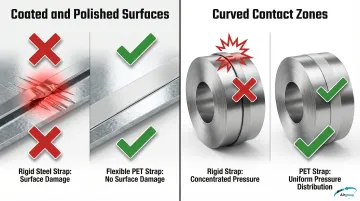
- Coated and polished surfaces — galvanized, painted, or finished metal can be rejected by the customer after a single scratch or dent, making strap softness as important as holding strength
- Curved contact zones — straps tensioned over a cylindrical surface concentrate pressure at the contact point; rigid straps gouge or crack the surface, while flexible straps conform to the curve and spread load more evenly
Polyester vs. Steel Strapping: Head-to-Head Comparison
Both materials offer high tensile strength, but they behave very differently under real-world shipping conditions. Four dimensions matter most for metal coils and pipes: tension retention, surface contact, weight, and safety.
Tension Retention
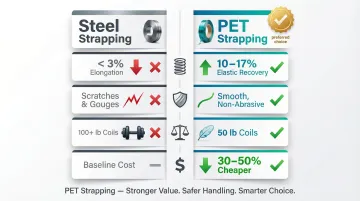
PET strapping functions like a rubber band, stretching 10–17% under load and recovering to maintain tension even as loads settle or vibrate during transport. This elastic elongation lets PET act as a shock absorber, dampening impacts that would otherwise stress the cargo.
Steel, by contrast, has less than 3% elongation and deforms plastically — it doesn't recover. Once a coil settles or vibrates loose, the steel strap stays slack, which can cause load failure or telescoping (coil wraps sliding out of alignment).
Surface Safety
Steel strapping's rigid edges scratch, gouge, or dent metal surfaces, particularly coated or galvanized finishes. During application, transit vibration, or removal, steel bands can mar high-value products and trigger quality claims.
PET's smooth, flexible surface is non-abrasive and won't damage coil finishes or pipe exteriors — protecting product value through delivery.
Weight and Freight Cost
PET strapping is approximately 80% lighter than steel. A 100 lb steel coil yields roughly 1,961 feet of 3/4" strap, while a 50 lb PET coil provides 3,000 feet — roughly three times more footage per pound.
This weight differential compounds across high-volume shipments. Lighter PET strapping reduces freight costs, especially for operations shipping hundreds of coils monthly.
Worker Safety
Steel strapping presents documented injury risks:
- Sharp edges cause lacerations during handling
- High spring-back tension when cut creates dangerous recoil
- Heavy coils (100+ lbs) increase lifting injuries
OSHA reports document severe injuries and fatalities from steel strap spring-back and lacerations. In one incident, a broken steel band struck a worker in the head and neck, causing fatal injuries.
PET strapping eliminates spring-back risk and is lighter to handle (50 lb coils vs. 100+ lb steel coils), reducing workplace injury liability and improving operator ergonomics.
Cost Per Foot
Divide cost per coil by feet per coil to get your true cost-per-foot comparison. On that basis, PET typically offers:
- More footage per coil (3,000 ft vs. 1,961 ft for equivalent width)
- Lower per-foot cost than steel (often 30–50% cheaper)
- Eliminated buckle/seal costs when using friction-weld tools
For high-volume operations, switching to PET can reduce total strapping costs by 25–50%.
Key Advantages of Polyester Strapping for Metal Coils and Pipes
PET strapping's advantages go beyond cost savings — they show up directly in load security, product quality, and floor-level efficiency.
Shock and Vibration Resistance
On flatbed transport, road vibration puts constant stress on every strap. PET absorbs those shocks without snapping, while steel strap can fracture at crimped seal joints under repeated impact — turning a weak point into a load failure risk.
No Surface Damage
Unlike steel, PET won't scratch or mar pipe exteriors or coated coil surfaces. For high-value finished steel or copper pipe, protecting surface quality through delivery is reason enough to make the switch.
Lighter Coil Weight and Faster Changeovers
PET strapping coils weigh around 50 lbs — roughly half the weight of a steel coil at 100+ lbs. That difference reduces operator fatigue and handling injuries when loading dispensers, swapping coils mid-shift, or moving stock around the floor.
Battery-powered friction-weld tools (which tension, weld, and cut in a single cycle) also eliminate the need for separate metal seals or buckles, cutting both per-unit cost and application time compared to crimped steel strap.
Corrosion and Contamination Prevention
In humid storage or long-haul transit, plain steel strapping rusts — and that rust transfers as iron oxide staining directly onto coil surfaces or pipe bundles. PET strapping does not corrode, eliminating that contamination risk entirely.
When Steel Strapping Still Makes Sense
PET dominates most coil and pipe strapping applications — but steel still has a place in three specific scenarios:
Railroad Shipments
The Association of American Railroads (AAR) requires steel strapping for certain open loads. Companies shipping coils by rail must use steel by law—or use AAR-approved PET grades (Type 1A, Grades 6 and 7) that meet specific break strength requirements for rail applications.
Extremely Heavy Loads with Sharp Edges
Large I-beams, structural steel plates, or loose sheet metal stacks with rigid, sharp edges may still benefit from steel's superior break strength, provided edge protectors are used at all contact points.
Long-Term Outdoor Storage
In outdoor environments with prolonged UV and heat exposure, standard PET strapping can degrade faster than steel. For coils stored outdoors for extended periods, UV-stabilized PET or steel is the better choice.
How to Choose the Right Polyester Strapping for Metal Applications
Key Specification Factors
Three spec factors determine the right PET strap for your load:
- Strap width (3/4" to 1-1/4"): wider straps distribute pressure more evenly across heavier coils
- Break strength: must match or exceed load weight with a safety factor — for a 5,000 lb coil, use multiple straps rated at 2,000–2,500 lbs each (8,000–10,000 lbs total system strength)
- Joint type: friction-weld joints deliver 75–80% of nominal break strength and cut out seal costs entirely
Example Sizing:
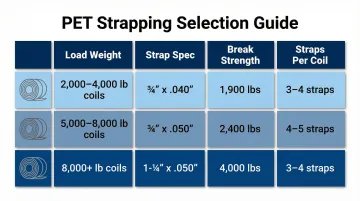
- For 2,000-4,000 lb coils: 3/4" x .040" PET (1,900 lbs break strength), 3-4 straps per coil
- For 5,000-8,000 lb coils: 3/4" x .050" PET (2,400 lbs break strength), 4-5 straps per coil
- For 8,000+ lb coils: 1-1/4" x .050" PET (4,000 lbs break strength), 3-4 straps per coil
Down-Gauging for Cost Savings
These sizing ranges also open the door to a cost-saving move that many operations overlook: down-gauging. Because PET has a higher tensile strength-to-gauge ratio than steel, some operations can switch to a lighter gauge PET strap without compromising load stability. Down-gauging typically yields 25-50% material savings.
Alliance Packaging Group's PET Strapping Solutions
Alliance Packaging Group carries PET strapping across widths, gauges, and break strengths for industrial coil and pipe applications — all available with factory-direct pricing and just-in-time nationwide delivery. Trialing or transitioning from steel to polyester won't disrupt your supply chain. Contact the team at 770-309-1012 or sales@apg-go.com for sizing guidance and inventory specifics.
Conclusion
For the vast majority of metal coil and pipe strapping applications, polyester strapping outperforms steel on tension retention, surface protection, worker safety, and total cost per foot.
Before finalizing your strap specification, take three steps:
- Calculate your cost per foot against current steel usage
- Assess your load type (coil vs. pipe, indoor vs. outdoor storage)
- Consult a packaging specialist to confirm grade and width requirements
Alliance Packaging Group can help you select the right PET grade, evaluate UV-stabilized options for outdoor storage, and manage the full transition from steel. With over 10,000 products in stock and nationwide delivery, the right strap ships when you need it. Contact the team at sales@apg-go.com or call 770-309-1012 to get started.
Frequently Asked Questions
What is polyester strapping used for?
PET strapping secures and bundles heavy industrial loads including metal coils, pipes, timber, bricks, and palletized goods. It performs best in high-tension applications where consistent load containment and surface protection matter.
What is the difference between strapping and banding?
The terms are largely interchangeable in industrial use. "Strapping" is the standard term across packaging and shipping, while "banding" appears more often in metal service centers and pipe bundling contexts — but both describe the same process of securing loads with flat strap material.
Can polyester strapping handle the weight of metal coils?
Yes. High-tensile PET strapping is rated for break strengths that rival and often exceed steel strap of equivalent width. Matching the correct gauge and width to your coil weight is what determines performance — your distributor can confirm the right spec based on load requirements.
Does polyester strapping scratch metal pipe or coil surfaces?
No. PET strapping has a smooth, non-abrasive surface that does not gouge or scratch metal coil finishes or pipe exteriors, unlike steel strapping which can dent or scratch coated surfaces under tension.
How do I calculate cost savings when switching from steel to polyester strapping?
Start with cost per foot: divide the price per coil by total footage for both materials. PET typically delivers more footage per coil at a lower per-foot rate, and eliminates seal and buckle costs when friction-weld tools are used.
Is polyester strapping affected by UV exposure or outdoor storage?
Standard PET strapping can degrade with prolonged UV exposure. For coils or pipes stored outdoors for extended periods, specify UV-stabilized PET strapping — these grades are widely available and designed for long-term outdoor exposure.