Introduction
For U.S. procurement and operations managers, sustainability mandates and tight packaging budgets are pulling in opposite directions. Recyclable PET strapping sits at that crossroads, making supplier selection more consequential than ever. The wrong choice carries real operational risk: inconsistent strap quality, missed deliveries, equipment incompatibility, and ESG reporting gaps that can derail compliance efforts.
The U.S. sustainable packaging market reached $45.37 billion in 2022 and is projected to hit $58.27 billion by 2028, driven by Extended Producer Responsibility (EPR) laws now active in six states. With 80% of brand owners planning packaging material changes, supplier qualification in recyclable PET strapping has moved from sustainability checkbox to formal procurement priority.
Key Takeaways
- Recyclable PET strapping is made from post-consumer resin (often bottles), performs on par with steel, and can be recycled again after use
- Vet suppliers on six criteria: recycled content verification, performance specs, certifications, inventory reliability, equipment compatibility, and total cost of ownership
- Red flags include vague recycled content claims, no domestic stock, and limited product ranges
- WBENC-certified suppliers like Alliance Packaging Group meet diversity requirements and offer factory-direct pricing with nationwide delivery
- This guide walks through each evaluation factor for confident, defensible procurement decisions
What Is Recyclable PET Strapping?
Recyclable PET strapping is a load-securing strap extruded from polyethylene terephthalate resin—often sourced from post-consumer material like plastic bottles—that retains high tensile strength while being fully recyclable after use.
Under ASTM D3950-23, PET strapping is classified as Type IV nonmetallic strapping, suitable for closing, reinforcing, bundling, unitizing, and palletizing applications.
Buyers will encounter two main forms:
- Machine-grade PET strapping - Used with automated or semi-automated strapping equipment, featuring large core diameters (typically 406 mm or 408 mm) and jumbo coil weights (70-115 kg) to minimize changeover downtime
- Hand-grade PET strapping - Used with manual tensioners and sealers, featuring smaller cores and standard coil weights (~25 kg) for portability
Choosing the wrong grade creates equipment compatibility issues—jams, inconsistent seal strength, or voided tool warranties. Grade selection also affects which performance specs matter most for your operation.
Core Performance Properties
PET strapping delivers performance characteristics that make it suitable for demanding U.S. industrial applications:
- Break strengths range from 1,601 N (360 lbs) up to 18,850 N (4,000 lbs), covering light bundling through heavy-duty palletizing
- Elongation recovery - Elongation at break of 12%–20% lets the strap absorb shock and hold tension when loads shift or vibrate in transit
- UV and moisture resistance - PET strapping is 100% rust-free and naturally UV-resistant, suitable for outdoor storage
- No sharp edges or snap-back recoil, eliminating two of the most common injury risks associated with steel strapping
High-quality PET strapping made with recycled content can match or approach virgin-resin performance. Some suppliers offer strapping with up to 100% post-consumer recycled (PCR) content that meets full mechanical requirements. When evaluating options, verify actual break strength and elongation specs—recycled content percentage alone doesn't confirm load performance.
Why U.S. Businesses Are Prioritizing Recyclable PET Strapping
Recyclable PET strapping has moved from a "nice to have" to a procurement priority for two concrete reasons: mounting ESG and regulatory pressure to cut plastic waste, and real operational advantages over steel—lighter freight, zero rust damage, and a safer handling profile.
The Americas recycled PET (rPET) market reached $3.14 billion in 2024 and is projected to grow at 6.9% CAGR through 2030. Major U.S. corporations have set aggressive packaging targets:
- Kraft Heinz pledged to cut virgin plastic use by 20% (over 100 million pounds) by 2030
- General Mills committed to 100% recyclable or reusable packaging by 2030
- Dell Technologies set a 2030 goal for 100% recycled or renewable packaging materials
Companies with public sustainability reports or supplier codes of conduct—common in retail, e-commerce, and manufacturing—now require documented recycled content and recyclability from packaging vendors. Procurement teams need verifiable data to substantiate claims to customers, regulators, and internal auditors alike.
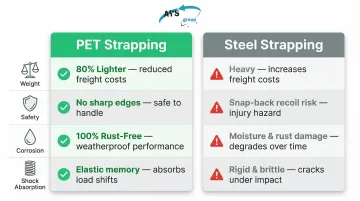
Beyond compliance, the operational case stands on its own. Here's how PET compares to steel across the metrics that matter most to procurement and operations teams.
PET vs. Steel Strapping: Total Cost Comparison
| Feature | PET Strapping | Steel Strapping |
|---|---|---|
| Weight | 80% lighter, reducing freight costs | Heavy, increasing shipping expenses |
| Safety | No sharp edges; falls safely when cut | Sharp edges; dangerous snap-back recoil |
| Corrosion | 100% rust-free; will not stain cargo | Prone to rust and moisture damage |
| Shock Absorption | Excellent elastic memory; absorbs impacts | Rigid and brittle; poor shock absorption |
What to Look for in a Recyclable PET Strapping Supplier
Recyclable PET strapping is often treated as a commodity — but supplier differences have real operational consequences. These six factors help U.S. buyers move past surface-level comparisons and connect supplier capabilities to measurable outcomes.
Recycled Content Transparency and Verification
Start here: "recyclable" and "recycled content" are not the same thing. Some suppliers market PET strapping as eco-friendly while using predominantly virgin resin. Ask specifically for the percentage of post-consumer recycled (PCR) content and request documentation or third-party verification.
Key distinctions:
- Recyclable — Per FTC Green Guides (16 CFR 260.12), an unqualified "recyclable" claim requires recycling facilities to be available to at least 60% of consumers or communities where the item is sold
- Recycled content — Includes materials diverted from the waste stream during manufacturing (pre-consumer) or after consumer use (post-consumer)
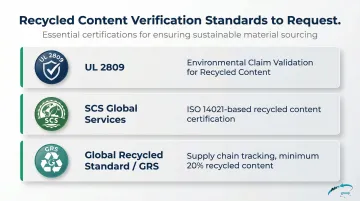
Verification standards to request:
- UL 2809 — Environmental Claim Validation Procedure for Recycled Content
- SCS Global Services — Certifies recycled content based on ISO 14021 standards
- Global Recycled Standard (GRS) — Tracks and verifies recycled materials through the supply chain, requiring minimum 20% recycled content for certification
The supplier's ability to provide documented recycled content is directly tied to your capacity to make accurate claims in ESG or sustainability reports, respond to customer supplier questionnaires, or comply with emerging EPR regulations.
Performance Specifications and Product Range
A credible supplier provides clear performance specs: breaking strength, elongation at break, width and thickness options, and roll weight. Match specs to load weight and application — palletizing, bundling, or unitizing each have different requirements.
What to ask for:
- Break strength ratings for specific strap widths and thicknesses
- Elongation at break percentages
- Available width options (typically 9 mm to 32 mm)
- Available thickness options (typically 0.5 mm to 1.3 mm)
- Roll weight and length options
- Surface finish (embossed vs. smooth)
Operational impact: Strap failures mid-transit result in damaged goods, freight claims, and reputational risk. A supplier offering a narrow size range may force you into oversized or undersized strapping, increasing both material cost and failure risk.
Certifications and Quality Standards Compliance
Reputable suppliers should hold or reference relevant standards:
- ASTM D3950 — The U.S. standard for strapping dimensions and performance, specifying minimum breaking strengths, elongation ranges, and joint strength testing methods
- ISO 9001:2015 — Quality Management System certification ensuring consistent product quality and traceability
- AAR approval — For rail or intermodal applications, nonmetallic strapping must be approved by the Association of American Railroads (e.g., AAR-60, AAR-77)
Ask suppliers to provide their quality testing protocols and whether products are batch-tested. Working with a non-certified or non-compliant supplier can result in load rejection by freight carriers, failed internal quality audits, or difficulty substantiating sustainability claims to customers or regulators.
Domestic Inventory Availability and Delivery Reliability
Supplier geography and inventory depth have a direct effect on operational continuity. A supplier with domestic stock and nationwide delivery infrastructure supports just-in-time procurement, eliminating the lead time and import duty exposure that comes with sourcing directly from overseas manufacturers.
Why this matters: PET strapping imported from China carries a base duty rate of 4.2% plus Section 301 tariffs, materially increasing landed cost. Combined with elevated ocean freight lead times and global shipping disruptions, relying on direct overseas sourcing for critical consumables poses severe continuity risk.
What to ask:
- Standard lead times for typical order volumes
- Minimum order quantities (MOQs)
- Whether they maintain regional or nationwide warehouse stock
- Whether they offer just-in-time or scheduled delivery programs
Operational impact: Stockouts in strapping can halt palletizing and shipping operations. Unreliable lead times force buyers to hold excess safety stock, tying up capital.
Equipment Compatibility and Technical Support
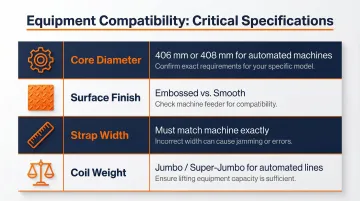
Strap-to-tool compatibility is not optional. Whether you're running manual tensioners, pneumatic sealers, or a fully automatic strapping system, an incompatible width, core size, or surface finish can cause equipment jams, inconsistent seal strength, or voided tool warranties.
Critical specifications to verify:
- Core diameter — Automated machines typically require 406 mm or 408 mm cores
- Surface finish — Embossed strapping improves grip and feeding reliability in large arch machines; smooth strapping offers higher break strength for heavy, sharp-cornered loads
- Strap width must match machine specifications exactly
- Jumbo or super-jumbo coil weights minimize changeovers on automated lines
A qualified supplier confirms compatibility with your existing equipment or recommends appropriate tooling. Equipment downtime from strap-tool mismatches rarely shows up in price-per-roll comparisons — but it shows up in your operating costs.
Pricing Structure and Total Cost of Ownership
The lowest price-per-roll is rarely the lowest total cost. Evaluate:
- Pricing at realistic order volumes (not just promotional minimums)
- Whether volume discount programs are available
- Whether the supplier bundles strapping with tools, accessories, and service in a way that reduces procurement complexity
Financial impact: Procurement teams that compare only unit price miss downstream costs: freight, excess inventory from high MOQs, strap failures, product damage claims, and the administrative burden of managing multiple packaging vendors.
Factory-direct pricing structures and consolidated invoicing reduce both cost and vendor management overhead — ask suppliers directly whether they offer either.
How Alliance Packaging Group Can Help
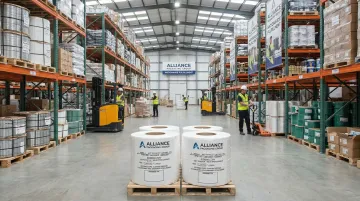
Alliance Packaging Group is a nationwide single-source packaging distributor stocking over 10,000 products — including recyclable PET strapping — with factory-direct pricing and just-in-time delivery programs built to simplify procurement for U.S. manufacturers, distributors, and warehouses.
Alliance has held WBENC certification as a Women's Business Enterprise since 2011, making it a qualified diverse supplier for procurement teams with formal diversity spend requirements. Approximately 85% of Fortune 500 companies maintain supplier diversity programs — so when two PET strapping vendors offer similar specs, this certification can be the deciding factor.
Alliance Packaging Group's advantages for recyclable PET strapping buyers:
- Factory-direct pricing that undercuts typical distributor margins, lowering total cost of ownership
- Just-in-time delivery nationwide, reducing lead time risk and excess safety stock
- 10,000+ packaging and industrial products in stock for true single-source procurement — strapping, tools, accessories, and more
- WBENC certification (since 2011) supporting supplier diversity compliance for corporate and government buyers
- Proven experience across manufacturing, distribution, warehousing, food & beverage, e-commerce, and industrial operations
Conclusion
The right recyclable PET strapping supplier earns that designation through specifics: verified recycled content documentation, performance specs matched to your application, confirmed domestic inventory depth, and proven equipment compatibility. Before committing to a vendor relationship, make sure you can check each of these boxes.
A quick pre-commitment checklist:
- Recycled content documentation — SDS sheets, third-party certifications, or chain-of-custody records available on request
- Performance specs — tensile strength, elongation, and break strength confirmed for your load type
- Domestic inventory depth — consistent stock on hand, not drop-shipped from overseas on long lead times
- Equipment compatibility — confirmed fit with your existing sealers, tensioners, or automated strapping systems
- ESG reporting support — supplier can provide data you need for internal sustainability reporting
Revisit supplier performance at least annually. Recycled content standards, ESG reporting requirements, and strapping technology are all moving targets. A supplier worth keeping will surface those changes proactively — not wait for you to ask.
Frequently Asked Questions
Is recyclable PET strapping as strong as steel strapping?
PET strapping offers break strengths up to 18,850 N (4,000 lbs), suitable for most industrial applications. Steel strapping remains preferred for extreme heavy-duty loads exceeding 12,000 lbs, applications requiring zero elongation, or environments with extreme heat. High-quality PET retains tension after load settling due to its elongation recovery properties.
What percentage of recycled content should I look for in PET strapping?
"Recyclable" and "recycled content" are different claims. Ask suppliers for post-consumer recycled (PCR) content percentage and third-party documentation such as UL 2809 or Global Recycled Standard (GRS) certification. Leading manufacturers offer 80-100% PCR content PET strapping that meets all performance requirements.
What certifications should a reliable recyclable PET strapping supplier have?
Look for ASTM D3950 compliance (the U.S. performance standard for nonmetallic strapping), ISO 9001:2015 quality management certification, and for rail/intermodal use, AAR approval (e.g., AAR-60, AAR-77). Third-party recycled content verification (UL 2809, SCS Global Services, or GRS) is increasingly important for sustainability compliance.
Is recyclable PET strapping compatible with automated strapping machines?
Yes, recyclable PET strapping is available in machine-grade formulations compatible with semi-automatic and fully automatic equipment. Confirm that strap width, core diameter (typically 406 mm or 408 mm for automated machines), and surface finish (embossed or smooth) match your specific machine's requirements before ordering to avoid equipment jams or voided warranties.
How do I evaluate whether a supplier can meet our delivery timelines?
Ask about domestic inventory levels, standard lead times, minimum order quantities, and whether the supplier offers just-in-time or scheduled delivery programs. Vague answers on inventory are a red flag. Suppliers with domestic stock and nationwide distribution infrastructure can support just-in-time procurement and sidestep overseas shipping delays.
Can recyclable PET strapping help our company meet ESG or sustainability reporting requirements?
Yes, provided the supplier offers documented recycled content percentages and third-party verification such as UL 2809, SCS Global Services, or Global Recycled Standard certification. Working with a WBE/WBENC-certified supplier like Alliance Packaging Group can also support supplier diversity reporting goals, addressing multiple procurement compliance requirements through a single vendor.