Introduction
Manufacturing, distribution, and warehouse operations face mounting pressure from regulatory mandates, customer sustainability requirements, and rising disposal costs. Many businesses struggle with the complexity of transitioning away from traditional packaging materials while maintaining operational continuity and cost efficiency. State-level Extended Producer Responsibility (EPR) laws now hold producers financially accountable for packaging waste, with California's SB 54 mandating 100% recyclable or compostable packaging by 2032.
Recyclable industrial packaging reduces environmental liability while cutting long-term material and disposal costs. The global recyclable packaging market is projected to reach $299 billion by 2030, growing at 6.2% annually.
Industrial operations that act now position themselves ahead of compliance deadlines while capturing savings through right-sizing, waste diversion, and volume procurement programs. This guide covers seven practical strategies to get there.
Key Takeaways
- Recyclable industrial packaging — corrugated cardboard, HDPE, PET, PP, and aluminum — avoids virgin resource consumption
- Seven proven strategies cover material selection, design, sourcing, and regulatory compliance to build a circular packaging program
- Manufacturing, food & beverage, e-commerce, and medical sectors reduce costs and strengthen sustainability credentials
- Success requires a packaging audit and reliable sourcing partner to maintain uninterrupted supply
- Early adopters gain competitive advantage ahead of expanding U.S. state regulations
What Is Recyclable Industrial Packaging?
Recyclable industrial packaging refers to materials used in B2B supply chains—including bulk containers, corrugated boxes, stretch wrap, and protective materials—that can be collected, reprocessed, and returned to the manufacturing cycle without creating landfill waste. These materials must meet strict criteria: they need established collection infrastructure, sortation capability at Materials Recovery Facilities (MRFs), reprocessing capacity, and viable end markets.
Recyclable vs. Compostable vs. Biodegradable
These terms are often used interchangeably, but they describe distinct end-of-life pathways:
- Recyclable: Materials like corrugated cardboard or HDPE containers are collected, processed, and manufactured into new products within a closed-loop system
- Compostable: Packaging breaks down into organic matter inside certified industrial composting facilities — infrastructure that isn't universally available
- Biodegradable: Packaging decomposes naturally, but the FTC warns against misleading claims without scientific evidence of timeframe or conditions
The recyclable packaging market hit $197.08 billion in 2023 and continues to expand. Regulatory pressure and buyer demand are pushing businesses to treat recyclability not just as a compliance requirement, but as a tangible cost-saving opportunity.
Top 7 Strategies for Recyclable Industrial Packaging
Implementing recyclable packaging in industrial settings requires a phased, strategy-first approach—not just a material swap—to ensure operational continuity and measurable sustainability outcomes. The following strategies provide a roadmap for B2B operations to transition effectively.
Strategy 1: Switch to Mono-Material or Single-Stream Recyclable Materials
Multi-material industrial packaging creates significant processing challenges. Composite packaging—such as laminates combining plastic with foil or paper—is difficult to recycle because it requires material separation before processing. MRFs are incentivized to invest only in infrastructure for materials with viable end markets and sufficient volume, making multi-layer materials economically unviable for recycling.
Viable mono-material alternatives include:
- Replace mixed-layer films with single-resin PE stretch wrap
- Switch to all-paper void fill instead of composite cushioning
- Use 100% corrugated cardboard boxes without plastic windows or mixed-material labels
- Transition from composite bubble mailers to all-paper protective packaging alternatives
PET, HDPE, and PP are widely accepted in U.S. recycling programs, with established infrastructure and end markets. Switching to these single-resin materials simplifies sorting at MRFs and improves recyclability rates and MRF acceptance.
Strategy 2: Right-Size and Optimize Packaging to Reduce Total Material Use
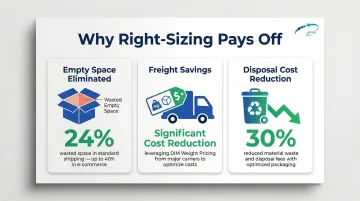
Right-sizing matches box dimensions, pallet configurations, and fill materials precisely to product dimensions, eliminating excess material. This principle reduces both the volume of packaging consumed and the weight of waste generated per shipment.
Operational and financial benefits:
- Cut wasted space: 24% of average shipping container volume is empty space, with e-commerce parcels containing up to 40% air
- Freight cost savings: Major carriers use dimensional weight pricing—UPS and FedEx charge based on volume rather than actual weight when volume is greater, penalizing oversized packaging
- Reduced disposal fees: Less packaging volume means lower waste management costs
For warehousing and distribution operations, right-sizing delivers measurable ROI through reduced material spend and lower freight charges. It's both an environmental win and a direct cost-reduction lever.
Strategy 3: Incorporate Post-Consumer Recycled (PCR) Content Into Industrial Packaging
Using packaging made with PCR content—such as corrugated boxes with recycled fiber or HDPE containers made with recycled resin—closes the loop by creating demand for collected recyclables, directly supporting a circular economy.
Industry benchmarks:
Corrugated packaging shows what a closed-loop system looks like in practice. The average corrugated box in the U.S. contains 52% recycled content, supported by a robust recovery system with 2024 recycling rates reaching 69%-74%.
State PCR mandates:
| State | Requirement | Timeline |
|---|---|---|
| California (SB 54) | PCR certification required for source reduction credit | Ongoing |
| Washington (SB 5022) | 15% PCR for plastic bottles (rising to 50% by 2031) | 2023-2031 |
| New Jersey (S2515) | 10-15% PCR for rigid plastic containers | 2024+ |
| Maine (LD 1467) | 25% PCR for beverage containers (rising to 30%) | 2026-2031 |
Industrial buyers should target minimum 25-50% PCR content in corrugated materials and 15-25% in plastic packaging to align with emerging standards.
Strategy 4: Design Industrial Packaging for Easy Disassembly and Sorting
Design packaging with sortability in mind: clear material labels, no adhesive contamination, and separable components. These decisions directly determine whether materials survive the MRF sorting process or end up in landfill.
Design principles for recyclability:
- Avoid mixed-material labels: Don't glue plastic labels directly to corrugated; use water-soluble adhesives or removable labels
- Use resin identification codes: Apply clear RIC codes (1-7) to plastic components, though note that RIC codes alone don't guarantee recyclability
- Ensure separability: Design closures and liners to separate easily from main containers during processing (e.g., float/sink separation)
- Follow APR guidelines: The Association of Plastic Recyclers Design® Guide provides authoritative standards for plastic packaging recyclability
Strategy 5: Transition Protective Packaging to Recyclable Alternatives
Void fill, cushioning, and blocking/bracing materials represent high-volume packaging waste in industrial shipping. In 2018, the U.S. generated 4.2 million tons of plastic bags, sacks, and wraps, yet only 10% were recycled. Polystyrene foam saw negligible recycling, with less than 5,000 tons recycled out of 80,000 tons generated.
Recyclable protective packaging alternatives:
- Paper void fill — widely accepted in curbside and industrial paper recycling streams
- Honeycomb cushioning — 100% recyclable compressed paper that adapts to product shapes
- All-paper bubble mailers — cushioning protection without plastic components
- Recyclable air pillows — made from mono-material LDPE #4, recyclable via store drop-off (not curbside)
Performance validation:
Protective packaging must meet damage-reduction benchmarks. Testing standards from the International Safe Transit Association (ISTA), such as ISTA 1A and 3A, allow companies to validate that recyclable alternatives provide adequate protection compared to EPS foam before full-scale rollout.
Strategy 6: Partner with Suppliers Who Prioritize Circular and Recyclable Packaging Supply Chains
Sourcing recyclable industrial packaging from a supplier with broad inventory access—covering materials, box sizes, protective packaging, and industrial consumables—simplifies compliance and reduces the risk of reverting to non-recyclable alternatives when stock is limited.
Key supplier capabilities:
- Inventory depth: Can they supply all packaging needs from one source to avoid supply gaps?
- Recyclable product range: Do they stock mono-material films, corrugated with PCR content, paper void fill, and other sustainable alternatives?
- Delivery reliability: Can they support just-in-time replenishment nationwide to prevent reverting to non-compliant alternatives?
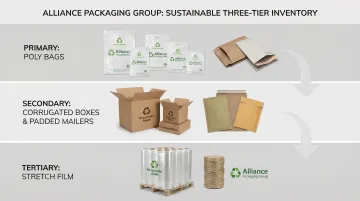
Alliance Packaging Group stocks over 10,000 packaging and industrial products with nationwide just-in-time delivery. That inventory depth means industrial buyers can source recyclable-compatible packaging consistently — without defaulting to non-compliant alternatives during supply gaps. Recyclable options span all three packaging tiers:
- Primary packaging: FDA-approved recyclable poly bags and food-safe materials
- Secondary packaging: 1,000+ corrugated box sizes with recycled content options, including EarthKraft™ recyclable padded mailers and TerraBoard™ products with 75% post-consumer content
- Tertiary packaging: Stretch film with 50% recycled material content (RecyClass certified), producing 30% less CO₂ emissions than standard film
Their factory-direct pricing model and volume programs make sustainable packaging economically competitive with traditional materials.
Strategy 7: Align with EPR Regulations and U.S. Packaging Compliance Requirements
Extended Producer Responsibility (EPR) is a regulatory model adopted by states including California, Oregon, Colorado, and Maine that holds producers and distributors financially accountable for end-of-life packaging management. Seven U.S. states have enacted comprehensive packaging EPR laws as of 2025.
Key state EPR requirements:
| State | Statute | Key Dates | Scope |
|---|---|---|---|
| California | SB 54 | Producers must join PRO by Jan 1, 2027; 100% recyclability by 2032 | Single-use packaging and plastic food serviceware |
| Oregon | SB 582 | PRO membership fees due July 1, 2025 | Packaging, printing/writing paper, food serviceware |
| Colorado | HB 22-1355 | Producers registered by Oct 2024; dues begin Jan 2026 | Packaging materials and paper products |
| Maine | LD 1541 | Program operational by 2027 | Consumer packaging material |
Compliance strategy:
Industrial businesses should proactively audit their packaging portfolio against current and pending EPR legislation, Sustainable Packaging Coalition (SPC) guidelines, and customer-mandated sustainability requirements. Oregon's PRO membership fees are due July 2025 — for businesses shipping into that state, that deadline is already here.
Key Benefits of Recyclable Industrial Packaging
Environmental Impact Reduction
Switching to recyclable materials decreases landfill contribution, reduces reliance on virgin raw materials, and lowers the carbon footprint of industrial packaging operations. Recycling PET reduces energy consumption by 84% compared to virgin resin production, while recycling HDPE reduces it by 88%. Using recycled PET reduces greenhouse gas emissions by 71% compared to virgin PET.
In 2018, the U.S. recycled 32.1 million tons of corrugated boxes, achieving a 96.5% recycling rate for that specific category—demonstrating the environmental impact achievable through established recycling systems.
Brand and Business Credibility
Major enterprise customers in retail, food & beverage, and electronics increasingly require suppliers to meet sustainability packaging standards as part of vendor qualification. Amazon's "Compact by Design" and "Frustration-Free Packaging" programs incentivize vendors to use 100% curbside recyclable materials and reduce excess volume.
For businesses serving multiple sectors, recyclable packaging adoption delivers tangible business advantages:
- Strengthens supplier relationships with enterprise buyers who audit vendor sustainability
- Opens access to sustainability-focused contracts and preferred vendor programs
- Differentiates bids through certifications and documented packaging compliance
Long-Term Cost Savings
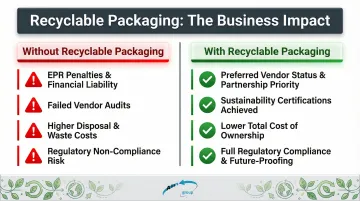
While recyclable packaging may carry slightly higher upfront costs, multiple factors offset and ultimately lower total packaging spend:
- Reduces material volume and freight costs by right-sizing packaging to dimensional weight requirements
- Lowers disposal fees by diverting recycled materials away from landfill tipping charges
- Avoids future EPR penalties and producer responsibility fees as regulations tighten
- Unlocks competitive pricing through volume procurement programs with broad recyclable catalogs
Factory-direct sourcing and volume programs — like those offered by Alliance Packaging Group — make it practical for industrial buyers to reach cost parity or savings over a 12-month procurement cycle compared to traditional materials.
How to Source and Evaluate Recyclable Industrial Packaging for Your Operations
Start with a Packaging Audit
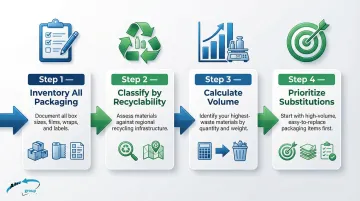
Before sourcing new materials, industrial buyers should map all current packaging types in use—primary, secondary, and tertiary—classify them by recyclability, and identify the highest-volume non-recyclable materials as priority targets for substitution.
Audit steps:
- Inventory all packaging: Document box sizes, protective materials, stretch wrap, strapping, and labels currently in use
- Classify by recyclability: Identify which materials have established recycling infrastructure in your region
- Calculate volume: Determine which non-recyclable materials represent the largest waste volume
- Prioritize substitutions: Target high-volume, easy-to-replace materials first
Evaluate Suppliers on Three Criteria
Once your audit identifies substitution targets, the next step is vetting suppliers who can actually support a sustainable transition. Evaluate on these three factors:
1. Inventory depth: Look for suppliers with comprehensive ranges covering corrugated boxes, protective packaging, stretch film, and industrial consumables. Single-source suppliers reduce complexity and prevent stock gaps that force you back to non-recyclable alternatives.
2. Recyclability documentation: Request resin identification codes, PCR content percentages, and third-party certifications such as APR Design® Guide compliance or RecyClass certification. Suppliers should back their recyclability claims with documentation you can use in procurement audits—not just marketing language.
3. Delivery reliability: Suppliers with nationwide distribution and just-in-time delivery programs ensure you maintain access to recyclable materials without gaps in your recyclable supply. Consistent availability matters as much as product specs.
Common Procurement Mistakes to Avoid
Knowing what to look for is only half the equation—understanding where buyers go wrong can save you from costly reversals.
- Single material focus: Don't rely on one material type without testing performance across different applications
- Price-only decisions: Selecting packaging based on upfront price alone ignores disposal costs, freight savings, and compliance risk
- Unverified claims: Always verify recyclability claims with resin codes, spec sheets, or third-party certification—don't accept marketing language without documentation
Conclusion
Recyclable industrial packaging requires coordinated action across material selection, packaging design, supplier partnerships, and regulatory awareness — not a single swap. Operations and procurement teams should begin with a packaging audit and prioritize the highest-impact changes first—whether that's mono-material switching, right-sizing, or upgrading protective packaging—before scaling across the full supply chain.
Early adopters gain real advantages: they position themselves ahead of expanding state EPR requirements, strengthen relationships with sustainability-focused customers, and capture cost savings through waste diversion and operational efficiency. Acting now means building a compliant, efficient program on your terms — before regulatory timelines force rushed decisions.
For operations ready to act, Alliance Packaging Group provides nationwide access to over 10,000 packaging and industrial products — including recyclable options spanning primary, secondary, and tertiary packaging. As a single-source partner with factory-direct pricing, just-in-time delivery, and consultation support, they work with manufacturers, distributors, and warehouses to build sustainable, compliant packaging programs. Contact their team at 770-309-1012 or sales@apg-go.com to explore recyclable packaging options suited to your operation.
Frequently Asked Questions
Frequently Asked Questions
What are the examples of recyclable packaging?
Common examples include corrugated cardboard boxes, aluminum containers, PET and HDPE plastic bottles, glass, paper bags, and all-PE stretch film. Recyclability depends on both material type and local infrastructure—established collection, sorting, and reprocessing systems must exist for a material to be genuinely recyclable.
What is an example of industrial packaging?
Industrial packaging includes corrugated bulk boxes (gaylords), stretch wrap, strapping, edge protectors, wooden pallets, intermediate bulk containers (IBCs), and protective void fill materials. These products protect and transport goods in manufacturing and distribution environments, used in B2B supply chains rather than consumer retail.
What is industrial compostable packaging?
Industrial compostable packaging breaks down in commercial composting facilities under controlled conditions of heat, humidity, and microbial activity. Unlike recyclable packaging, it returns as soil amendment rather than re-entering the material supply chain—and requires certified composting infrastructure that isn't universally available across the U.S.
What materials are most commonly used in recyclable industrial packaging?
The most widely recycled industrial packaging materials are corrugated cardboard/paperboard, HDPE and LDPE plastics, PET, polypropylene (PP), aluminum, and steel. Single-material (mono-material) packaging is easier to recycle than composites because it doesn't require separation before processing at Materials Recovery Facilities.
How can recyclable packaging reduce operational costs for industrial businesses?
Recyclable packaging lowers costs through right-sizing, reduced waste disposal fees, EPR compliance savings, and volume pricing programs from full-catalog suppliers. While upfront costs may be slightly higher, total cost of ownership often favors recyclable materials.
What U.S. regulations should industrial businesses know about regarding packaging recyclability?
Extended Producer Responsibility (EPR) legislation is active in California, Oregon, Colorado, and Maine, requiring producers and distributors to fund or manage end-of-life packaging recovery. This makes recyclable packaging design a compliance issue—California's SB 54, for example, mandates 100% recyclable or compostable packaging by 2032.