Introduction
Lumber yards move thousands of board-feet daily through handling, stacking, and transport—where a single strapping failure triggers load shifts, product damage, worker injuries, and costly delays. OSHA accident reports document severe injuries and fatalities related to strapping failures in lumber operations, including employees crushed by shifting wood stacks and lacerations from snapping steel bands.
Those risks don't disappear with better training alone — the materials doing the securing matter just as much. The wrong strapping choice leads to overspending, wasted labor re-bundling failed loads, and unacceptable safety exposure. Two-thirds of cargo damage claims stem from inadequate cargo securing, which means material selection directly affects your bottom line, not just your operations.
This guide covers the primary strapping materials used in lumber yards, how to match strap type to load conditions, and the tools that keep bundling fast and consistent.
Key Takeaways
- Polyester strapping delivers high break strength and shock-absorbing elasticity that steel can't match, with lower material costs and reduced injury risk
- Polypropylene suits lighter bundles where upfront cost per unit is the priority
- Steel strapping remains an option for extreme-weight loads, though most lumber yards are moving away from it
- Match strapping width, thickness, and break strength to bundle weight and handling conditions
- Battery-powered and automated strapping tools determine application speed and consistency
Why Proper Bundle Strapping Matters in Lumber Yards
Lumber bundles present unique strapping challenges: irregular surfaces, sharp corners, heavy loads (often 1,000+ lbs per bundle), moisture exposure in outdoor storage, and high throughput volume. Standard packaging straps aren't engineered for these conditions.
Improper strapping selection creates compounding costs:
- Strap breakage during transport and product damage claims
- OSHA safety risks—steel bands under tension act as "dangerous weapons that will lash out when cut"
- Wasted labor re-bundling failed loads
- Trip hazards and lacerations from loose strapping on the yard floor
The consequences go beyond product loss. OSHA records document a worker who suffered a fractured shoulder and head injuries after cutting a metal band caused timber to shift and fall. Choosing the right strapping material and tools eliminates this risk before it reaches the yard floor.
Best Strapping Solutions for Lumber Yards
Not all strapping holds up equally in a lumber yard. What works for retail trim packs fails fast on heavy green lumber. Each option below is assessed on load-holding performance, safety, cost, and fit for real yard conditions.
Polyester (PET) Strapping
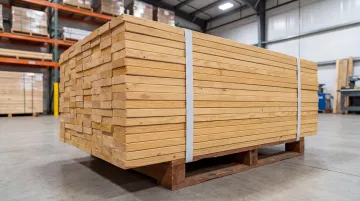
Polyester strapping has become the industry standard replacement for steel in lumber applications. It maintains tension over time even as lumber settles or shifts during transport, thanks to superior elongation recovery that absorbs shocks without snapping.
Key differentiators for lumber yards:
- Maintains grip on settling loads via "elastic memory", with 70% elongation recovery versus minimal recovery in steel
- Performs consistently in humid or wet storage without rust or staining
- Eliminates sharp-edge injury risk associated with steel bands
- Costs less per foot than steel and reduces worker injury expenses
| Specification | Details |
|---|---|
| Break Strength Range | 600 lbs to 4,000+ lbs depending on width and thickness |
| Common Widths | 3/4" (1,900–2,500 lbs), 1" (2,200–3,000 lbs), 1-1/4" (3,200–4,000 lbs) |
| Best Lumber Application | Medium to heavy lumber bundles, palletized dimensional lumber, long-haul transport loads |
| Application Method | Compatible with handheld battery tools, semi-automatic, and fully automatic strapping machines |
Polypropylene (PP) Strapping
Polypropylene is the entry-level plastic strapping option—lighter, more flexible, and much lower in cost than polyester. It suits lighter lumber bundles or retail-ready packaging where load weights are moderate.
Limitations for heavy lumber:
- Lower break strength (typically 264–880 lbs for common widths)
- Poor tension retention over time due to high creep
- Not ideal for heavy green lumber or long-distance transport
Works well for:
- Bundled trim boards, molding, or pre-packaged retail lumber
- Dry indoor conditions with short storage duration
- Operations where upfront material cost is the primary concern
| Specification | Details |
|---|---|
| Break Strength Range | 264 lbs (1/2" width) to 880 lbs (3/4" width) |
| Best Lumber Application | Light dimensional lumber bundles, trim and molding packs, short-distance yard transfers |
| Cost Profile | Lowest cost per foot among plastic strapping; higher consumption rate offsets some savings at volume |
Steel Strapping
Steel strapping is the legacy solution for lumber yards—still in use for extremely heavy loads or high-tension applications where plastic strapping cannot meet required break strength.
Why it's declining in lumber yards:
- Razor-sharp edges when cut or snapped create serious injury risk
- Rusts in outdoor lumber storage, especially with treated wood
- Adds load weight and requires specialized tensioning tools
- PET now covers most medium to heavy-duty applications; steel is recommended only when load requirements exceed high-tensile PET capacity
| Specification | Details |
|---|---|
| Break Strength Range | 1,750 lbs (3/4" standard) to 5,500 lbs (1-1/4" high tensile) |
| Best Lumber Application | Extremely heavy timber packs, engineered wood product bundles, rail/flatbed shipments with maximum load weight |
| Key Risk Factor | Sharp-edge injury hazard during tensioning and cutting; not recommended for high-frequency manual application |
Poly Cord Strapping
Poly cord (also called composite or corded) strapping combines woven polyester-core construction with a polypropylene coating. This design offers flexibility with added tensile performance, particularly well-suited for rough or uneven lumber surfaces where rigid strap may not conform well.
Niche advantages in lumber yards:
- Soft texture reduces surface marking on finished or appearance-grade lumber
- Handles irregularly shaped bundles better than flat strapping
- Can be applied using friction-weld tools or galvanized wire buckles
| Specification | Details |
|---|---|
| Break Strength Range | 1,050 lbs to 3,320 lbs depending on width |
| Surface Compatibility | Ideal for appearance-grade, planed, or finished lumber where surface marring is a concern |
| Sealing Method | Seals via friction-weld, eliminating loose metal hardware on the yard floor |
| Best Lumber Application | Specialty lumber, hardwood bundles, flooring packs, appearance-grade dimensional lumber |
Composite / Woven Strapping
Woven composite strapping (fiberglass or polyester fiber-reinforced) is a premium option offering the highest strength-to-weight ratio among non-steel strapping. It delivers maximum load security without the weight or injury hazard of steel.
Where it fits in lumber operations:
- AAR-approved for open-top and closed rail car shipments of lumber, brick, and panel products
- Handles LVL beams, engineered wood products, and export containerized loads
- Higher per-unit cost makes it best reserved for high-value or high-risk shipments, not routine bundling
| Specification | Details |
|---|---|
| Strength Profile | 2,800 lbs (3/4" width) to 8,800 lbs (1-1/4" heavy-duty systems); maintains tension comparable to steel |
| Best Lumber Application | High-value timber products, LVL/engineered beams, export containerized loads |
| Cost vs. Benefit | Higher cost per unit; best reserved for specialized high-value or high-risk shipments rather than routine bundling |
How to Choose the Right Strapping for Your Lumber Operation
Match Strapping to Load Weight
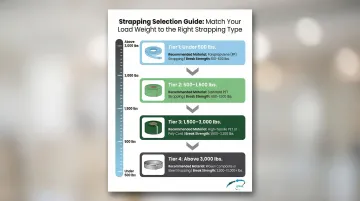
Bundle weight is the first filter. Match break strength to load before considering anything else:
- Under 500 lbs: Polypropylene strapping suits light bundles where cost per unit is the priority
- 500–1,500 lbs: Standard polyester strapping (1,900–2,500 lbs break strength) handles medium loads effectively
- 1,500–3,000 lbs: High-tensile polyester (3,000–4,000 lbs break strength) or poly cord strapping
- Above 3,000 lbs: Woven composite or steel strapping for extreme-weight applications
Consider Moisture and Storage Environment
Lumber stored outdoors or in humid conditions requires strapping with corrosion resistance. Steel rusts and loses integrity, while PET and poly cord maintain performance in wet environments.
Field studies show steel strapping suffers severe red rust corrosion when in contact with ACQ or CA-B treated lumber, making polyester the standard choice for pressure-treated stock. Kiln-dried lumber stored indoors gives you more flexibility on material selection.
Select Appropriate Strap Width and Thickness
Wider and thicker strapping distributes tension more evenly across a bundle face, reducing the risk of the strap cutting into softer wood species.
Common widths by application:
- 1/2": Light retail packs and trim bundles
- 5/8"–3/4": Standard dimensional lumber bundles (most common)
- 1": Heavy lumber bundles and palletized loads
- 1-1/4": Maximum-weight timber packs and engineered wood products
Use Edge Protectors
Strapping corners on lumber bundles concentrate tension at sharp edges, risking strap cut-through and surface damage. Edge protectors distribute strap tension across load corners, preventing the strap from cutting into wood and reducing damage.
Specify corner boards or edge protectors alongside strapping for any load where the strap crosses a sharp lumber corner—particularly for heavy or long-haul shipments. Sourcing both from the same supplier, such as Alliance Packaging Group, ensures compatibility between strap width and protector dimensions and simplifies reordering.
Essential Strapping Tools for Lumber Operations
Handheld Strapping Tools
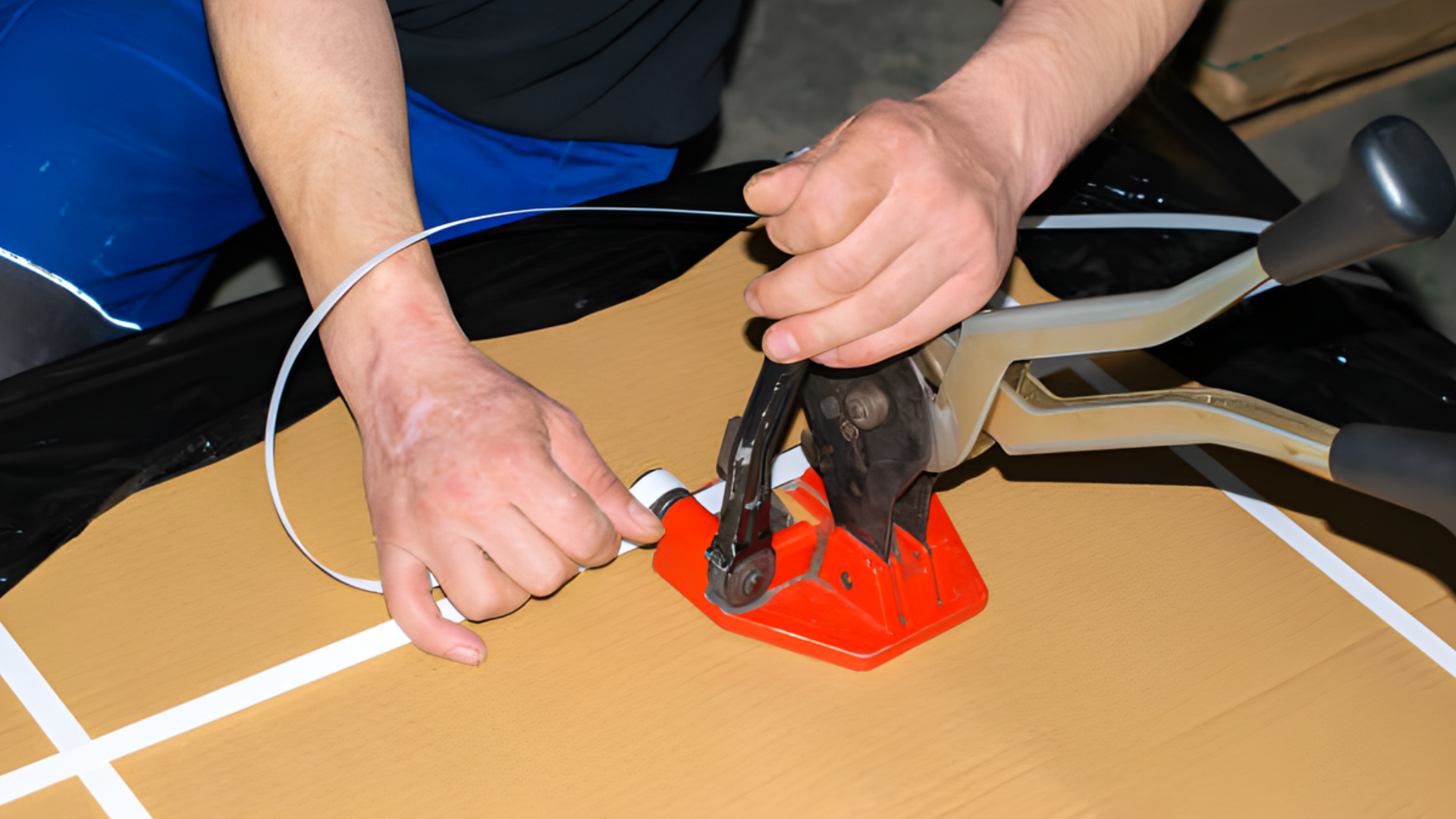
Manual tensioners and sealers, battery-powered combination tools, and pneumatic tools serve as baseline equipment for most lumber yards where workers strap bundles at varying locations.
Battery-powered tools (offering tensioning, sealing, and cutting in one unit) are the fastest-growing choice for yard floor use because they:
- Eliminate trip hazards from air lines
- Improve consistency with electronically controlled tension
- Reduce hand fatigue during high-volume strapping
- Perform up to 800 cycles per battery charge
Semi-Automatic and Automatic Arch Machines
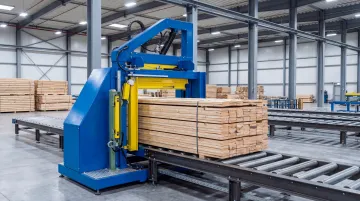
For high-volume lumber operations with a fixed bundling station, semi-automatic and automatic arch machines offer a step-change in throughput that handheld tools simply can't match.
Automatic arch machines can reach 52 to 65 straps per minute, which translates directly into:
- Lower per-bundle labor cost at scale
- Consistent strap tension on every cycle, regardless of operator
- Higher bundling station throughput during peak production
Strap Choppers
Strap choppers are a waste-management tool that belongs in any lumber yard's strapping setup. Used strapping from incoming and outgoing bundles accumulates fast, and OSHA guidelines identify loose steel bands as a serious trip and laceration hazard.
Strap choppers reduce this waste to compact pieces that take up a fraction of the space of loose coils — cutting disposal frequency and keeping the yard floor clear.
How We Evaluated These Strapping Solutions
This guide evaluates strapping based on:
- Break strength relative to typical lumber bundle weights
- Safety profile: edge hazard and snapping risk
- Tension retention over time and in varying humidity
- Application tool compatibility
- Cost-effectiveness: factoring in material cost, application speed, injury risk, and waste disposal
Common Mistakes Lumber Yard Operators Make
- Selecting based on upfront material cost alone (ignoring labor, injury, and re-strapping costs)
- Using a single strap type across all bundle weights
- Failing to use edge protectors on heavy or long-haul loads
- Underestimating the importance of consistent strap tension
Each of these errors is avoidable — and each one shows up in damage claims and re-strapping delays that eat into margins.
Conclusion
For most lumber yards, polyester strapping represents the best balance of strength, safety, cost, and versatility. The right choice still depends on your operation's bundle weights, storage conditions, throughput volume, and what tooling you already have in place.
If your current setup isn't holding up to those demands, Alliance Packaging Group supplies strapping materials, edge protection, and strapping equipment at factory-direct pricing with nationwide just-in-time delivery. Reach out to their team at sales@apg-go.com or 770-309-1012 to discuss your specific requirements.
Frequently Asked Questions
What type of strapping is best for bundling lumber?
Polyester (PET) strapping is the preferred material for lumber yards due to its high break strength, tension retention, elasticity, and resistance to corrosion. It's safer and more cost-effective than steel for most lumber applications.
What is the difference between polyester and polypropylene strapping for lumber?
Polyester offers significantly higher break strength, better tension retention over time, and superior moisture resistance, making it the right choice for heavy or transport-bound lumber bundles. Polypropylene is lighter and cheaper but suited only for lighter, short-distance, or indoor applications.
How wide should strapping be for lumber bundles?
3/4" to 1-1/4" wide strapping is most commonly used for standard dimensional lumber bundles. Wider strapping spreads load more evenly, protecting softer wood surfaces from strap bite. Select width based on bundle weight and wood species.
Is steel strapping still used in lumber yards?
Steel strapping was once common in lumber yards, but most operations now use polyester (PET) strapping instead. PET offers equivalent holding strength without the sharp-edge injury risk, corrosion issues, or specialized disposal requirements associated with steel.
What tools are needed to strap wood bundles in a lumber yard?
The right tool depends on your volume: manual tensioner/sealer combos work for low-volume work, battery-powered combination tools suit yard-floor mobility, and automatic arch strapping machines handle high-throughput bundling stations. Battery-powered tools are now the industry standard for their consistency and portability.
Do I need edge protectors when strapping lumber bundles?
Edge protectors (corner boards) are strongly recommended wherever strapping crosses sharp lumber corners. They distribute tension, prevent strap bite and corner breakage, and are especially critical for heavy loads or long-haul transport.