Introduction
E-commerce fulfillment centers face mounting pressure: surging order volumes, tight shipping windows, and the constant drive to reduce labor dependency. Yet one critical bottleneck often goes unnoticed until it cripples throughput—strapping. When packages move through pick-pack-ship lines at hundreds per hour, manual bundling becomes a constraint that no amount of overtime can solve.
Choosing the wrong automatic strapping machine makes that bottleneck worse. A machine mismatched to your throughput creates line stoppages during peak season. Poor strap tension on variable-size packages increases shipping damage rates. Frequent jams during Black Friday or Q4 surges force operators back to manual methods, erasing any efficiency gains.
The market reflects this urgency. The global strapping machine market reached $5.5 billion in 2025 and is projected to hit $8.2 billion by 2033, driven largely by e-commerce expansion. Meanwhile, U.S. retail e-commerce sales reached $316.1 billion in Q4 2025 alone, a 5.3% year-over-year increase.
The right strapping machine scales with order volume without adding headcount — which is exactly why the selection decision matters.
Key Takeaways
- Automatic strapping machines eliminate manual bundling through a feed-tension-seal-cut cycle, sharply increasing packing line speed
- Prioritize throughput speed, package size flexibility, and conveyor integration over upfront price when selecting equipment
- Match strapping material (PP for light packages, PET for heavy loads) to your package weight and transit requirements
- Total cost of ownership—strap consumption, maintenance intervals, and peak-season downtime risk—matters more than purchase price alone
- The right machine pays for itself fast; the wrong one stalls your line when order volume peaks
What Is an Automatic Strapping Machine?
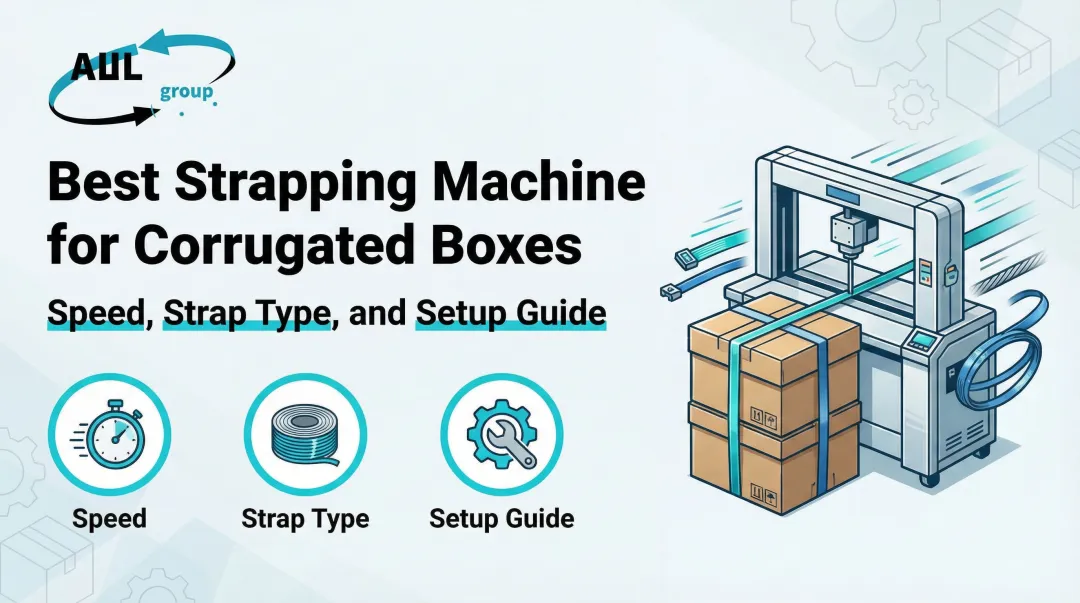
An automatic strapping machine is a packaging device that automatically feeds, tensions, seals, and cuts plastic or metal strap around a package without manual intervention. These machines turn end-of-line packaging from a labor-intensive task into a high-speed, repeatable operation.
Three main machine types serve e-commerce fulfillment:
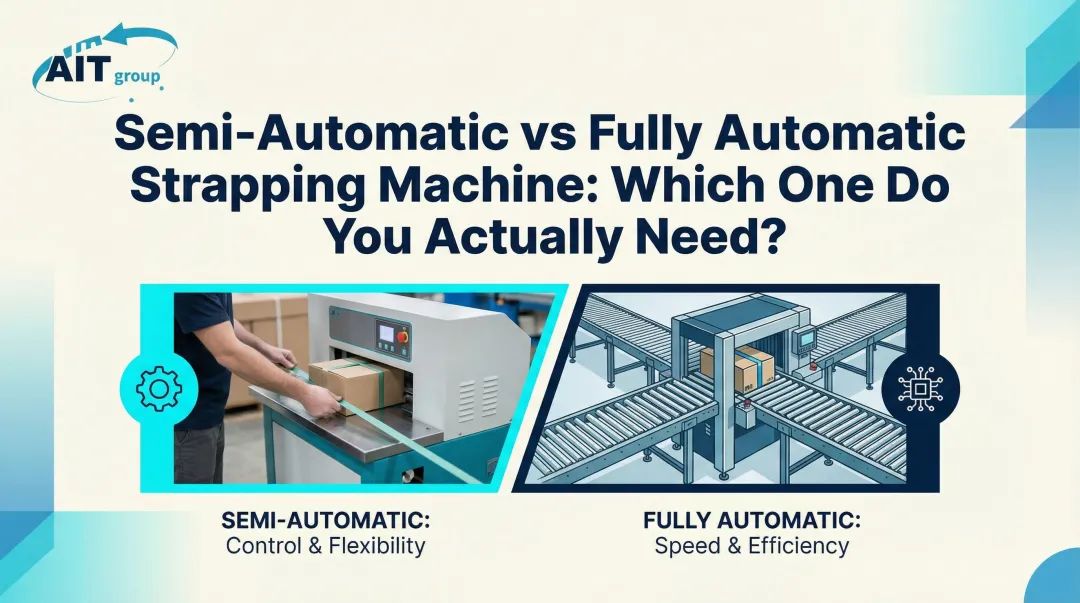
- Inline fully automatic — Integrates directly into conveyor lines with upstream pacers and automated actuation; ideal for high-volume operations processing 500+ packages per hour
- Standalone fully automatic — Self-contained units that handle package presentation automatically but don't control primary conveyor flow; suited for moderate-volume operations with dedicated strapping stations
- Semi-automatic — Requires operators to position packages and initiate each cycle via foot pedal or button; appropriate for facilities processing fewer than 200 packages per hour or handling highly irregular package shapes
How It Works
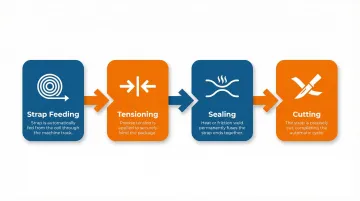
The four-stage cycle operates in sequence:
- Strap feeding — The machine draws strap from a coil and wraps it around the package
- Tensioning — Programmable tension control applies controlled pressure to secure the load
- Sealing — Heat or ultrasonic welding joins the strap ends into a permanent bond
- Cutting — The machine cuts the strap and resets for the next cycle
Advanced models add capabilities that support hands-free operation on live conveyor lines:
- Auto-tension adjustment — Compensates for package size variations without operator input
- Self-diagnostics — Alerts operators to potential issues before jams occur
- Photo-eye sensors — Detect package presence to trigger each cycle automatically
This lets one operator monitor multiple machines rather than manually feeding each package.
Why E-commerce Fulfillment Centers Rely on Automatic Strapping
E-commerce operations face a unique pressure: high daily order volumes combined with seasonal peaks that can triple throughput requirements overnight. Holiday surges, Prime Day events, and same-day delivery SLAs make manual strapping a throughput constraint and a labor cost problem. Warehouse compensation costs increased 3.4% year-over-year as of December 2025, while the industry faces a shortage of over 35,000 workers nationwide.
Manual strapping also introduces variability that hits the bottom line directly. Inconsistent tension leads to loose packages that shift in transit, and returns due to damaged products cost an average of $33 per $50 item—a cost that compounds fast at scale.
Automatic machines apply uniform tension on every cycle regardless of operator fatigue, removing that variability entirely.
Beyond consistency, automatic strapping machines integrate directly into conveyor-based pick-pack-ship lines — and that's where the real throughput gains appear:
- Handle 2x–3x peak-season volume with the same operator count
- Scale output with order flow, not headcount
- Maintain cycle speed regardless of shift length or fatigue
- Fit inline with existing conveyor systems without workflow disruption
Key Factors to Consider When Choosing an Automatic Strapping Machine for E-commerce
E-commerce fulfillment centers don't run like standard manufacturing lines. Package sizes shift by the hour, SKU counts run into the thousands, and machines must talk to upstream and downstream automation without friction. Six factors determine whether a strapping machine fits that environment — or fights it.
Throughput Speed and Cycle Time
Strapping cycles per minute must match upstream pick-and-pack rates and downstream sortation speed. A machine that's too slow becomes an immediate bottleneck, forcing line slowdowns or manual workarounds.
Critical sizing principle: Calculate your peak-hour package volume, not average daily volume. A facility averaging 300 packages per hour might hit 600 packages per hour during Black Friday. Select a machine rated above peak threshold—ideally 20-40% above—to allow the line to catch up after brief stoppages.
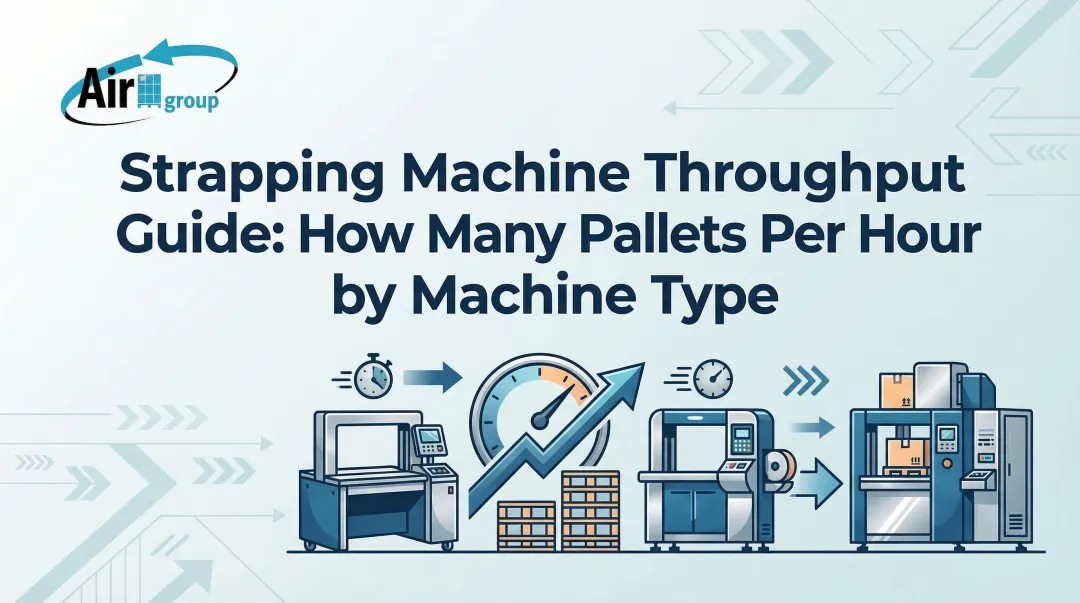
Inline fully automatic machines typically deliver:
- High-speed models: 42-58 straps per minute
- Standard models: 27-35 straps per minute
- Entry-level inline: 20-27 straps per minute
A 35-cycle-per-minute machine translates to 2,100 packages per hour theoretical maximum. Factor in changeovers, strap reloading, and brief stoppages to estimate realistic sustained throughput at 70-80% of theoretical maximum.
Package Size Range and Dimensional Flexibility
E-commerce SKUs vary widely—from small electronics in 6"×4"×2" mailers to large appliances in 24"×18"×12" cartons. The machine's arch size (the opening through which packages pass) and table height adjustability must accommodate your full range.
Key specifications to verify:
- Confirm the minimum package threshold — some machines can't reliably strap anything smaller than 4"×3"
- Check arch height (typically 24" to 48") and arch width (typically 18" to 36") against your largest carton dimensions
- Motorized or quick-adjust arch height settings cut changeover time significantly between package profiles
Facilities handling multi-category SKU mixes in a single shift benefit most from machines with saved job presets. An operator can switch from small packages to large cartons with a single button press rather than manual arch adjustment.
Strapping Material Compatibility
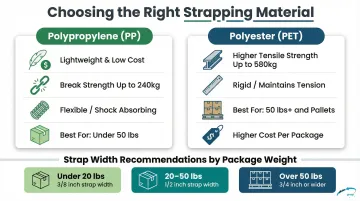
Two primary strap materials serve different applications:
Polypropylene (PP):
- Lightweight, lower cost per package
- Suitable for light-to-medium loads (up to 240kg break strength)
- Most common choice for e-commerce cartons
- Flexible, absorbs shock during transit
Polyester (PET):
- Higher tensile strength (up to 580kg break strength)
- Better for heavier loads or pallets
- More rigid, maintains tension better over time
- Higher cost per package
Matching material to load weight matters more than most buyers expect. PP strap on heavy packages breaks in transit and generates damage claims; PET strap on light packages means paying for strength the load doesn't require.
Match strap to load weight:
- Packages under 20 lbs: 5-6mm PP strap
- Packages 20-50 lbs: 9-12mm PP strap
- Packages over 50 lbs or pallets: 12-16mm PET strap
Verify the machine is rated for your chosen strap width and thickness. Calculate strap consumption cost per thousand packages to understand operating cost impact—a machine using 20% less strap per cycle delivers significant savings at high volumes.
Conveyor and Line Integration Compatibility
Inline automatic strapping machines must be mechanically and electrically compatible with existing conveyor systems. Mismatches require costly retrofitting that can delay deployment by weeks.
Critical integration parameters:
| Parameter | Typical Range | Why It Matters |
|---|---|---|
| Conveyor height | 800-1040mm (31-41 inches) | Machine table must align with belt height |
| Control voltage | 24V DC common | PLC integration requires matching voltage |
| I/O signals | Potential-free contacts | Communication with WMS or line control software |
| Pacer requirements | Upstream gapping | Prevents feed jams on continuous conveyors |
Unplanned warehouse downtime costs between $5,000 and $100,000 per hour during peak operations. Integration failures that cause line stoppages during Q4 carry severe financial consequences. Audit existing line speeds, belt heights, and I/O handshakes before purchasing to prevent engineering rework.
Ease of Operation and Changeover
Fulfillment center workforces often involve high turnover and rotating operators. Machines with intuitive touchscreen controls, clearly labeled preset programs, and minimal-tool strap re-threading reduce training time and operator error.
Quick-changeover features that matter:
- Tool-free strap path access for clearing jams
- Saved job presets for different package types
- Color-coded strap path guides
- Self-diagnostic displays that show specific error codes
These features directly reduce unproductive downtime when shifting between package types or strap widths mid-shift. A machine requiring 15 minutes of manual adjustment between changeovers costs 2-3 hours of lost productivity per day in facilities running mixed SKU operations.
Total Cost of Ownership and Serviceability
Purchase price is only one component of cost. Evaluate the full lifecycle:
TCO components:
- Consumable strap cost per cycle — Compounds significantly over 5-7 years
- Mean time between failures (MTBF) — Higher MTBF reduces maintenance labor
- Replacement parts availability — Common wear items should ship within 24-48 hours
- Service technician proximity — Local or contracted service reduces downtime
- Warranty terms — 2-3 year warranties with parts coverage reduce risk
Peak-season downtime is especially costly for e-commerce operations. Prioritize machines with strong warranty terms, available spare parts kits, and suppliers who can provide rapid technical support or replacement equipment. Over a five-year run, higher MTBF and faster parts availability routinely outweigh the upfront price difference between competing models.
How Alliance Packaging Group Can Help
For e-commerce fulfillment centers, coordinating separate vendors for strapping equipment, consumables, and line integration adds cost and delays deployment. Alliance Packaging Group consolidates all of that into a single source, with over 10,000 products in stock, factory-direct pricing, and nationwide just-in-time delivery.
APG's engineering team assesses your existing line layout and recommends strapping machine configurations that integrate cleanly with current systems, not off-the-shelf products that require costly adaptation.
Key reasons to work with Alliance Packaging Group:
- Prices below industry standard through factory-direct sourcing, reducing capital outlay on strapping equipment
- Ships immediately from over 10,000 products in stock, cutting lead time between decision and deployment
- Restocks PP and PET strap rolls on a just-in-time basis, so fulfillment lines don't carry excess inventory
- Designs custom conveyor systems and automation for facilities building or upgrading fulfillment lines
- Covers equipment, consumables, and material handling under one vendor relationship
During peak-season surges, that just-in-time restocking keeps consumables arriving on schedule without tying up warehouse space. On the integration side, APG's engineers handle the technical work that most often delays strapping automation projects: designing pacer conveyors, integrating photo-eye sensors, and configuring PLC communication protocols.
Conclusion
The right automatic strapping machine for an e-commerce fulfillment center isn't necessarily the fastest or the cheapest—it's the one that matches the facility's throughput requirements, package size range, integration architecture, and total cost profile. Common mismatches to avoid:
- Volume undersizing — a machine calibrated for average daily output will bottleneck during peak season
- Conveyor incompatibility — systems that don't integrate with existing lines require costly retrofitting
- Poor serviceability — limited parts availability or slow field support turns minor failures into extended downtime
As order volumes and shipping expectations rise, strapping automation is a strategic infrastructure decision, not just a line equipment purchase. Revisit your strapping setup periodically as your SKU mix, volume, and fulfillment technology evolve.
What works at 500 packages per day often becomes a constraint at 2,000. Peak-season surges expose bottlenecks that average-volume planning never catches—so build for where your operation is headed, not just where it stands today.
Frequently Asked Questions
What is the difference between a semi-automatic and fully automatic strapping machine?
Semi-automatic machines require an operator to position the package and manually initiate the strap cycle via foot pedal or button. Fully automatic machines detect the package via sensor and complete the entire feed-tension-seal-cut cycle without operator involvement. For fulfillment lines processing 300+ packages per hour, fully automatic machines are the practical choice.
What type of strapping material is best for e-commerce packages?
Polypropylene (PP) strap suits most e-commerce cartons up to 50 lbs — it's cost-effective and flexible. For heavier shipments or pallet unitizing above 50 lbs, polyester (PET) strap provides the higher tensile strength needed to prevent transit breakage.
How fast can an automatic strapping machine process packages in a fulfillment center?
Most inline fully automatic strapping machines apply one strap in 1.5–3 seconds, translating to 27–58 cycles per minute. Size your equipment to peak-hour order volume — not daily averages — so it doesn't bottleneck during seasonal surges.
Can automatic strapping machines integrate with existing conveyor systems?
Most fully automatic strapping machines support inline conveyor integration, but compatibility depends on belt height (typically 800–1040mm), conveyor speed, and I/O signal protocols. Confirm these specs with your supplier before purchasing to avoid costly retrofitting.
How do I calculate the ROI on an automatic strapping machine for my fulfillment center?
Compare your current annual labor cost for manual strapping against the machine's purchase price plus annual consumable and maintenance costs. Factor in productivity gains and reductions in shipping damage claims. Most facilities processing 300+ packages per day see payback periods of 12–24 months.
Do automatic strapping machines require dedicated maintenance or technical support?
Routine maintenance — strap path cleaning, sealing element checks, tension roller inspection — is handled by in-house operators following the manufacturer's schedule. Keep a service agreement or spare parts kit on hand to minimize downtime during peak periods when technician availability may be limited.