Introduction
Strapping machine prices span a surprisingly wide range—and picking the wrong tier can mean overspending by tens of thousands or buying a machine that bottlenecks your line within a year. The global strapping machine market is projected to reach $8.15 billion by 2033, driven by labor shortages and rising pressure to move product faster with fewer people.
Costs run from around $200 for basic manual tools to well over $100,000 for fully automated inline systems. What you pay depends on machine type, output speed, and automation level. This guide breaks down 2026 price ranges by tier, the factors that drive cost, and how to match the right machine to your operation.
Key Takeaways
- Manual strapping tools start around $200; fully automated high-speed systems exceed $100,000
- Machine type (manual, semi-automatic, or fully automatic) is the single biggest price driver
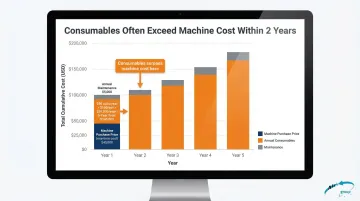
- Strapping consumables frequently outpace the machine's purchase price over a 3–5 year period
- Low-volume operations typically fit the $1,000–$6,000 range; high-volume facilities generally need $15,000+
- Total cost of ownership, not just the sticker price, should drive your budget decision
How Much Does a Strapping Machine Cost? (2026 Pricing Overview)
Strapping machine costs range from under $300 to well over $100,000 — and the gap comes down to machine type, automation level, throughput capacity, and strap material compatibility (PP, PET, or steel).
Common budgeting mistakes to avoid:
- Underestimating installation and consumable costs
- Choosing the wrong machine tier for the workload
- Overlooking compatibility with existing packaging lines
Here's how pricing breaks down across each tier.
Entry-Level Strapping Machines ($200–$3,500)
What's included:
- Manual handheld strapping tools and basic semi-automatic tabletop machines
- Suitable for light-duty or low-volume use
- Usually PP-compatible only
- Limited features and manual tension adjustment
Best for: Small businesses, e-commerce sellers, and operations strapping fewer than 100–200 packages per day that don't need continuous throughput.
Example pricing:
- Signode SCL manual tool: $1,415
- Fromm P328 battery-powered tool: $3,942
- IDL S-666 semi-automatic tabletop: $1,229
Mid-Range Strapping Machines ($3,500–$15,000)
What's included:
- Standard semi-automatic arch strapping machines and entry-level automatic machines
- Faster cycle times (24-30 cycles per minute)
- Adjustable tension and improved build quality
- PP and PET strap compatibility
- Basic digital controls
Best for: Mid-size manufacturers, distributors, and warehouses with moderate daily volume (200–1,000+ packages/day) looking to reduce labor and improve consistency.
Example pricing:
- PAC AUTOPAC300 semi-automatic arch: $6,160
- Strapack SQ-800: $8,995
- PAC SM65 automatic: $9,586
High-End Strapping Machines ($15,000–$100,000+)
What's included:
- Fully automatic inline strapping systems
- High-speed machines with conveyor integration (40-65+ cycles per minute)
- Multi-head strapping capability
- PLC controls and compatibility with steel strapping
- Built for continuous 24/7 operation
Best for: Large-scale manufacturing and distribution operations requiring high throughput, automation, and integration with existing conveyor or sortation systems.
At this tier, configuration and integration complexity vary widely — so requesting a direct quote based on your specific throughput and line requirements is always worth the extra step.
Key Factors That Affect the Cost of a Strapping Machine
Pricing depends on your technical specifications, operational demands, and sourcing decisions. Understanding these factors prevents overspending or underbuying.
Machine Type and Automation Level
Each step up in automation adds cost but reduces labor dependency and increases throughput:
- Manual tools ($200–$1,500): Require full operator involvement for every strap
- Semi-automatic tabletop ($1,000–$3,500): Operator loads package; machine tensions and seals
- Semi-automatic arch ($3,500–$9,000): Operator positions package under arch; machine handles rest
- Fully automatic ($8,500–$100,000+): Integrated with conveyors; minimal operator intervention
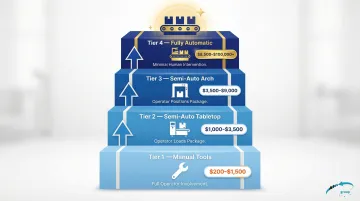
The cost differential between levels can be 3-5x, but labor savings often justify the investment for facilities processing over 100 packages daily.
Strapping Material Compatibility
Machines designed for different materials carry vastly different price tags:
| Material | Typical Applications | Machine Requirements | Relative Cost |
|---|---|---|---|
| Polypropylene (PP) | Light-duty, e-commerce, cartons | Low tension, standard heat-seal | Lowest |
| Polyester (PET) | Medium/heavy loads, lumber, bricks | Thermoelectric friction welding (0.5–1.5 kN force) | Moderate |
| Steel | Heavy industrial, metal coils, sharp edges | High-pressure hydraulic crimping (>10 kN force), hardened anvils | Highest |
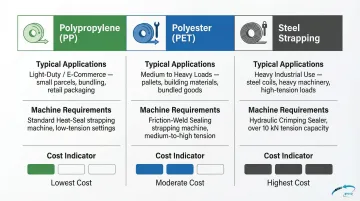
Steel machines command the highest prices — sometimes 3-4x more than PP-only units — because the hardened components and hydraulic crimping systems are built to an entirely different tolerance.
Speed and Throughput Capacity
Machines rated for higher cycles per minute (CPM) carry premium pricing:
- Entry-level: 24 CPM maximum
- Mid-tier automatic: 27-46 CPM
- High-speed automatic: 55-65 CPM
High-speed machines use advanced technologies like brushless DC motors and ultrasonic sealing. Top-tier models from brands like Transpak and Signode achieve 55-65 straps per minute through brushless motor drives that cut mechanical wear significantly.
Undersizing for your volume doesn't just create bottlenecks — it accelerates wear and shortens machine life, which makes throughput planning as important as the upfront price.
Integration and Automation Features
Each of the following can add $1,500–$15,000+ to the base equipment price:
- Inline conveyor integration
- PLC controls
- Automatic strap feeding
- Sortation system compatibility
- Multi-head strapping capability
Standalone machines cost less but require manual labor for feeding and positioning. Conveyor integration alone averages $1,500 per linear foot, while full integration can add 15-30% to the base equipment cost.
Brand, Build Quality, and Warranty
Reputable brands with longer warranties and better-quality components carry higher upfront costs but typically yield:
- Lower maintenance expenses
- Longer service life (10-15 years vs. 5-7 years)
- Better parts availability
- More reliable technical support
Premium machines with direct-drive brushless motors eliminate wear-prone belts and pulleys, reducing annual parts costs to as low as $500 per machine.
Full Cost Breakdown of a Strapping Machine
The purchase price is only one part of the total investment. Buyers should calculate the full cost of ownership over 3–5 years to make an accurate budget comparison.
Initial Purchase Price
One-time cost: $200 for manual tools to $100,000+ for fully automated systems.
Most buyers fixate on this number — but a cheaper machine often carries higher per-unit labor costs and more frequent repair bills that erode the savings quickly.
Installation and Setup
One-time cost that includes:
- Site preparation and machine mounting
- Electrical or pneumatic connections
- Integration with existing conveyor lines
Typical costs:
- Basic semi-automatic machine installation: $500–$2,000
- Electrical upgrades (110V/220V/480V 3-phase): $3,000–$15,000
- Compressed air systems (90 PSI / 6 bar): $2,000–$8,000
- Conveyor integration: $1,500 per linear foot
For complex systems, installation adds 15–30% to the base equipment cost. Ask vendors for turnkey quotes that cover ancillary costs — safety guarding, electrical work, and on-site commissioning — before signing off on any purchase.
Strapping Consumable Costs
The largest long-term expense in most strapping operations is the consumable — not the machine.
Material pricing per coil:
- PP strapping: $65–$138 (7,200–9,900 feet)
- PET strapping: $120–$200 (similar lengths)
- Steel strapping: $299–$398 (1,500–2,900 feet)
Annual consumption example: A facility strapping 500 boxes per day (125,000 boxes/year) using 30 inches of strap per box will consume approximately 290 coils annually. At $100 per coil, that's $29,000 in PP consumable spend each year — and $145,000 over five years, well above most machine purchase prices. Negotiating bulk consumable pricing at the time of equipment purchase is one of the most effective ways to control total cost of ownership.
Maintenance and Repairs
Maintenance covers scheduled servicing, replacement of wear parts (sealing jaws, tension rollers, feed wheels), and unplanned repairs.
Typical maintenance schedules:
- Semi-automatic machines: Bi-annual technician visits
- Fully automatic machines: Quarterly technician visits
Annual maintenance costs:
- Semi-automatic: $800–$2,000
- Fully automatic: $1,500–$5,000
- High-quality machines with brushless motors: As low as $500
Common wear parts pricing:
- Heater assembly: $117
- Full heater set: $291
- Drive belts: $12–$50
- Initial spare parts inventory: $3,000–$10,000
Operator Training and Downtime
These periodic costs include:
- Initial operator training (suppliers typically provide this at installation)
- Lost production time during breakdowns or scheduled maintenance windows
More complex machines demand more training investment upfront. That said, facilities moving to automatic systems often recoup it fast — one pharmaceutical distributor saved over $18,000 annually in labor costs while hitting 22 totes per minute throughput.
Low-Cost vs High-Cost Strapping Machines — What's the Difference?
Budget and premium strapping machines both strap packages, but they differ significantly in performance consistency, durability, and long-term operating economics.
Performance and speed:
- Low-cost machines run slower cycle times (12–24 CPM) and require more operator involvement
- High-cost machines deliver consistent, automated strapping at 40–65 CPM with minimal operator intervention
Durability and downtime risk:
- Entry-level machines use lighter-gauge components prone to wear and misalignment under heavy use, increasing unplanned downtime
- High-end machines use industrial-grade frames and sealed mechanisms built for continuous operation with lower downtime risk
Those feature gaps translate directly into operating costs. A cheaper machine carries higher per-unit labor costs and more frequent repair bills — and once a facility crosses roughly 100 packages per day, the math usually favors the upgrade.
TCO example:
- Entry-level semi-automatic ($3,000): 1 operator required, 30 CPM, ~$1,500/year in maintenance
- Mid-tier automatic ($12,000): 0.25 operators required, 50 CPM, ~$2,000/year in maintenance
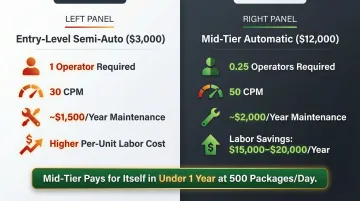
For a facility strapping 500 packages daily, the labor savings alone ($15,000–$20,000 annually) pays for the higher-tier machine in under a year.
How to Estimate the Right Budget for a Strapping Machine
The right budget comes down to operational fit. A machine priced too low for your volume becomes a bottleneck; one priced for capacity you won't reach for years ties up capital you could deploy elsewhere. Start with volume, then build outward.
Assess Daily Strapping Volume and Growth Projections
Decision matrix:
- Light volume (under 200/day): Entry-level manual or semi-automatic ($1,000–$3,500)
- Moderate volume (200–1,000/day): Mid-range semi-automatic or automatic ($3,500–$15,000)
- High volume (1,000+/day): Fully automatic inline system ($15,000–$100,000+)
Plan for 12-18 months of projected growth, not just current needs. A machine that fits today's volume but can't scale will become a bottleneck within months.
Calculate Total Cost of Ownership, Not Just Sticker Price
Factor in:
- Consumables (often the largest cost over 3-5 years)
- Maintenance and wear parts
- Energy costs
- Labor savings
A mid-range machine that saves 2 hours of labor per day may pay for itself faster than a cheaper model, even with a higher purchase price.
5-year TCO comparison:
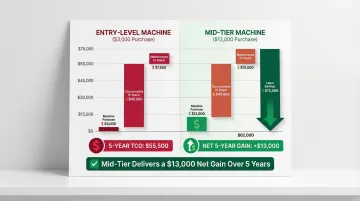
- Entry-level ($3,000 purchase): $3,000 + $45,000 consumables + $7,500 maintenance = $55,500 total
- Mid-tier ($12,000 purchase): $12,000 + $40,000 consumables + $10,000 maintenance = $62,000 costs — offset by $75,000 in labor savings = net gain of $13,000 over five years
Avoid These Common Budgeting Mistakes
- Focusing solely on upfront price
- Ignoring annual consumable costs
- Choosing a machine incompatible with required strapping material
- Skipping a site assessment before purchase
- Underestimating installation and integration costs
Most of these mistakes are avoidable when you work with a supplier who handles both equipment and consumables together.
Work with a Single-Source Packaging Partner
Alliance Packaging Group supplies strapping machines alongside the strap, seals, and accessories — all sourced through a single order. Factory-direct pricing cuts out distributor markups, and bundled purchases typically unlock volume discounts and just-in-time delivery programs that reduce inventory carrying costs. Compatibility between machine and consumable is confirmed before anything ships, not troubleshot after installation.
Frequently Asked Questions
What is the cheapest type of strapping machine available?
Manual handheld strapping tools start around $200–$500 and are the most affordable option. They're suitable for very low-volume applications (fewer than 50 packages per day) but require full manual operation for tensioning and sealing each strap.
How much does strapping material cost annually?
Annual consumable costs depend on volume and material type. PP strapping averages $65–$138 per coil (7,200–9,900 feet), while steel strapping costs $299–$398 per coil (1,500–2,900 feet). A facility strapping 500 boxes daily will spend approximately $29,000 annually on PP consumables—often exceeding machine cost over a 3-year period.
Is a semi-automatic or fully automatic strapping machine better for a small business?
Semi-automatic machines in the $2,000–$6,000 range are typically the best fit for small businesses with moderate volume (100–500 packages/day). They automate tensioning and sealing without the operational complexity or capital cost of fully automatic systems.
Can I lease or finance a strapping machine instead of buying outright?
Yes. Many equipment suppliers and third-party lenders offer leasing or financing options, which can reduce upfront capital requirements. This is particularly useful for mid-range to high-end machines in the $5,000–$50,000 range. Minimum financing amounts typically start at $5,000.
How long does a strapping machine typically last?
Well-maintained strapping machines last 7–15 years depending on usage intensity and quality. Manual tools average 3–5 years, semi-automatic machines 5–10 years, and fully automatic systems 10–15 years. Replacing wear parts on schedule is the single biggest factor in reaching the top of those ranges.
What's the difference between PP and PET strapping machines, and does it affect cost?
Most semi-automatic machines handle both PP and PET strap by adjusting tension settings, so you're not locked into a single material. PET-compatible models typically run $500–$2,000 more than PP-only machines due to higher tension requirements and friction-weld sealing mechanisms. Steel strapping is a different category entirely—it requires a dedicated machine and carries a substantially higher price tag.