Introduction
A warehouse manager faces a familiar dilemma: two strapping tools on the table, both capable of securing pallets, but the decision reaches far beyond the purchase order. One choice means installing compressors, running air lines, and scheduling maintenance. The other means managing battery rotations and charging schedules. Both impact workflow speed, labor costs, and the bottom line for years to come.
For manufacturing, distribution, and warehousing teams, the wrong strapping tool creates bottlenecks that ripple through operations. A tethered pneumatic tool limits worker mobility across sprawling facilities. A battery tool that dies mid-shift stalls an entire packaging line.
Hidden costs make the stakes even higher. Compressor energy bills, battery replacements, and infrastructure buildouts can turn a $4,000 tool into a $15,000 system investment.
This guide covers a side-by-side breakdown of battery-powered and pneumatic strapping tools: real cost data, performance differences, and a decision framework based on your operation type, facility layout, and strapping volume.
Key Takeaways
- Battery-powered tools are cordless and low-maintenance, ideal for mobile teams and flexible warehouses handling light-to-medium volumes
- Pneumatic tools deliver higher tension and faster cycles — best for fixed, high-volume industrial settings that already have compressed air infrastructure in place
- Battery tools cost more upfront but eliminate infrastructure expenses; pneumatic tools require compressors, hoses, and ongoing energy costs
- Strapping machine demand is projected to hit $8.15 billion by 2033, fueled by e-commerce growth and the shift toward cordless tools
- Match your tool to your operation: volume, load weight, facility setup, and team mobility all point toward one clear winner
Battery-Powered vs. Pneumatic Strapping Tools: Quick Comparison
| Feature | Battery-Powered | Pneumatic |
|---|---|---|
| Power Source | Rechargeable 18V lithium-ion batteries | Compressed air via compressor and hose |
| Portability | Fully cordless; use anywhere in facility or offsite | Tethered to air line; limited mobility |
| Tension Output | 2,600–4,500 N (585–1,011 lbf) | 4,500–8,400 N (1,000–1,888 lbf) |
| Cycle Speed | Moderate (49–150 mm/s tensioning) | Faster (continuous high-speed operation) |
| Maintenance | Minimal (battery charging, strap reload) | Regular compressor, hose, valve servicing |
| Noise Level | Quiet operation | Loud (often exceeds 100 dB) |
| Infrastructure Cost | Near-zero (chargers only) | High (compressor, filters, hoses, installation) |
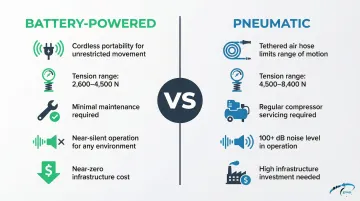
The table highlights the core trade-offs, but two differences tend to drive most purchasing decisions: portability and tension output.
On portability, battery tools have a clear edge. Without a hose tethering operators to a compressor, workers can move freely across large warehouses, outdoor loading docks, and remote packaging stations. Pneumatic tools cap mobility at roughly a 20-foot air line radius—a real constraint in large or multi-zone facilities.
On tension, the gap has narrowed. Battery tools reach up to 4,500 N, which covers most plastic strapping applications. Pneumatic tools still lead for extreme-duty steel strapping (up to 8,400 N) and high-volume lines where continuous power delivery is non-negotiable.
The infrastructure cost difference is worth factoring in early. Battery tools require only chargers. Pneumatic systems add compressor purchase, air filtration, hose distribution, and ongoing servicing—typically 5–10% of total system investment per year. Pneumatic tools also frequently exceed OSHA's 85 dBA hearing conservation threshold, which can trigger hearing protection requirements and associated compliance costs.
What Are Battery-Powered Strapping Tools?
Battery-powered strapping tools are handheld, cordless devices that use rechargeable 18V lithium-ion batteries to automatically tension, friction-weld, and cut plastic strapping (PP or PET) around packages, pallets, or bundles—no air hose or fixed power outlet required.
Key Operational Benefits:
- Completes each strap in seconds—automated tensioning and sealing replace several manual steps
- Handles strap widths from 12–19mm with adjustable tension, covering everything from lightweight cartons to heavy pallet loads
- Cordless design eliminates trip hazards and hose drag, so operators move freely across the floor
Tools like the Signode BXT4-19 show what modern 18V platforms can do: up to 4,500 N (1,011 lbf) of tension, 800 strapping cycles per charge on low-tension settings, and CoolPack heat dissipation that extends battery lifespan by 135% over standard lithium-ion cells.
Limitations to Consider:
- Long shifts require battery rotation—most operations keep 2–3 spare packs on hand
- Optimized for 13–19mm plastic strap; not suited for heavy-duty steel strapping
- Lithium-ion cells typically need replacement every 3–5 years, a recurring cost to factor into total ownership
Use Cases of Battery-Powered Strapping Tools
Battery tools fit best in warehousing and distribution workflows where workers move across large floor areas strapping cartons and pallets, operations without centralized air lines, and facilities with variable packaging stations or seasonal volume changes.
Industries Where Battery Tools Dominate:
- Logistics and e-commerce fulfillment centers processing diverse package sizes
- Food and beverage packaging operations requiring mobility between production lines
- Retail distribution centers with decentralized packaging stations
- Construction sites and outdoor packaging locations without power infrastructure
- Remote shipping docks and temporary staging areas
The global shift toward battery-operated handheld tools is driven by improved mobility and safety, with the strapping machine market expected to grow at a 5.1% CAGR through 2033. Field testing indicates that switching to battery systems can boost warehouse output by up to 65% compared to manual tools, with payback periods under 1.5 years for facilities processing more than 200 packages daily.
What Are Pneumatic Strapping Tools?
Pneumatic strapping tools are air-powered handheld devices that use compressed air to apply high-tension strapping for heavy, irregular, or large-volume loads. Supplied via compressor and hose at 6 bar (87 psi), they're available for both plastic (PP/PET) and steel strapping applications.
Key Operational Benefits:
- Consistent, high-tension output on every cycle with no power fade between charges—pneumatic tools deliver 4,500–8,400 N of tension continuously
- Faster strapping speeds suited to continuous high-volume lines where cycle time directly impacts throughput
- Rugged build with fewer electronic components contributes to longer tool lifespan in demanding environments; some models achieve 50,000 cycles before major component replacement
That durability comes at a trade-off, though—pneumatic tools depend entirely on compressed air infrastructure, which shapes both where and how they can be deployed.
Limitations:
- Tools are tethered to a compressor and air hose, reducing flexibility and creating a 20-foot operational radius
- Facilities without existing compressed air infrastructure face significant setup costs (compressors, hoses, filters, dryers)
- Compressor noise frequently exceeds 100 dB, creating hearing protection requirements in many facilities
- Ongoing energy cost to run the compressor adds to long-term overhead—compressed air systems require 7–8 HP of electrical power to generate 1 HP of pneumatic power
Use Cases of Pneumatic Strapping Tools
Pneumatic tools fit best in fixed industrial workstations, conveyor-integrated packaging lines, facilities already equipped with compressed air systems, and operations requiring consistent high-tension strapping across shifts without recharging interruptions.
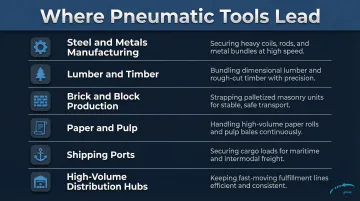
Industries Where Pneumatic Tools Dominate:
- Steel and metals manufacturing (coils, rods, sheets)
- Lumber and timber bundling operations
- Brick and block production facilities
- Paper and pulp bundling lines
- Shipping ports handling heavy export loads
- Large distribution hubs with high-volume pallet strapping requirements
For facilities already running compressed air infrastructure, that investment is largely sunk—making pneumatic tools a straightforward fit. Studies show switching to battery-powered equivalents can yield 76% energy savings, or roughly $104 per tool annually, which becomes relevant when weighing the two options head-to-head.
Cost Breakdown: What You'll Really Spend on Each Option
Upfront Tool Cost
Battery-Powered Tools: $3,900–$5,100 per unit
- Signode BXT4-16: $3,899–$5,081
- FROMM P328S: $3,942–$4,170
- Orgapack OR-T 270: $4,400
Pneumatic Tools: $3,850–$4,450 per unit
- FROMM A480: $3,858
- Signode PNSC-2 series: $4,444
Battery tools carry a higher per-unit purchase price, while pneumatic tools cost less upfront but require additional infrastructure to operate.
Infrastructure Investment
Battery Tools: Near-zero infrastructure cost
- Battery chargers included with tool purchase
- Standard 110V electrical outlets sufficient
- No installation or setup required
Pneumatic Tools: $2,500–$5,000+ for basic setup
- Industrial air compressor (5 HP, 60–80 gallon): $2,239–$3,399
- Refrigerated air dryer (15 cfm): $1,627
- Inline coalescing filters: $86–$197
- Air hoses, fittings, and installation labor: $500–$1,000
For facilities without existing compressed air systems, the infrastructure investment increases the total cost of pneumatic tool adoption.
Ongoing Operating Costs
Battery Tools: $50–$150 per year per tool
- Electricity for periodic charging: minimal (under $50 annually)
- Battery pack replacement every 3–5 years: $47–$213 per battery depending on capacity (4.0Ah vs. 8.0Ah)
Pneumatic Tools: $200–$400+ per year per tool
- Compressor electricity: compressed air is energy-intensive — it takes 7–8 HP of electrical input to run a 1 HP air motor (DOE compressed air efficiency data)
- Annual maintenance (5–10% of system investment): scheduled compressor servicing, air filter replacements, hose inspections
An Oak Ridge National Laboratory case study found that switching from pneumatic to battery-powered tools cut energy costs by 76% — roughly $104 per tool annually at $0.10/kWh.
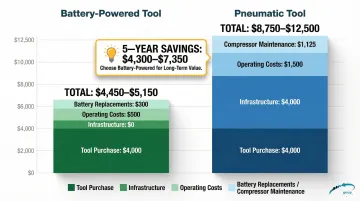
Total Cost of Ownership (5-Year Horizon)
Battery-Powered Tool:
- Tool purchase: $4,000
- Infrastructure: $0
- Operating costs (5 years): $250–$750
- Battery replacements (2 cycles): $200–$400
- Total: $4,450–$5,150
Pneumatic Tool:
- Tool purchase: $4,000
- Infrastructure: $3,000–$5,000
- Operating costs (5 years): $1,000–$2,000
- Compressor maintenance: $750–$1,500
- Total: $8,750–$12,500
If your facility already runs a compressed air system, pneumatic tools can close that gap — you're not paying for infrastructure you don't have. But for operations starting from scratch, the 5-year cost difference of $4,300–$7,350 is hard to ignore.
Which Strapping Tool Is Right for Your Operation?
Decision Framework: Four Key Variables
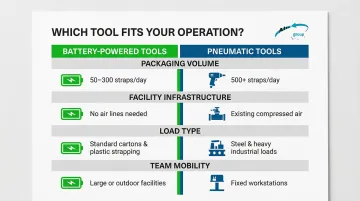
1. Packaging Volume
- High-volume continuous lines (500+ straps/day): Pneumatic tools deliver consistent tension without recharging interruptions
- Light-to-medium volume (50–300 straps/day): Battery tools handle the workload efficiently with 1–2 spare batteries
2. Facility Infrastructure
- Existing compressed air system: Pneumatic tools become far more cost-effective when infrastructure is already in place
- No air lines: Battery tools eliminate the $3,000–$5,000 infrastructure investment
3. Load Type
- Heavy, dense, or irregular loads requiring maximum tension: Pneumatic tools excel with steel strapping and extreme tension (up to 8,400 N)
- Standard cartons and pallets: Battery tools deliver sufficient tension (2,600–4,500 N) for most plastic strapping applications
4. Team Mobility
- Workers moving across large facilities or outdoor settings: Battery tools eliminate the 20-foot hose radius limitation
- Fixed packaging stations: Pneumatic tools work efficiently when operators remain in one location
Situational Recommendations
Choose battery-powered if:
- Your team moves across the floor to strap in multiple locations
- Your facility lacks existing compressed air infrastructure
- You need to strap outdoors or in remote areas
- You want to minimize maintenance burden and noise levels
- Your operation handles standard cartons and pallet loads with plastic strapping
Choose pneumatic if:
- You run a fixed, high-volume packaging line (500+ straps/day)
- You already have compressed air infrastructure in place
- You need consistent high-tension performance shift after shift
- You're strapping heavy industrial loads (steel, lumber, brick) requiring maximum tension
- Your operation prioritizes tool longevity and continuous operation over mobility
Real-World Example
A mid-sized distribution center processing 300 pallets daily evaluated both options. The facility lacked compressed air infrastructure, and workers moved between 12 packaging stations across a 50,000-square-foot warehouse. Initial analysis showed pneumatic tools would require a $4,500 compressor system plus 200 feet of air hose runs.
The operation chose battery-powered tools with three spare battery packs per unit. Six months in, the results were clear:
- ~40% reduction in strapping time per pallet by eliminating hose management
- Zero downtime from tangled air lines across all 12 stations
- Significantly lower energy costs compared to the projected pneumatic system
- Full investment payback estimated at 14 months
Alliance Packaging Group supplies both battery-powered and pneumatic strapping tools, along with compatible PP and PET strapping materials. If you're weighing the options for your facility, contact us at 770-309-1012 or email sales@apg-go.com — we can help you match the right tool to your volume, load type, and setup.
Frequently Asked Questions
What is the difference between battery tools and pneumatic tools?
Battery tools run on rechargeable 18V lithium-ion batteries for cordless, portable use anywhere in your facility. Pneumatic tools use compressed air from a compressor to deliver higher, continuous tension. The core difference is power source, mobility, and performance tier.
Which strapping tool is better for high-volume packaging operations?
Pneumatic tools are generally preferred for continuous, high-volume operations (500+ straps/day) due to consistent tension output and faster cycle times without recharging interruptions. Modern battery tools now handle moderate volumes (200–400 straps/day) reliably with spare battery rotation.
How much does a pneumatic strapping system cost compared to a battery-powered tool?
The pneumatic tool itself costs $3,850–$4,450 — comparable to battery tools at $3,900–$5,100. Total system cost climbs significantly once you add a compressor ($2,239–$3,399), filters ($86–$197), dryers ($1,627), and installation. Battery tools require only chargers, so infrastructure cost is near zero.
Can battery-powered strapping tools handle heavy-duty applications?
Modern battery strapping tools deliver 2,600–4,500 N of tension and handle most general packaging tasks, including heavy pallet loads with plastic strapping. For very heavy loads (steel, lumber, dense industrial materials) requiring maximum tension (up to 8,400 N), pneumatic tools remain the stronger option.
What strapping materials are compatible with battery-powered vs. pneumatic tools?
Battery tools are optimized for PP and PET plastic strapping, typically 12–19mm widths and 0.4–1.0mm thicknesses. Pneumatic tools support a broader range including wider PP/PET and, in specific models, steel strapping from 12–19mm widths.
How long do batteries last on a battery-powered strapping tool?
Most 18V lithium-ion battery packs support 400–800 strapping cycles per charge (depending on tension settings) with typical charge times of 60–90 minutes. The battery itself lasts 3–5 years before needing replacement. High-output operations commonly rotate 2–3 spare battery packs to eliminate downtime.