Introduction
LTL freight passes through multiple terminals and is handled repeatedly by forklifts, dock workers, and loading equipment. Unlike full truckload (FTL) shipments, there is no dedicated truck for your pallet — your freight shares space with dozens of other shipments and changes hands eight to ten times between origin and destination.
Every one of those handoffs is a chance for an unsecured pallet to shift, tip, or drop pieces.
Carriers have specific, non-negotiable expectations for how pallets must be strapped and secured before they'll accept or move a shipment without issue. This article walks you through exactly what carriers inspect for strapping compliance, what materials and techniques meet the standard, and what happens when a shipment falls short.
NMFC (National Motor Freight Classification) guidelines set the baseline for packaging requirements, but individual carrier tariffs often add their own specifications on top. Knowing both layers is what keeps shipments moving — and keeps damage claims and reclassification fees off your invoice.
Key Takeaways
- LTL shipments face shock, vibration, compression, and repeated handling — strapping is your only protection across every terminal transfer
- Start with a structurally sound pallet, interlocked case stacking, and aligned corners — strapping can't compensate for a weak foundation
- Polyester or polypropylene strapping covers most LTL loads; steel is only needed for very heavy industrial freight
- Anchor straps to the pallet deck, clear the forklift tine zones, and use powered tensioning tools for consistent pull
- Most LTL carriers require stretch film applied with 50% overlap, anchored at the base, and folded over the top layer
Why LTL Handling Makes Proper Strapping Non-Negotiable
LTL freight is subjected to four primary hazard forces during transit:
- Shock — from braking, potholes, and forklift handling, creating compressive forces up to 5 times the weight of upper shipments (5g)
- Vibration — constant during road transport, gradually loosening insufficiently secured loads
- Compression — from stacking, strapping tension, and load shifting inside the trailer
- Environmental exposure — temperature swings, humidity, and condensation that weaken packaging materials
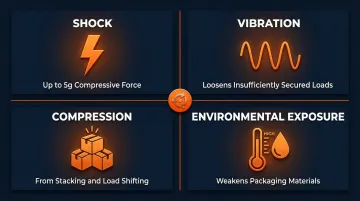
Each of these forces can dislodge or damage a pallet that is poorly secured. The problem compounds in LTL because freight doesn't travel point to point — it moves through multiple break-bulk terminals, getting loaded, unloaded, staged, and reloaded along the way. Each touchpoint is a new opportunity for an unsecured pallet to shift or tip.
Carriers track claims per shipper account. Up to 3% of all LTL shipments result in claims, and a pattern of improperly secured freight can lead to increased scrutiny at pickup, refused loads, or reclassification fees. If a carrier accepts a non-compliant shipment and it's later damaged, they can deny your freight claim citing improper packaging — and you'll have no grounds to dispute it.
Pallet Construction Standards: What Must Come Before the Strap
Strapping only works if the pallet itself is structurally sound. Carriers expect pallets to have a bottom deck board to prevent collapse from forklift tine pressure, with at least three inches of clearance on the side for pallet jack access. Per the NMFTA LTL freight packaging guidelines, longer pallets should allow access from all four sides, with chamfered runner boards spaced at least 28 inches apart.
Once the pallet base is solid, how you stack cases on top determines whether the load survives transit.
Proper Case Stacking Patterns
Cases should be placed in a column or brick pattern (interlocking layers) rather than stacked in straight columns. Interlocking distributes weight across multiple boxes and prevents column collapse.
Corner alignment directly affects how much load a stack can bear:
| Misalignment Type | Strength Loss |
|---|---|
| Slight corner misalignment | 12.5% |
| Pallet deck misalignment | 32% |
| Total misalignment (overhang or interlock stacking) | 50% |
As the ABF Packaging Guidelines explain, misalignment bypasses the vertical corners of corrugated boxes — the structural element that carries two-thirds of the stack's weight. Even a quarter-inch overhang can cut load strength in half.
Dimensional and Weight Limits
Carriers enforce strict dimensional standards:
- Maximum freight height: 90 inches for trailers, 84 inches for straight trucks
- Weight distribution: Heavier items belong on the bottom layers, never the top
- Pallet overhang: Cases must not extend beyond the pallet deck edge
Strapping Materials and Specifications Carriers Expect
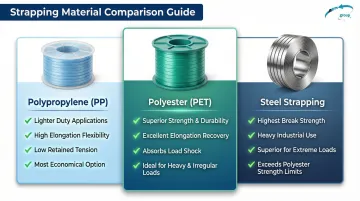
Carriers don't usually mandate a specific strapping material, but the strap must be rated to hold the load weight without breaking or slipping. The three main types used for LTL pallets are:
Polypropylene (PP):
- Lighter duty, suitable for lighter or uniform loads
- High elongation but low retained tension — can deform over time
- Economical for moderate-weight shipments
Polyester (PET):
- Stronger with better elongation recovery
- Preferred for heavier or irregularly shaped loads
- Absorbs shock without snapping, maintains tension even if the load settles
Steel:
- Highest strength, used for very heavy or industrial freight
- Reserved for applications where break strength demands exceed what polyester can meet
Tensile Strength and Break Strength
ASTM D3950 governs nonmetallic strapping specifications, requiring that joined strapping retain at least 45% of its minimum breaking strength. Check the manufacturer's break strength rating and confirm it exceeds your load weight by a reasonable safety margin before committing to a strap grade.
Strap Width Matters
Wider straps distribute load pressure over a larger surface area, reducing the risk of the strap cutting into packaging or crushing edges. Common widths include 3/4" for lighter loads and 1¼" for heavier or more fragile freight.
Alliance Packaging Group stocks polypropylene, polyester, and steel strapping at factory-direct pricing — useful for operations that ship varied freight types and need more than one strap grade on hand.
Strap Hardware: Seals, Buckles, and Tensioners
Choosing the right material is only half the equation — the closure method determines whether tension holds through the full transit. Failure points that inspectors flag most often include:
- Open seals that weren't crimped properly
- Hand-tensioned straps that weren't pulled to adequate tension
- Buckles that slipped during transit
For heavier pallets, use powered tensioners — pneumatic or battery-operated — rather than manual tools. They deliver consistent tension that hand tools can't match reliably across a full shift.
How to Strap a Pallet Correctly: Placement, Tension, and Coverage
Getting strapping placement right is the difference between a load that arrives intact and one that shifts, collapses, or gets rejected at the dock. Each element — placement, tension, and coverage — has to work together.
Standard Strap Placement Pattern
Straps should run both lengthwise and widthwise over the load, securing the cargo to the pallet deck itself rather than just bundling the boxes together. For most standard pallets:
- Minimum of two horizontal straps — one near the top of the load, one near the bottom
- At least one vertical strap running over the top of the load
- Cross strapping on heavier or taller loads to prevent lateral shift
Where Straps Must NOT Be Placed
Carriers specifically flag improper strap placement during pickup. Two zones to avoid:
- Forklift tine entry zones on the pallet bottom — a strap in the tine path snaps on pickup and can release the entire load
- Pallet jack wheel paths across the top of the pallet — straps in this position get pinched and fail under load movement
Tension Requirements
A strap that can be wiggled, lifted, or shifted by hand is not adequately tensioned. Powered tensioners are more reliable than manual tools for achieving consistent tension across a full load. Manual tensioning rarely achieves the force needed for LTL compliance, which is why powered tools are the standard in professional shipping operations — and why edge protection at strap contact points matters just as much as tension.
Strap Protectors (Edge Protectors)
Place strap protectors beneath the strap at box corners to prevent the strap from cutting through corrugated packaging and creating a pressure point that leads to box failure mid-transit. Carriers may not require them explicitly, but their absence is a common source of freight damage that voids claims.
Anchor to the Pallet Deck
Straps should anchor under the pallet runners or through the deck boards to prevent upward movement of the load, not just wrap around the exterior of the boxes. Without proper anchoring, a load can lift vertically off the deck during transit — even if horizontal strapping is tight.
Stretch Film and Corner Boards: Completing the Securing System
The Role of Stretch Film
Stretch film is NOT a substitute for strapping on heavy loads, but it serves a critical complementary function:
- Keeps individual boxes unified as a single unit
- Protects surfaces from abrasion and dust
- Reduces shifting between layers
Carriers expect stretch film on nearly every palletized LTL shipment.
Correct Stretch Film Application
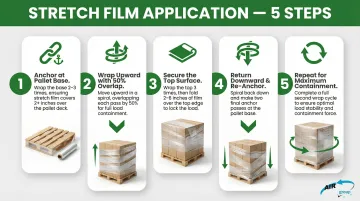
NMFTA and major LTL carriers require specific stretch wrapping techniques:
- Wrap the pallet base and bottom layer 2-3 times, with at least 2 inches of film covering the pallet itself
- Move upward in overlapping passes with at least 50% overlap between layers
- Wrap the top surface 3 times, folding 2-6 inches of film over the top edge
- Return downward and anchor the film at the pallet base with two final passes
- Repeat the full wrap cycle for optimal load containment
Stretch the film to roughly 80% of its rated capacity. Hand-tight wrapping falls short of LTL requirements — machine wrapping with films pre-stretched to 200-250% delivers the containment force carriers actually need.
The Role of Corner Boards
Corner boards (also called edge protectors) are placed vertically at the four corners of the pallet load before strapping. They:
- Prevent straps from cutting into box edges
- Distribute compression forces across the full height of the load
- Prevent column collapse when loads are stacked
High tension from stretch wrappers can collapse corrugated box corners — corner boards protect against this failure mode. Both corner boards and stretch film are available from Alliance Packaging Group if you need to source these components together.
Limitations of Stretch Film
Stretch film handles surface protection and load unity — but it has real limits that matter under LTL conditions:
- Does NOT prevent damage to fragile surfaces
- Does NOT protect fragile contents from internal impact or vibration
- Will NOT hold a heavy or unstable load together under LTL conditions without supplemental strapping
What Gets Flagged: Common Strapping Mistakes and Their Consequences
Most Common Pallet Strapping Failures
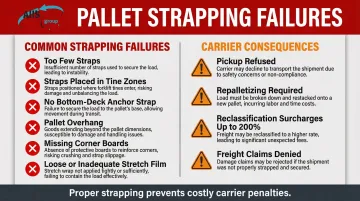
Carriers flag these issues at pickup or use them as grounds to deny claims:
- Too few straps for the load weight — one or two straps rarely meet minimum requirements above 1,000 lbs
- Straps positioned across forklift tine zones, where they'll snap on the first lift
- No bottom-deck anchor, so straps slide off under lateral stress
- Overhang beyond the pallet deck edge, shifting load weight off-center
- Missing corner boards, letting straps cut into carton edges and fail
- Stretch film applied too loosely or only at mid-height, leaving the top layer unsecured
Carrier Consequences
Non-compliant pallets trigger:
- Driver refuses pickup outright and leaves without loading
- Repalletizing required on-site before the truck will move, delaying your freight window
- Reclassification surcharges added at billing — FedEx Freight Tariff Item 687 allows carriers to charge 200% of the highest LTL class for non-compliant packaging
- Freight claims denied after delivery — if damage traces back to poor securing, the carrier owes you nothing
The Rule of Thumb Test
Knowing the consequences makes the pre-shipment check worth two minutes of your time. Before calling for pickup, push and tip the pallet from each side with moderate pressure. If it shifts, wobbles, or individual boxes slide, it is not ready. A correctly strapped pallet moves as one rigid unit — not a stack of boxes held together by hope.
Frequently Asked Questions
Do LTL shipments need to be on a pallet?
While pallets are strongly recommended and often required by carriers, some will accept floor-loaded or crated freight. However, non-palletized shipments face greater handling risk, may incur special handling charges, and must still meet NMFC packaging standards for their commodity class.
When building a pallet to be shipped, how should the cases be placed on the pallet?
Cases should be arranged in an interlocking or brick-lay pattern — heavier items on the bottom, lighter on top, corners aligned with the pallet edge — since straight column stacking without interlocking dramatically reduces load integrity and increases the risk of collapse during transit.
Do pallets have to be wrapped?
Most LTL carriers expect stretch film wrapping on palletized freight as a standard requirement. Unwrapped pallets are more likely to be flagged, refused, or to suffer damage during transit — wrapping is considered part of the minimum securing standard alongside strapping.
What is the significance of the 750 and 6 rule in LTL shipping?
The "750 and 6" rule is a density-based freight classification formula. When a shipment occupies 750 cubic feet or more at under 6 lbs. per cubic foot, carriers multiply total cubic feet by 6 to calculate a rated weight — making accurate measurement and weight declaration essential for cost control.
What happens if my pallet doesn't meet carrier strapping requirements?
The carrier may refuse pickup, require on-site repackaging, accept the shipment and later deny any damage claims citing improper packaging, or assess additional handling charges. All of these outcomes create delays, added costs, or lost claim value.
Can I use plastic strapping instead of steel for LTL freight?
Polyester strapping is widely accepted and often preferred for LTL — it absorbs shock without snapping, is lighter, and is safer to handle than steel. Steel strapping is reserved for very heavy industrial freight where break strength demands exceed what polyester can provide.
Final Takeaway: Carriers inspect pallet strapping at pickup and use packaging standards as grounds to deny damage claims. Following the placement, tension, and material specifications covered above keeps your freight protected and your claims valid.