Introduction
Picture this: A procurement manager at a mid-sized distribution center spots an opportunity to cut costs by 20% on strapping material. The supplier's quote looks attractive on paper—lower price per roll, immediate availability, no questions asked. Three months later, that same manager is dealing with:
- A damaged shipment claim worth $15,000
- A worker's compensation case from a snapped steel strap
- An emergency reorder at triple the normal price because the latest batch won't feed through the strapping machine
Sound familiar? Or worse—is this a risk you're currently taking?
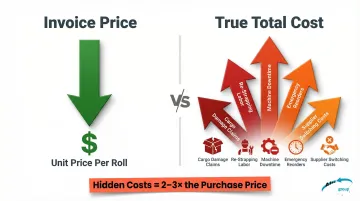
The true cost of strapping material never appears on the supplier's invoice. It hides in cargo damage claims, re-strapping labor, machine downtime, and safety incidents—costs that compound fast once a critical packaging component starts failing. This article uncovers the specific cost categories that drain operating budgets across manufacturing, distribution, and shipping, and shows you how to evaluate strapping the right way.
Key Takeaways
- Cheap strapping compounds costs through cargo damage, labor delays, equipment wear, and emergency reorders
- One strapping failure can trigger damaged goods claims, rejected shipments, and customer relationship damage
- Use total cost of ownership (TCO) to evaluate strapping — not price per roll
- Matching the correct material (PP, PET, or steel) to your load eliminates most hidden costs
Why Cheap Strapping Looks Like a Smart Buy
Strapping is typically treated as a commodity line item in procurement. Buyers compare price per roll or per meter across suppliers, select the lowest quote, and move on to the next purchase order.
The problem: strapping performance only becomes visible after purchase, when it's holding (or failing to hold) a $50,000 pallet load during cross-country transit.
The procurement trap works like this:
- Strapping gets classified as MRO (Maintenance, Repair, and Operations) spend
- MRO accounts for just 5-10% of cost of goods sold but generates 70-80% of all procurement transactions
- Decentralized, fragmented MRO spend pushes procurement toward unit-price purchasing rather than strategic sourcing
- The buyer never sees dimensional tolerances, raw material grade, or surface treatment specs—all invisible in a catalog listing but critical to performance under load
What low-cost suppliers cut to hit that price:
- Raw material grade (virgin resin vs. recycled content with inconsistent properties)
- Dimensional consistency (width and thickness tolerances that affect machine feeding and tensile performance)
- Surface treatments (galvanizing, waxing, or corrosion protection for moisture environments)
- Quality control testing (batch-to-batch tensile strength verification)
Unit price is just the starting point. Every downstream cost triggered by strapping failure — repackaging labor, freight claims, damaged goods — adds to the total. Initial packaging prices represent only 20-30% of true lifetime costs, with hidden expenses multiplying the investment by 2 to 3 times.
The Hidden Costs That Never Show Up on Your Invoice
Cargo Damage and Product Loss
When low-tensile or inconsistently manufactured strapping snaps under load during transit, the cost of damaged or destroyed goods—often many times the cost of the strapping itself—falls on the shipper. Cargo theft and loss cost the U.S. trucking industry up to $6.6 billion annually, and improper securement is a leading cause of freight damage.
The math is brutal: the average value per cargo theft incident reached $202,364 in 2024. Even partial damage claims from shifted loads easily exceed $10,000-$15,000 per incident. A $40 strapping decision can trigger a five-figure loss.
Re-Strapping Labor and Productivity Loss
Cheap strapping that fails mid-application, breaks during tensioning, or requires multiple passes to hold a load properly slows down packaging lines. Each re-strap event adds direct labor time and creates downstream delays in shipping schedules.
According to Bureau of Labor Statistics May 2023 data, fully burdened labor rates tell the real story:
- Packers and packagers earn $17.05/hour base wage
- Freight and material movers earn $19.12/hour
- Industrial equipment operators earn $21.98/hour
When you factor in benefits, taxes, and overhead, the fully burdened labor rate is typically 25-40% higher—meaning that $19/hour worker actually costs $24-27/hour.
Example scenario: If a packaging line experiences just 3 re-strap incidents per shift (8 hours), with each incident taking 10 minutes to identify, cut away failed strapping, reposition the load, and re-apply strapping, that's 30 minutes of lost productivity per shift. At $25/hour fully burdened cost, that's $12.50 per day, $62.50 per week, or $3,250 annually—from a single packaging station.
Strapping Machine Wear and Maintenance Costs
Low-quality strapping with dimensional inconsistencies causes excessive wear on strapping tool components—sealing heads, tensioners, and feeding mechanisms—and increases jam frequency. OEM manuals explicitly warn that improper strap threading, inconsistent material dimensions, and contaminated strapping lead to failed welds and machine jams.
When automated strapping lines fail, the costs escalate rapidly. 83% of industry decision-makers agree unplanned downtime costs a minimum of $10,000 per hour, with 76% estimating costs up to $500,000 per hour.
Even minor maintenance events add up: frequent service calls, replacement sealing heads, and preventive part swaps that wouldn't be necessary with dimensionally consistent, high-quality strapping.
Emergency Procurement Costs
Inferior strapping from unreliable suppliers often comes with inconsistent batch quality. Operations managers suddenly find themselves with a roll of material that won't tension correctly, won't seal properly, or breaks repeatedly under normal loads. This triggers rush orders at premium pricing, expedited freight, and operational disruption.
The emergency procurement premium compounds fast:
- Air freight runs 5-10x more expensive than ground shipping
- Sourcing through brokers during shortages adds 10-30% or more in premiums
- Carriers like FedEx impose demand surcharges from $1.55 to $8.75 per package during peak periods
Suppliers with deep, consistent inventory—Alliance Packaging Group carries over 10,000 packaging products with nationwide just-in-time delivery—let operations teams avoid this cost category by design rather than by luck.
Supplier Switching and Qualification Costs
When cheap strapping repeatedly underperforms, procurement teams eventually cycle through suppliers. Each switch requires time to evaluate samples, test material on production equipment, qualify new batches, update specifications, and retrain operators. This hidden administrative and operational cost is rarely attributed to the original low-price decision, but it's real: procurement staff time, production testing time, and the risk period while new material is being validated.
Cargo Damage, Shipment Rejections, and Brand Fallout
The Chain Reaction of Strapping Failure
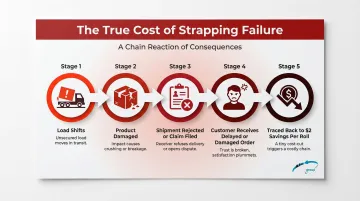
A single strapping failure during transit sets off a chain reaction:
- Goods shift or tip during acceleration, braking, or cornering
- Product damage occurs—crushed boxes, broken components, contaminated materials
- The shipment is rejected at receiving or a damage claim is filed
- The end customer experiences a delayed or damaged order
- All traceable back to the strap that cost $2 less per roll
Contamination and Compliance Rejections
Shipment rejections—especially in food and beverage, pharmaceutical, or retail sectors—can be triggered not just by product damage but by contamination risk or load instability that makes the shipment non-compliant upon arrival.
Rust contamination example: Low-quality or untreated steel strapping that corrodes can rust-stain palletized goods. In food and pharmaceutical applications, the FDA considers food adulterated if it contains extraneous materials, including rust. This can trigger full-batch rejections, not just individual carton write-offs.
Retail compliance penalties: Walmart's OTIF (On-Time In-Full) program deducts 3% of the cost of goods sold from supplier invoices when shipments fail to arrive on time or in correct quantity. Walmart's routing guide prohibits metal banding and requires specific pallet configurations—cases that fall or become unstable when stretch wrap is removed are flagged as non-compliant.
The Brand and Customer Relationship Cost
Repeated delivery failures erode customer confidence and can displace a supplier from preferred vendor status. In manufacturing, distribution, and e-commerce, on-time and intact delivery is a baseline expectation—not a differentiator. When strapping failures cause delays or damage, the consequences are difficult to put a number on but very real:
- Lost contracts and reduced order volumes
- Future orders discounted just to retain the relationship
- Removal from approved vendor lists in compliance-heavy industries
Insurance Implications
The financial exposure doesn't stop at the damaged goods. A pattern of cargo damage claims raises freight insurance premiums over time and can trigger policy exclusions for improperly secured loads. Under Institute Cargo Clauses (Clause 4.3), insurers can deny claims due to "insufficiency of packing". If a load shifts because cheap strapping snaps, the insurer can legally deny the claim, leaving the shipper liable for the full loss.
Safety, Compliance, and the Liability Nobody Budgets For
The Specific Safety Hazard of Cheap Strapping
When low-quality steel strapping or brittle polypropylene strapping snaps under tension, it can whip back and cause lacerations or eye injuries. U.S. businesses spend more than $58 billion per year on serious workplace injuries, with the National Safety Council reporting that the cost per medically consulted injury averages $43,000.
OSHA accident reports document severe strapping incidents:
- An employee was killed when crushed while attempting to unjam a banding machine
- An employee died from a cranial injury after falling when a trailer door strap broke
- An employee suffered laceration and tendon damage when struck by a falling steel band
Each recordable incident carries direct costs — workers' comp, medical bills, lost production time — plus indirect costs like investigation, retraining, and the morale damage that follows a serious injury. Those indirect costs often run 3–5× the direct expense, yet they rarely appear in a line-item budget review.
Regulatory Compliance Requirements
Beyond the physical injury risk, strapping failures in regulated shipping channels create a separate layer of exposure. Rail, maritime, and intermodal freight all operate under load securement standards that specify acceptable materials — and "cheap but functional" doesn't satisfy them:
- Rail (AAR standards): The Association of American Railroads Open Top Loading Rules dictate strapping requirements, such as using 1¼ in. × 0.029 in. high-tension bands or approved Type IA polyester strapping for lumber
- Maritime (IMDG/USCG): 49 CFR § 176.74 mandates that packages containing hazardous materials must be secured by proper lashing, including strapping, and must not be over-tightened to cause damage
- Cross-border (CTPAT): CTPAT guidelines require documented load securement procedures
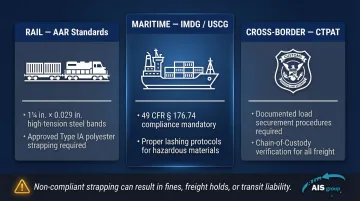
Using non-compliant or substandard strapping can result in regulatory fines, freight holds, or liability in the event of a transit accident.
Audit Risk in Regulated Industries
Companies in pharmaceutical, food and beverage, or medical sectors face a harder problem: audit findings. When a third-party auditor or FDA inspector reviews packaging security procedures, "we used whatever strapping was available" isn't a defensible answer.
Off-brand or inconsistently manufactured strapping creates traceability gaps. If you can't provide lot numbers, tensile load certifications, or manufacturer documentation for the strapping used on a given shipment, you may fail a qualification audit — triggering re-inspection costs, corrective action requirements, or, in worst cases, contract termination with a regulated customer.
How to Calculate the True Cost of Your Strapping Material
The Total Cost of Ownership (TCO) Framework
The real cost per unit secured should factor in far more than the roll price. The Institute for Supply Management's TCO framework tracks every dollar from purchase to disposal. For strapping, a complete TCO calculation must include:
1. Material cost per load
- Unit price × straps per application
- Include waste from failed applications
2. Labor cost per application
- Base application time × fully burdened labor rate
- Add re-strapping time × failure rate
3. Machine maintenance cost
- Annual maintenance spend attributable to strapping quality
- Downtime cost from jams and feeding issues
4. Cargo claim costs
- Average claim value × annual claim frequency
- Include rejected shipment costs
5. Safety incident costs
- Workers' comp, medical, and lost time
- Investigation and retraining expenses
Simple TCO Worksheet for Buyers
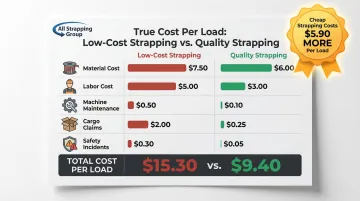
| Cost Category | Low-Cost Strapping | Quality Strapping |
|---|---|---|
| Material cost per load | $2.50 | $3.00 |
| Straps per load (due to failures) | 3 | 2 |
| Total material cost | $7.50 | $6.00 |
| Labor cost per load (including re-strapping) | $5.00 | $3.00 |
| Machine maintenance (annual ÷ loads) | $0.50 | $0.10 |
| Cargo claims (annual ÷ loads) | $2.00 | $0.25 |
| Safety incidents (annual ÷ loads) | $0.30 | $0.05 |
| Total cost per load | $15.30 | $9.40 |
This simplified example shows how a "cheaper" strapping option that costs $0.50 less per strap actually costs $5.90 more per load when you include downstream impacts.
How to Evaluate Quality Before Buying
Look for these specifications:
- Dimensional consistency: Width and thickness tolerances within ±0.5mm
- Tensile strength ratings: Matched to load requirements (verify with test certificates)
- Surface treatment: Galvanized for moisture, painted/waxed for general use, rust-proof PET for food/pharma
- Supplier transparency: Material grade disclosure (virgin vs. recycled content percentages)
Red flags that signal low quality:
- No published dimensional tolerances
- Generic "heavy-duty" claims without tensile strength data
- Far lower price than established brands with no explanation
- No batch testing or quality certificates available
- Inconsistent color or texture within the same roll
The Single-Source Advantage
Once you know what to look for, the next challenge is finding a supplier who can deliver it consistently. Unreliable suppliers introduce two hidden costs the TCO worksheet above doesn't fully capture: emergency procurement premiums and batch quality surprises that reset your failure rate mid-run.
Alliance Packaging Group addresses both through factory-direct pricing and nationwide just-in-time delivery programs. With over 10,000 products in stock and more than 1,000 box sizes available for immediate shipment, operations managers can maintain lean inventory without the stockout risk that forces last-minute substitutions — and the downstream costs that follow.
Frequently Asked Questions
What are the different types of strapping materials?
There are three primary types: polypropylene (PP) for light-to-medium loads, polyester (PET) for medium-heavy loads as a cost-effective alternative to steel, and steel strapping for the heaviest applications requiring zero stretch or high heat and edge resistance.
What is an alternative to steel strapping?
Polyester (PET) strapping is the most common alternative, offering comparable break strength at lower weight and cost, with greater safety during handling. Steel remains necessary for loads involving extreme weight, sharp edges, or very high temperatures where plastic would degrade.
How does cheap strapping affect my strapping machine?
Strapping with dimensional inconsistencies (width or thickness variation) can jam feeding mechanisms, accelerate wear on sealing heads, and increase maintenance frequency—effectively shifting cost from the strapping budget to the equipment maintenance budget.
Can low-quality strapping void cargo insurance claims?
Yes. Insurers can deny or reduce claims if the strapping used was inadequate for the declared load weight or type. Documenting compliant strapping specifications is part of proper cargo claim defense under Institute Cargo Clauses.
How do I know if my strapping is the right grade for my load?
Match tensile strength rating to total load weight plus transit stress, choose width and thickness based on load surface material (wider for soft goods to prevent cutting), and verify the surface treatment matches the storage and transit environment.
Is polypropylene strapping ever the right choice?
PP strapping is appropriate and cost-effective for light-to-medium loads in stable environments, but it's not suitable for heavy loads, sharp edges, high heat, or outdoor/moisture-exposed applications where its low stretch recovery and environmental sensitivity become failure points.
Cheap strapping isn't cheap. The real costs show up elsewhere: damaged goods, injured workers, rejected shipments, and emergency reorders that weren't in any budget. Calculate total cost of ownership, match material to application, and work with a supplier who keeps quality-tested stock on hand. That's how you close the gap between what strapping costs on paper and what it actually costs to operate.