Introduction
Using the wrong strapping width creates operational risk. Loads shift in transit. Straps snap under tension. Box surfaces get damaged. These failures happen daily across warehouses and distribution centers.
Strapping width isn't one-size-fits-all. Cardboard boxes, mixed pallets, and heavy industrial loads each have different requirements. Choose wrong and you face real costs: product damage, rework time, and failed shipments that erode customer trust.
Getting the width right starts with understanding your load. This guide covers standard width ranges, the six key selection factors, and practical application breakdowns for boxes versus pallets — so you can specify the right size with confidence.
Key Takeaways
- Strapping width affects holding strength — 1/2" suits light cardboard boxes; 1" to 1.25"+ secures pallets and heavy loads
- PP (polypropylene) works for lighter applications; PET (polyester) handles heavier loads and long-haul transport
- Six factors drive width selection: load weight, box/pallet size, material type, application method, break strength, and standards
- Too narrow risks strap failure; too wide wastes material and may jam equipment
- Alliance Packaging Group stocks PP and PET strapping in standard widths — factory-direct pricing, nationwide delivery
What Is Strapping Width?
Strapping width is the measurement across the flat face of the strap, typically expressed in inches or millimeters. This dimension determines three critical performance factors: surface contact area, tension distribution, and load-bearing capacity around a package or pallet.
Types of Strapping Materials and Width Ranges
Four main strapping materials dominate industrial packaging:
- PP (Polypropylene) — Lightweight, economical, suited for light-to-medium loads
- PET (Polyester) — Higher tension retention, preferred for heavy pallets and long-haul transport
- Steel — Maximum strength for extreme industrial applications
- Composite/Cord — Specialized applications requiring flexibility and high break strength
PP and PET dominate cardboard box and pallet applications and are available in the widest range of widths. Standard widths include:
- 1/4" (6mm) — Light bundling and small parcel reinforcement
- 1/2" (12mm) — Small cardboard boxes and retail packaging
- 3/4" (19mm) — Medium loads and multi-case bundles
- 1" (25mm) — Standard pallet loads and distribution applications
- 1.25" (32mm) — Heavy industrial pallets and high-weight loads
Why Correct Width Matters
A strap's holding strength is directly related to its width. Wider straps distribute tension across a larger surface area, reducing the chance of the strap cutting into or crushing cardboard. That larger contact area also reduces snap-under-load failures on heavier shipments.
Beyond load performance, width directly determines equipment compatibility. Strapping machines are calibrated for specific width ranges — using a mismatched strap causes feeding errors, seal failures, and line downtime. For example, the Fromm P328 tool is specified strictly for 10.0–16.0 mm widths; outside that range, the tool jams or fails to tension correctly.
What to Consider When Choosing the Right Strapping Width
Strapping width must match your load, environment, and operational constraints — evaluate all three together to get both security and cost efficiency right.
Load Weight and Volume
Load weight is the primary driver of strapping width. Heavier loads require wider straps with higher break strength to prevent strap failure during handling, stacking, or transport vibration.
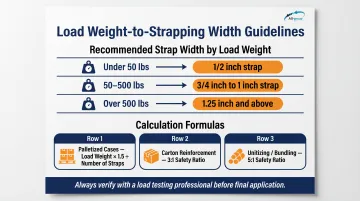
General load-to-width guidelines:
- Under 50 lbs — 1/2" strapping typically sufficient
- 50–500 lbs — 3/4" to 1" recommended
- Over 500 lbs or multi-tier pallets — 1.25" or wider
Industry formulas provide more precision. For palletized cases, calculate required tensile strength using: (Pallet Weight × 1.5) / Number of Straps. For carton reinforcement, use a 3:1 ratio of total strap break strength to package weight. For unitizing and bundling, a 5:1 ratio protects against failure.
Box or Pallet Size and Surface Area
The footprint of the load affects how strap width distributes tension. A small cardboard box with a narrow profile benefits from a narrower strap that applies focused tension. A wide pallet needs a wider strap to prevent lateral load shift.
For tall or unstable pallet configurations, multiple straps of the appropriate width work better than relying solely on a wider strap. NMFC Item 680 mandates at least two straps in each direction for palletized freight to enhance stability.
Strapping Material: PP vs. PET
Material choice interacts directly with width selection:
PP (Polypropylene):
- More flexible and lower-cost
- Appropriate for lighter boxes and hand-strapping applications
- Available in narrower widths (typically 5mm to 19mm)
- Loses approximately 50% of applied tension within an hour
PET (Polyester):
- Retains tension better over time
- Resists elongation and environmental stress
- Preferred for pallets and heavy corrugated loads
- Available in wider widths (9mm to 32mm)
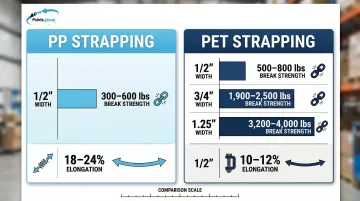
PET strapping at the same width as PP provides significantly higher break strength. For example, 1/2" PP typically offers 300–600 lbs break strength, while 1/2" PET delivers 500–800 lbs.
PET also resists temperature and moisture changes during long-haul transit, making it the better choice for loads exposed to outdoor storage or cross-country shipping.
Application Method: Hand vs. Machine Strapping
How the strap is applied determines the usable width range. Most strapping machines are designed for specific widths (commonly 3/4" or 1"). Using an incompatible width causes equipment jams and inconsistent seals.
Hand vs. machine compatibility:
- Hand-grade strapping — Generally available in narrower widths, softer tensions, appropriate for operator-applied packaging with manual tensioners and sealers
- Machine-grade strapping — Manufactured under tighter tolerances with minimal camber, engineered for consistent automated tension at wider widths
Battery-powered tools create friction welds that achieve up to 85% joint efficiency, compared to ~60% for manual tools using mechanical closures. This efficiency difference matters when calculating required break strength.
Break Strength and Elongation Requirements
Break strength (the maximum load a strap can bear before snapping) and elongation (how much it stretches before breaking) are both functions of width and thickness combined. Both must be evaluated against the load's weight and handling conditions.
Standard break strength by width:
- 1/2" (12mm) PP: 300–600 lbs; 18–24% elongation
- 1/2" (12mm) PET: 500–800 lbs; 10–12% elongation
- 3/4" (19mm) PET: 1,900–2,500 lbs
- 1.25" (32mm) PET: 3,200–4,000 lbs
For shock-prone or vibration-heavy transport (flatbed trucking, ocean freight), select a strap with adequate width and higher elongation tolerance. This prevents snap failure on impact when loads experience sudden deceleration or rough handling.
Box Type: Corrugated vs. Carton Board
The box material being strapped matters. Corrugated cardboard boxes are structurally stronger and can tolerate the higher tension of wider, tighter straps. Carton board or high-print-quality boxes are more vulnerable to surface damage and may benefit from wider, lower-tension strapping to distribute pressure and avoid crushing.
For high-value printed carton boxes, some operations opt for banding over traditional strapping. Banding uses wide, gentle materials (paper or film) with a maximum tensile force of 30 kg, while strapping uses PP, PET, or steel for applications requiring higher tensile strength where the product isn't sensitive to abrasive forces.
Industry and Regulatory Requirements
Certain industries have packaging and load-securement standards that may mandate specific strapping specs:
- Food and beverage — Often requires food-safe PP materials
- Medical/pharmaceutical — May have temperature-stability requirements favoring PET
- Freight carriers — May enforce minimum break-strength requirements for pallet loads
FMCSA 49 CFR 393.102 requires tiedown assemblies to withstand 0.8g deceleration in the forward direction. Compliance with ISTA (International Safe Transit Association) or ASTM packaging standards may also factor into strapping selection. Verify applicable standards for your sector before finalizing specifications.
Strapping Width by Application: Cardboard Boxes vs. Pallets
The right strapping width depends on load weight, box construction, and how far the shipment travels. These recommendations give you a practical starting point before finalizing specs with your supplier or running tension tests.
Cardboard Boxes: Light to Medium Loads
For light applications — e-commerce parcels, retail shelf stock, and small corrugated cartons under 50 lbs — 1/2" (12mm) PP strapping is typically sufficient. It handles hand-strapping lines well without crushing corners or damaging printed surfaces.
Medium-weight corrugated boxes in the 50–150 lb range call for 3/4" (19mm) PP or light-gauge PET. This width holds tension without crushing box corners or flaps, and it provides enough break strength for warehouse handling and short-to-medium haul transport.
Pallets: Standard to Heavy Industrial Loads
For pallet loads in the 300–1,000 lb range — typical of retail and distribution operations — 1" (25mm) PET strapping is the standard choice. It holds tension across truck and warehouse environments without the gradual loosening you get with PP strapping.
Heavy loads over 1,000 lbs — machinery, stone, lumber, and dense industrial components — require 1.25" (32mm) PET or steel strapping. Use multiple strap placements at different heights for full load control. This keeps top-heavy loads stable during transport and reduces the risk of strap failure mid-haul.
Quick-Reference Width Selection Summary
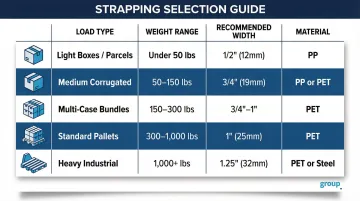
| Load Type | Weight Range | Recommended Width | Material |
|---|---|---|---|
| Light boxes/parcels | Under 50 lbs | 1/2" (12mm) | PP |
| Medium corrugated boxes | 50–150 lbs | 3/4" (19mm) | PP or PET |
| Multi-case bundles | 150–300 lbs | 3/4" to 1" (19–25mm) | PET |
| Standard pallets | 300–1,000 lbs | 1" (25mm) | PET |
| Heavy industrial pallets | 1,000+ lbs | 1.25" (32mm) | PET or Steel |
How Alliance Packaging Group Can Help
Alliance Packaging Group stocks a full range of PP and PET strapping across standard widths — from 1/2" for cardboard box applications to 1.25"+ for heavy pallet operations. Products ship nationwide from available inventory, so orders don't sit waiting on lead times.
That availability pairs with factory-direct pricing, which is particularly useful for high-volume operations. Bulk orders reduce per-unit cost while maintaining the load security and material quality the application requires.
Alliance serves manufacturing, distribution, warehousing, and shipping operations across the U.S., with over 10,000 packaging and industrial products in stock. The sales team can help match the right strapping width and material to specific load profiles.
To get product guidance or request a quote:
- Phone: 770-309-1012
- Email: sales@apg-go.com
Conclusion
Choosing the right strapping width comes down to a few key variables:
- Load weight and density
- Box or pallet type and dimensions
- Strapping material (polyester, polypropylene, steel)
- Application method (manual, semi-automatic, or automatic)
Using one width for everything leads to either under-secured loads or unnecessary material waste.
Strapping requirements should be reviewed whenever load profiles change. New products, new shipping lanes, or new equipment can all shift your requirements. What works today may not hold up after a line upgrade or carrier change. Make periodic specification review a standard operational practice.
Frequently Asked Questions
What is the best tape to secure cardboard boxes?
For corrugated cardboard boxes, pressure-sensitive polypropylene packing tape (2" wide) or water-activated reinforced tape is recommended for sealing flaps. Strapping (PP or PET) is the appropriate solution for bundling multiple boxes or securing loads to pallets. Tape and strapping serve different structural roles.
What strapping width is best for standard cardboard boxes?
1/2" (12mm) PP strapping suits light single-box applications under 50 lbs. 3/4" (19mm) PP or PET is the standard choice for heavier corrugated boxes or multi-case bundles. The right width depends on box weight and how the load will be handled in transit.
What is the difference between PP and PET strapping?
PP (polypropylene) strapping is lighter, more flexible, and lower-cost — suited for light-to-medium loads. PET (polyester) retains tension better over time, resists elongation, and is preferred for heavy pallets and long-haul transport where load shift is a higher risk.
Can I use the same strapping width for both boxes and pallets?
In most cases, no. Cardboard boxes typically require narrower strapping (1/2" to 3/4") to avoid surface damage and equipment mismatch. Pallets require wider strapping (1" to 1.25"+) for the break strength and tension retention needed to hold mixed loads during transit and warehouse handling.
What happens if strapping is too narrow for the load?
Undersized strapping concentrates tension on a small contact area, increasing the risk of the strap snapping under load or the strap cutting into the box surface. Both failures result in product damage, load shift, or failed delivery, adding rework and replacement costs.
Does strapping width affect which strapping machine I can use?
Yes. Strapping machines are configured for specific strap widths and must be matched accordingly. Using the wrong width causes feeding jams, improper sealing, or inconsistent tension, reducing the value of automated strapping and increasing line downtime.