Introduction
Shoppers make purchase decisions in under 7 seconds at the shelf—before reading a single word of copy. This reality makes retail packaging the single most important sales asset a brand controls at point of purchase. With 76% of purchase decisions made in-store, packaging must capture attention instantly while navigating sustainability mandates and logistics costs.
That pressure now extends beyond the physical shelf. E-commerce unboxing experiences have added a second arena where packaging either earns loyalty or loses it. This guide covers the core pillars—design psychology, material selection, sustainability credentials, and cost optimization—with strategies that drive measurable sales results in both channels.
Key Takeaways
- Shoppers decide in seconds — your packaging must lead with brand identity, product benefit, and a clear reason to buy
- Right-sizing packaging to actual product dimensions cuts shipping costs and signals quality to buyers
- Eco-friendly packaging drives purchase decisions, but sustainability and shelf appeal aren't mutually exclusive
- Overdesigning, oversized boxes, and ignoring omnichannel needs silently drain revenue
- Sourcing from suppliers with 1,000+ box sizes and nationwide just-in-time delivery keeps packaging decisions agile
Why Retail Packaging Is Your Brand's Hardest-Working Salesperson
Packaging functions as a "silent salesperson" that must attract attention, communicate value, differentiate from competitors, and trigger purchase decisions without human interaction. Unlike a product page or sales rep where clarification is possible, packaging gets one chance to convert browsers into buyers — and that window is shorter than most brands expect.
The 7-Second Shelf Decision Window
Shoppers use peripheral vision to scan shelves, making split-second judgments about which products deserve closer inspection. The first three visual cues — color, structure, and dominant graphic — determine whether a shopper reaches for your product or passes it by. Research from POPAI shows that in-store decision rates reached 82% in mass merchant channels, meaning most shoppers enter the aisle without brand commitment.
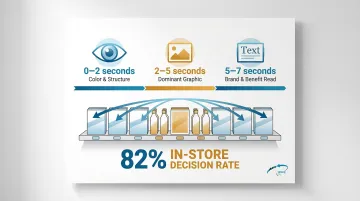
Designers must optimize for how shoppers scan shelves by creating clear focal points that register instantly. Complex designs with multiple competing elements get ignored. Simple, bold visual statements win the reach test.
Premium Packaging Cues Drive Higher Price Points
The psychological link between packaging quality and product value is measurable. Research on cosmetic packaging demonstrates that consumers willingly pay a 5% price premium for products featuring soft-touch tactile coatings compared to those without. Structural rigidity, matte finishes, and embossing all signal premium positioning and justify higher retail prices.
That 5% premium compounds quickly at scale — for a $20 product moving 50,000 units, upgraded tactile finishes can generate $50,000 in incremental revenue without changing the product itself.
The Omnichannel Packaging Challenge
A single SKU in 2026 must perform across three distinct scenarios:
- Competes on physical shelves against dozens of alternatives in seconds
- Reproduces accurately in e-commerce photos across varied lighting and screen settings
- Delivers an interior experience worth sharing — tissue, inserts, messaging included
Brands must design for all three scenarios simultaneously rather than adapting packaging after launch. Test prototypes under in-store lighting, photograph samples for digital channels, and evaluate the interior experience — all before committing to production runs.
Unboxing as Content and Revenue Driver
39% of online shoppers have shared product images on social media, with many specifically highlighting branded packaging. The interior experience — tissue paper, inserts, messaging — directly affects repeat purchase likelihood and word-of-mouth recommendations. 55% of consumers who watched an unboxing video were convinced to purchase as a result.
That means every box shipped is a potential piece of earned media — one that costs nothing extra if the packaging is already designed to impress.
The Core Design Elements of Retail Packaging That Converts
Effective retail packaging works by guiding shoppers through a specific sequence of information — from brand recognition to purchase decision — in under 10 seconds. Every design choice either supports or undermines that sequence. These are the core elements that determine whether your packaging converts at shelf.
Visual Hierarchy on Pack
Primary message (2-second readability):
- Brand name and logo
- Product category or hero benefit
- Must be readable from 6-8 feet away
Secondary message (5-second scan):
- Key differentiators (organic, award-winning, new formula)
- Product variants (flavor, size, strength)
- Supporting visuals that reinforce the benefit
Tertiary information (close inspection):
- Regulatory requirements
- Nutritional facts
- Ingredient lists
- Usage instructions
Example: A premium kombucha brand places its name and "Organic Probiotic Kombucha" as the primary message in large, bold type. Secondary elements include flavor callouts with fruit imagery. Tertiary details like ingredient lists and certifications appear in smaller type at the bottom.
Color Strategy for Shelf Differentiation
Color creates instant shelf differentiation within a category and signals product attributes. Green universally signals natural or organic positioning. Black communicates premium quality. Bright colors attract attention but can appear mass-market.
That said, color alone doesn't close the deal. Color research from Loyola University found that color improves brand personality ratings when aligned with specific attributes — red for excitement, blue for competence — but eye-tracking studies show that physical design features often drive initial attention more than color choices.
Color selection checklist:
- Does it stand out from competitors in the same category?
- Does it align with brand personality and product positioning?
- Is it consistent with broader brand visual identity?
- Will it reproduce accurately across different substrates?
Typography Choices That Communicate Instantly
Typography must be legible at small sizes while establishing clear hierarchy through font weight and scale. Type style carries personality: a serif font on a whiskey bottle signals heritage and craft; the same serif on a tech gadget package feels dated and misaligned. Choose based on what your category expects, then break that expectation deliberately if differentiation is the goal.
Common typography mistakes:
- Using more than two typeface families on a single package
- Choosing decorative fonts that sacrifice legibility
- Insufficient contrast between text and background
- Inconsistent type hierarchy that confuses the eye
Structural Design as a Competitive Advantage
Physical package shape differentiates products before shoppers read a word. Unusual die cuts, window cutouts, handles, and closure mechanisms attract attention and communicate product character. A competitor can match your color palette in weeks. Replicating a proprietary structural design takes months — and often a tooling investment that smaller rivals won't make.
Using Finishing Techniques to Elevate Perceived Value
Finishing options add cost but meaningfully shift consumer perception of quality and price tier:
- Spot UV directs the eye to brand marks or key visuals with glossy contrast against a matte surface
- Soft-touch lamination creates a velvety feel that shoppers associate with higher-end products — studies show it increases willingness to pay
- Foil stamping in gold, silver, or holographic finishes signals luxury and is particularly effective for gifting occasions
- Embossing and debossing add physical dimension that photographs don't convey, making the in-store experience distinct from e-commerce browsing
These effects should be used intentionally to direct attention, not scattered across every surface. Overuse dilutes impact and increases costs without proportional benefit.
How to Choose the Right Materials and Formats for Your Retail Packaging
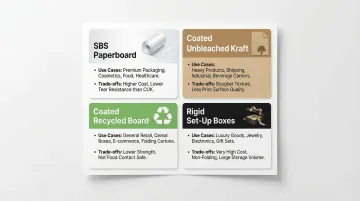
Substrate selection balances printability, cost, structural protection, and consumer perception while meeting sustainability requirements.
Common Retail Packaging Substrates
| Substrate | Best For | Key Trade-offs |
|---|---|---|
| SBS (Solid Bleached Sulfate) | Cosmetics, medical products, frozen foods, luxury goods | Superior printability and hygiene; higher cost and environmental impact |
| Coated Unbleached Kraft (CUK) | Beverage carriers, heavy-duty retail packaging | Excellent strength; natural brown backing may not suit all aesthetics |
| Coated Recycled Board (CRB) | Dry foods, laundry soap, paper products | Cost-effective and sustainable; lower tear resistance than virgin boards |
| Rigid (Set-Up) Boxes | Luxury jewelry, electronics, confections | Maximum perceived value; high shipping costs due to volume |
Format Selection by Channel and Price Point
The global e-commerce packaging market is valued at $106.46 billion in 2025, projected to grow at 17.9% annually through 2033 — with corrugated board holding over 50% market share. That growth means format decisions are increasingly tied to channel strategy, not just aesthetics.
- Folding cartons work best for mid-tier CPG products that need shelf visibility and moderate protection
- Rigid boxes suit premium or gift items where the unboxing experience justifies the higher packaging cost
- Mailer boxes handle direct-to-consumer e-commerce, balancing shipping durability with brand presentation
- Hanging retail bags serve accessories and small items that need planogram-friendly display formats
Format choice affects not only brand perception but also planogram placement and retail partner requirements. Alliance Packaging Group stocks over 1,000 box sizes available for immediate shipment, so brands can test new formats without locking into large custom runs upfront.
Sustainability in Material Selection
82% of consumers express willingness to pay more for sustainable packaging, and products making ESG-related claims achieved 28% cumulative growth over five years. That said, price sensitivity remains real — performance still has to come first.
Key sustainability credentials:
- FSC-certified paperboard from responsibly managed forests
- High post-consumer recycled content corrugated (50–100%)
- Mono-material structures that simplify recycling
- Curbside recyclable constructions meeting Amazon FFP requirements
Major retailers now enforce these standards directly. Amazon's Frustration-Free Packaging program requires 100% curbside recyclability, while Walmart's supplier scorecards prioritize FSC-certified fiber and right-sized packaging.
Meeting those requirements doesn't have to mean sourcing from multiple vendors. Alliance Packaging Group carries sustainability-credentialed options including 100% recycled paperboard mailers, TerraBoard™ products with 75% post-consumer content, and EarthKraft™ recyclable padded mailers that meet curbside recycling standards.
Right-Sizing Your Retail Packaging to Cut Costs Without Sacrificing Brand Impact
Dimensional weight pricing penalizes empty space — and for brands shipping multiple SKUs, that cost adds up fast. Right-sizing your packaging reduces shipping charges without stripping away the structural integrity or shelf presence your product needs.
Understanding DIM Weight Pricing
Carriers calculate dimensional weight using the formula: (Length × Width × Height) ÷ Divisor. They charge based on whichever is greater—actual weight or DIM weight.
Current carrier divisors:
- FedEx: 139 for U.S., Puerto Rico, and international
- UPS: 139 for Daily Rates, 166 for Retail Rates
Starting August 18, 2025: Both FedEx and UPS round every fractional inch up to the next whole inch for DIM calculations. A package measuring 11.1" × 8.1" × 6.1" now calculates as 12" × 9" × 7", meaningfully increasing billable weight.
The Right-Sizing Process
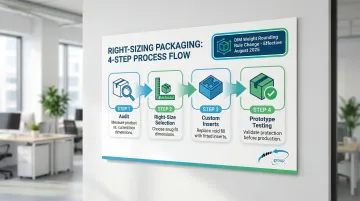
Step 1: Audit current packaging against actual product dimensions, identifying excess void space
Step 2: Select snug-fit dimensions that protect the product while minimizing both material cost and DIM weight charges
Step 3: Use custom inserts to replace excessive void fill, allowing for smaller outer boxes
Step 4: Test prototypes to ensure product protection remains adequate during shipping
Broader Operational Benefits
Follow those steps consistently and the savings extend well beyond the shipping invoice:
- Reduced warehouse storage footprint
- Lower material cost per unit
- Easier palletization and handling
- Reduced carbon footprint per shipment
For brands managing multiple SKUs, access to a wide range of stock box sizes makes right-sizing practical without committing capital to large custom runs. Alliance Packaging Group stocks over 1,000 box sizes available for immediate shipment, with just-in-time delivery programs that let you adjust as your product line evolves.
Common Retail Packaging Mistakes That Cost Brands Sales
Overdesigning Creates Visual Clutter
Layering too many finishing techniques, colors, fonts, and messages onto packaging causes no single message to dominate. 39% of consumers will disregard a product if packaging is too cluttered. Visual clutter causes shoppers to skip products entirely.
Restraint wins: white space, a clear hero element, and one clear benefit claim consistently outperform complexity on shelf. Poor visual hierarchy can reduce brand recall by 25-30% in shelf simulations.
Designing Packaging in Isolation
Skipping competitive context checks, lighting tests, and structural prototyping are three of the most common ways packaging fails before it ever reaches a shelf.
Pre-launch testing recommendations:
- Produce physical mockups and place them among competitor products
- Test under actual retail lighting (fluorescent, LED, natural light)
- Photograph for e-commerce to ensure digital reproduction quality
- Conduct eye-tracking studies or virtual shelf simulations
Tools like NielsenIQ's Pack360 use EEG and survey research to validate designs before production, predicting in-market performance through non-conscious reaction mapping.
The Omnichannel Mismatch
Testing in isolation — even with competitor comparisons — still misses a critical variable: channel. Packaging designed only for shelf performance often photographs poorly online, while e-commerce packaging stripped down for shipping creates no brand impression in store environments.
Getting this right means testing one design across every environment it will appear in: retail shelf, product photography, and the unboxing moment. All three need to work together.
Frequently Asked Questions
What makes retail packaging effective at driving sales?
Effective retail packaging combines clear visual hierarchy, strong shelf presence, and instant communication of the product's primary benefit. It must also create a satisfying tactile and unboxing experience that drives repeat purchases and social sharing.
What is the difference between retail packaging and e-commerce packaging?
Retail packaging optimizes for shelf visibility, planogram requirements, and shopper decision speed. E-commerce packaging prioritizes shipping durability, unboxing experience, and dimensional weight efficiency. By 2026, most brands operating across both channels need a single format that performs in both environments.
What materials are most commonly used for retail packaging?
SBS paperboard for folding cartons, corrugated board for shipping-ready formats, rigid board for premium products, and kraft for sustainable positioning. Your choice depends on product type, price point, and retail channel.
How do I balance eco-friendly packaging with strong brand appeal?
Sustainable materials and strong shelf impact work together. FSC-certified kraft, recycled-content corrugated, and mono-material constructions all support premium print and finishing. Shoppers increasingly treat eco credentials as a reason to buy, not a trade-off.
How does right-sizing packaging reduce costs?
Carriers charge based on dimensional weight, so matching package size to actual product dimensions cuts charges for empty space and reduces material use. Savings compound quickly at volume — and recent carrier rounding rule changes have made right-sizing more financially impactful than ever.