

Introduction
Spiral paper tubes show up everywhere — on the shop floor holding industrial film, in food plants protecting dry goods, on job sites forming concrete columns — yet most buyers only discover the full range of applications when they're already searching for a solution. For B2B operations that need reliable, lightweight containment without the cost or weight of metal or plastic, these tubes consistently outperform expectations.
The reason comes down to manufacturing flexibility. Winding paper plies at an angle around a mandrel produces tubes that range from thin-walled postal cores to heavy-duty winding mandrels capable of handling thousands of pounds of tension. The same geometry, scaled to spec, serves dozens of distinct industries.
This guide covers the top industrial and commercial applications for spiral paper tubes, and what to look for when selecting the right specifications for your operation.
Key Takeaways
- Spiral paper tubes are multi-layer cylinders wound from paper strips at an angle around a mandrel — strong, smooth, and highly customizable
- Common applications span manufacturing, shipping, construction, tape/label converting, and retail food packaging
- Selection depends on inner diameter, wall thickness (0.060" to 0.750"+), material grade, and load requirements
- Made from recycled content and fully recyclable, making them a practical substitute for plastic or metal cores
- Alliance Packaging Group stocks spiral tubes for immediate shipment with nationwide just-in-time delivery
What Are Spiral Paper Tubes?
Spiral paper tubes are multi-layer paper cylinders produced by winding narrow strips of paper—kraft, recycled, or coated—in a continuous spiral around a stationary steel mandrel. The paper plies are bonded with high-strength adhesive as they wrap at an angle, creating a helical seam that runs the full length of the tube.
This sets them apart from convolute tubes, which are formed by wrapping a single wide sheet of paper longitudinally at a 90-degree angle to the mandrel.
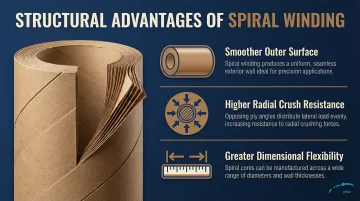
Structural Advantages of Spiral Winding
The spiral winding process delivers several key performance benefits:
- Smoother outer surface: The helical seam is less pronounced than the longitudinal seam of convolute tubes, making spiral tubes ideal for applications where surface quality matters (such as film winding)
- Higher radial crush resistance: Multiple angled plies distribute compressive forces more evenly, allowing spiral tubes to withstand winding tension without collapsing
- Greater dimensional flexibility: Manufacturers can easily adjust the number of plies, paper caliper, and winding angle to produce tubes with a wide range of inner diameters (from under 1 inch to 30+ inches) and wall thicknesses (from 0.018 inches to over 0.750 inches)
According to an IQS Directory overview of paper tube manufacturing citing CCTI data, spiral wound cores account for approximately 46.8% of the global paper core market, favored for their balance of structural strength and cost-efficiency in high-volume applications.
"Core" vs. "Tube" Terminology
Industry professionals distinguish between these terms based on function, not physical construction:
- Core: A spiral paper tube designed to have material wound around the outside—such as tape, film, fabric, wire, or paper. Cores typically feature thicker walls (up to 0.750 inches) to withstand radial pressure and torque during winding.
- Tube: A spiral paper tube designed to have material placed inside—such as posters, cosmetics, or food products. Tubes prioritize column strength and lightweight construction.
Two products with identical outer dimensions can be engineered for entirely different stress profiles—specifying the wrong one leads to structural failures during winding or in-transit damage to the contents inside.
Top Uses of Spiral Paper Tubes Across Industries
Spiral paper tubes serve as the structural backbone of dozens of industrial and commercial processes. The following use cases represent the most common and high-volume applications across key sectors.
Industrial Winding Cores (Film, Foil, Wire & Textile Manufacturing)
In manufacturing environments, spiral paper tubes function as precision machine components. Continuous materials — plastic film, aluminum foil, nonwoven fabrics, paper, wire, and cable — are wound around cores during production. The core's crush resistance and dimensional consistency directly impact product quality and machine uptime.
Critical specifications for winding cores:
- ID tolerances reach ±0.010 inches for cores up to 12 inches in diameter (±0.025 inches for larger sizes), ensuring the core fits the steel mandrel without slipping or binding.
- Wall thickness runs 0.036 inches (light-duty) to 0.750 inches (heavy-duty), with thicker walls preventing collapse under high winding tension.
- Length range spans 0.192 inches to 636 inches (53 feet); blade cutting is preferred over saw cutting for burr-free ends.
The stakes are high: TAPPI surveys indicate that core failures and dimensional inconsistencies account for approximately 50% of web breaks in paper mills, causing costly downtime and material waste.
Mailing Tubes and Poster Tubes (Shipping & Document Protection)
Spiral paper tubes are the standard solution for shipping rolled documents, blueprints, architectural drawings, and posters. They provide rigid protection against crushing and moisture without the excessive shipping weight of rigid cardboard boxes.
Key advantages over boxed shipping:
- Lower dimensional weight charges (critical as carriers increasingly price by volume, not actual weight)
- Easy end-closure options including snap-on plastic caps or crimped ends
- Cost-effective at volume, especially for businesses shipping documents regularly
Standard construction is 3-ply spiral wound kraft with wall thickness from 0.060" to 0.080" for light-duty applications. Inner diameters run 1" to 12" (custom up to 24"), with standard lengths between 15" and 36".
On pricing: USPS applies a cylindrical adjustment factor of 0.785 when calculating volume-based rates. Sizing the tube to fit contents snugly — rather than using an oversized default — can prevent significant surcharges on lightweight shipments.
Concrete Form Tubes (Construction Industry)
Heavy-duty, large-diameter spiral paper tubes (commonly called "form tubes" or "fiber forms") serve as temporary molds for pouring concrete columns, footings, and piers. After the concrete cures, the tube is peeled away and discarded.
Construction-grade specifications:
- Diameter range: 6 to 60 inches ID
- Wall thickness is substantially greater than mailing tubes, engineered specifically to withstand hydrostatic pressure during pours.
- Hydrostatic pressure ratings:
- Standard forms: 12 feet of full liquid head (approximately 1,800 psf)
- Commercial/heavy-wall forms: Up to 20 feet of full liquid head (approximately 3,000 psf)
- Proprietary outer plies provide moisture resistance for up to 72 hours of rain exposure without structural compromise.
Note on terminology: "Sonotube" is a registered trademark owned by SPC Resources, Inc. (a Sonoco subsidiary), not a generic term. The industry-standard term is "concrete form tube" or "fiber form."
Tape Cores and Label Cores (Converting Industry)
The 3-inch (76mm) inner diameter spiral paper core is the global standard spool for tape and label converting. Pressure-sensitive tapes, labels, and films are wound onto these cores during manufacturing and sold to end users on the same cores — making this one of the highest-volume paper core applications worldwide.
Why spiral construction dominates this sector:
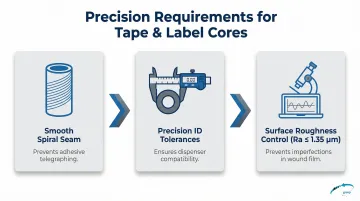
- The spiral seam is less pronounced than convolute construction, preventing tape adhesive from adhering unevenly to the core surface.
- Precision ID tolerances ensure compatibility with automatic tape dispensers and label applicators.
- Film cores may require surface roughness averages (Ra) as low as 1.35 µm to prevent imperfections from telegraphing (transferring surface defects) through wound materials.
Technical precision requirements:
- Straightness deviation: 0.5 mm/m average
- Roundness deviation: 0.3 mm/m average
- Standard wall thickness: 0.125 inches (1/8 inch)
Retail Packaging and Food Canisters (Consumer Goods & Food & Beverage)
Spiral paper tubes form the structural base for composite canisters used in retail packaging. Fitted with foil or plastic barrier liners and metal or plastic end caps, they create airtight, shelf-ready packaging for snacks, powdered foods, spices, and personal care products.
Growing market drivers:
- Consumers view paper-based packaging as more environmentally responsible than plastic, supporting corporate ESG commitments.
- Full-wrap printed labels or direct printing enable premium shelf presentation and brand differentiation.
- Paperboard and adhesives must comply with FDA regulations 21 CFR 176 and 21 CFR 175 for food contact applications.
Typical specifications:
- Diameters: 1 inch to 6 inches
- Construction: Spiral-wound paper body with barrier liners (foil, plastic) and end closures
- Recycled content: Leading manufacturers report using 100% recycled fiber (90% post-consumer) in paper cans
Carpet Cores and Specialty Textile Rolls (Flooring & Textile Industry)
Carpet manufacturers wind finished rolls around heavy-duty paper cores for storage and transport. Each core must hold the compressive weight of a carpet roll — sometimes several hundred pounds — while still allowing clean unwinding at the installation site.
Typical carpet core specifications:
- Inner diameter of 3.5 inches is standard, with manufacturer ranges spanning 22mm to 656mm across textile types.
- Lengths can reach 13,000mm (approximately 42 feet) to accommodate broadloom carpets.
- Multi-ply, heavy-duty walls prevent crushing under sustained carpet weight during storage.
Specialty innovations:
- Star-crimped inserts: A crimped "star" insert placed in the core ends secures plastic overwrap, cutting packaging time without additional tape or fasteners.
- Grip-flap surfaces: Textured surfaces that grip the carpet's leading edge without tape, speeding up the winding process.
Fabric rolls, nonwoven materials, and fiberglass matting follow the same spiral core logic: consistent ID, crush-resistant walls, and lengths matched to the material width.
How to Choose the Right Spiral Paper Tube for Your Application
Selecting the correct spiral paper tube requires matching mechanical properties to application stresses. Four key specifications drive performance.
Inner Diameter (ID) Selection
The ID must match the spindle, shaft, or mandrel it will fit on—or the product it needs to contain. Even small deviations cause machine downtime or product damage.
Tolerance standards:
- Standard precision: ±0.010 inches for IDs up to 12 inches (industry standard)
- Large diameter: ±0.025 inches for IDs 12-24 inches
- Measurement method: Use plug gauges rather than vernier calipers for accurate verification on flexible materials
Common ID standards:
- Tape/label cores: 3 inches (76mm) global standard
- Carpet cores: 3.5 inches typical
- Mailing tubes: 2-6 inches most common
- Construction forms: 6-60 inches
Wall Thickness and Load-Bearing Capacity
Thicker walls increase radial crush resistance and beam strength. Match wall thickness to the stress your application creates.
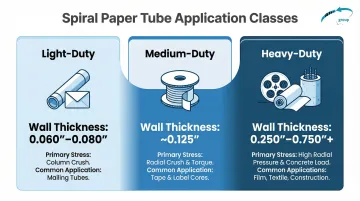
| Application Class | Typical Wall Thickness | Primary Stress Factor |
|---|---|---|
| Light-duty (mailing tubes) | 0.060" - 0.080" | Column crush from stacking |
| Medium-duty (tape/label cores) | ~0.125" | Radial crush and torque |
| Heavy-duty (film/textile/construction) | 0.250" - 0.750"+ | High radial pressure and concrete load (construction forms) |
For industrial winding applications, the Composite Can and Tube Institute publishes core grade guidelines that factor in web tension, roll weight, and winding speed — useful when standard wall thickness ranges aren't sufficient for your process.
Material Grade Selection
Paper grade affects surface smoothness, moisture resistance, and structural strength.
Common material options:
- Kraft paper: Long fibers provide superior burst strength and dimensional stability — the preferred choice where strength-to-weight ratio matters most.
- Recycled board (URB): Made from 100% recycled content; adequate for standard applications but lower strength-to-weight ratio than virgin kraft.
- Specialty liners: Silicone-coated or glassine surfaces prevent tape adhesion on tape cores; foil liners add moisture barriers for food contact use.
- Moisture-resistant treatments: Proprietary coatings let construction form tubes withstand rain exposure for up to 72 hours.
Length and Cut-Edge Quality
Spiral paper tubes can be manufactured in virtually any length and cut to precise tolerances.
Length capabilities: From 0.192 inches to 636 inches (53 feet), depending on manufacturer
Cut-edge considerations:
- Square cut: The default for most applications; blade cutting produces cleaner, burr-free ends than saw cutting.
- Chamfered edges: Beveled ends prevent catching in automated equipment feeds.
- Tolerance: Specify length tolerance requirements based on whether the tube feeds through automated machinery
Once you've confirmed your ID, wall thickness, material grade, and cut requirements, sourcing becomes straightforward. Distributors like Alliance Packaging Group carry spiral tubes alongside complementary materials — stretch film, tape, labels, and protective packaging — so procurement stays consolidated under a single vendor rather than spread across multiple suppliers.
Why Choose Spiral Paper Tubes Over Alternatives
Cost and Performance Comparison
| Feature | Spiral Paper Tubes | Plastic/Metal Cores |
|---|---|---|
| Unit cost | Significantly lower | Higher material and tooling costs |
| Weight | Low density (0.58-0.69 g/cm³) reduces freight | Aluminum (~2.7 g/cm³) and plastics (0.9-1.4 g/cm³) are heavier |
| Recyclability | High (68.2% recycling rate for paper) | Lower (~8.7% for plastics); metal recyclable but energy-intensive |
| Moisture resistance | Low (hygroscopic); requires barriers | High; naturally waterproof |
Plastic or metal cores are worth the premium in extreme moisture environments or multi-year reuse applications. For most single-use or limited-use industrial applications, paper delivers sufficient performance at a fraction of the cost.
Sustainability and Regulatory Drivers
Spiral paper tubes align with corporate ESG commitments and evolving packaging regulations:
Most spiral tubes use recycled paper content and qualify for standard paper recycling streams. Many manufacturers run on 100% recycled fiber—up to 90% post-consumer—making them a straightforward fit for sustainable sourcing programs.
Regulatory pressure adds another layer to consider. Extended Producer Responsibility (EPR) laws are shifting packaging economics across industries, though the picture isn't entirely simple: UK EPR fees may favor plastics over paper composites when plastic moisture-barrier content exceeds 15%. Beyond compliance, the core environmental profile of paper tubes remains strong.
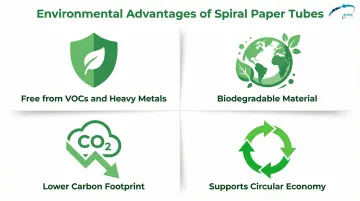
Environmental advantages:
- Free from VOCs and heavy metals
- Biodegradable (depending on coatings and adhesives)
- Lower carbon footprint than plastic or metal production
- Supports circular economy through recyclability
Market growth: The global paper core market is projected to exceed $15 billion by 2035 with a CAGR of 4.5%, driven by the shift toward sustainable packaging alternatives.
Procurement and Availability
Spiral paper tubes offer practical procurement benefits:
- Widely stocked: Standard sizes available in high volumes with relatively short lead times
- Lower unit cost: Significantly less expensive than plastic or metal cores for equivalent applications
- High-volume production: The default choice for high-turnover industrial applications where cost per unit matters
- Customization flexibility: Easier and more cost-effective to produce custom sizes compared to molded plastic or metal alternatives
Conclusion
Spiral paper tubes serve a remarkable breadth of applications—from industrial winding cores supporting high-speed manufacturing to construction form tubes shaping concrete infrastructure, from retail canisters protecting food products to mailing tubes safeguarding architectural drawings.
Their versatility comes from a manufacturing process that can be tuned to deliver vastly different performance characteristics: lightweight protection, heavy-duty crush resistance, precision dimensional tolerances, or sustainable retail presentation.
Selecting the right tube starts with getting the specifications right:
- Match inner diameter to your mandrel or product dimensions
- Choose wall thickness based on the compressive forces your application creates
- Select material grade for the surface quality and moisture resistance you need
- Specify length and cut-edge tolerances if your tubes feed through automated equipment
Just as important as specifications is sourcing from a reliable supplier who can deliver consistently at volume. Alliance Packaging Group offers spiral paper tubes alongside a full range of complementary packaging and material handling products, with factory-direct pricing and nationwide just-in-time delivery. Whether you need mailing tubes for document shipping or are exploring paper cores for manufacturing applications, reach out to Alliance Packaging Group at apg-go.com or 770-309-1012 to discuss your requirements with packaging experts who understand how the right tube specifications impact your operations, throughput, and material costs.
Frequently Asked Questions
What is the difference between a spiral paper tube and a convolute paper tube?
Spiral tubes are wound at an angle to the mandrel in continuous layers, producing a helical seam with a smoother surface and higher crush resistance. Convolute tubes wrap a single wide sheet longitudinally at 90 degrees, creating a parallel-layer structure with superior beam strength. Spiral construction offers more dimensional flexibility; convolute is preferred where rigid straightness matters.
What is the difference between a paper "tube" and a paper "core"?
The physical product is the same — terminology reflects function. "Core" refers to tubes with material wound around the outside (tape, film, carpet, wire), requiring thick walls for radial pressure. "Tube" describes products that carry content inside (posters, cosmetics, food), where column strength and lighter weight take priority.
What sizes do spiral paper tubes come in?
Spiral paper tubes are available in inner diameters ranging from under 1 inch to 30+ inches (construction form tubes can reach 60 inches). Wall thicknesses typically range from 0.060 inches for light-duty mailing tubes to over 0.750 inches for heavy-duty industrial cores. Lengths can extend from a few inches to 636 inches (53 feet) depending on manufacturer capabilities.
Are spiral paper tubes recyclable or eco-friendly?
Yes. Most spiral paper tubes are made with recycled paper content and accepted in standard paper recycling streams, making them a more sustainable choice than plastic or metal cores. Tubes with heavy wax coatings, foil laminates, or hot melt adhesives can complicate repulping — minimal coatings and water-soluble adhesives ensure full recyclability.
How strong are spiral paper tubes — can they support heavy loads?
Strength scales with wall thickness, ply count, and paper grade. Light-duty mailing tubes (0.060"–0.080" walls) handle standard stacking and shipping loads. Heavy-duty versions — such as construction form tubes with walls exceeding 0.250" — can support concrete pours and industrial winding cores regularly bear thousands of pounds of wound material without collapsing.
Can spiral paper tubes be custom printed or branded?
Yes. Spiral tubes can be produced with custom printed outer layers or full-wrap labels, making them practical for branded packaging in food, cosmetics, and consumer goods. The smooth spiral-wound surface accepts high-quality printing while keeping the sustainability benefits of paper-based materials intact.