Introduction
Newspaper printing facilities and graphics shops operate under relentless pressure—tight deadlines, high throughput, and zero tolerance for delays. Poorly strapped bundles don't just slow down delivery routes; they cause damaged prints, costly reprints, and frustrated customers who receive torn or creased materials.
Choosing the right strapping machine comes down to two critical decisions: matching machine speed (cycles per minute) to your production volume, and selecting the correct strap guide configuration for your bundle type. Get either wrong and you'll face bottlenecks, wasted material, or missed press deadlines. This guide walks through both decisions so you can spec the right machine the first time.
TLDR:
- Fully automatic or rotary strapping machines (30–60+ cycles/min) are required for high-volume newspaper lines
- Semi-automatic machines with adjustable tension suit graphics and large-format print shops
- Polypropylene strap (5–9 mm) is the standard for newspaper bundling; polyester or paper strap works better for fragile graphics
- Closed guides support faster feed rates; open guides handle variable bundle sizes
- Sourcing machines and consumables from one supplier simplifies procurement and keeps lines running
Why Strapping Matters in Newspaper and Graphics Operations
The Unique Bundling Challenges
Newspapers aren't static products. Page counts fluctuate daily: a Sunday edition might weigh three times more than a weekday run, yet your strapping line must handle both without adjustment delays.
Graphics products present different challenges. Blueprints, large-format prints, and rolled posters are fragile, easily creased, and demand consistent tension that secures without damaging the surface.
Operational consequences of poor strapping:
- Loose bundles shift during delivery, causing corner damage and unsellable inventory
- Over-tensioned straps crease glossy covers or emboss architectural prints
- Inconsistent strap placement forces manual rework at distribution centers
- Equipment downtime during peak production windows creates cascading delays
Two Distinct Use Cases
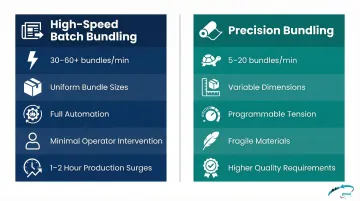
High-speed batch bundling:
- Requires sustained throughput of 30-60+ bundles per minute during 1-2 hour production surges
- Prioritizes speed, automation, and minimal operator intervention
- Bundles are uniform in size and weight within each production run
Precision bundling:
- Handles variable bundle dimensions and fragile materials
- Demands programmable tension control to prevent surface damage
- Lower volume (5-20 bundles per minute) but higher quality requirements
These two use cases call for fundamentally different equipment. A newspaper distributor running 40,000 bundles per day can't afford a semi-automatic machine rated at 15 bundles per minute: the throughput gap alone makes it unworkable. On the other end, a graphics studio strapping 200 oversized print rolls per week has no business case for a $75,000 rotary strapper.
Types of Strapping Machines Used in Print and Graphics
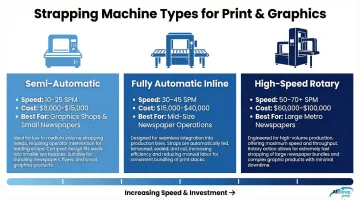
Three machine categories dominate this industry, each suited to different volume and bundle profile requirements.
Semi-Automatic Strapping Machines
Semi-automatic machines require an operator to position the bundle and press a button to initiate the strap cycle. The machine feeds strap around the bundle, tensions it, seals it, and cuts—then waits for the next bundle.
Best-fit applications:
- Graphics shops producing 50-300 bundles per shift
- Print fulfillment operations with frequent bundle size changes
- Facilities where labor cost per bundle is acceptable
Typical speed range: 15-25 cycles per minute under ideal conditions. Real-world throughput drops to 10-15 bundles per minute when accounting for operator positioning time. For a newspaper operation running 10,000 bundles in a 2-hour window, you'd need 8-10 operators working multiple semi-auto machines simultaneously—not practical.
When semi-auto works: Small regional newspapers (under 5,000 circulation), specialty print shops, or operations where bundle dimensions vary so frequently that automatic feed systems would require constant recalibration.
Fully Automatic and Inline Strapping Machines
Fully automatic machines integrate directly with conveyors and bundle-forming equipment. Bundles flow continuously into the strapping arch, get strapped without operator intervention, and exit to the next station.
Key features for print applications:
- Arch size adjusts to accommodate varying stack heights — essential when page counts fluctuate between print runs
- Tension control is programmable per bundle profile, preventing crushing on glossy covers or embossed architectural prints
- High-cycle motors sustain 30-45 bundles per minute across extended production runs
Best-fit applications:
- Mid-size newspaper operations (10,000-50,000 circulation)
- Commercial print facilities running multiple shifts
- Any operation where bundles arrive at the strapper continuously via conveyor
These machines run $15,000-$40,000 depending on features. One automatic machine typically replaces 3-4 semi-automatic stations and their operators — that personnel reduction alone drives fast payback.
High-Speed Rotary Strapping Machines
Rotary arm strapping machines represent the top tier for speed. Instead of feeding strap through a fixed arch, a rotating arm spins around the stationary bundle, wrapping and sealing in a single motion. This eliminates strap feed distance through guides, enabling cycle times under 1 second.
Speed advantage: 50-70+ bundles per minute sustained throughput—nearly double what inline automatic machines deliver.
When the cost premium is justified:
- Large metro newspapers (100,000+ circulation) with concentrated production surges
- Commercial printers running 24/7 operations where throughput directly impacts revenue
- Operations where current strapping capacity is the production bottleneck
Cost threshold: Rotary machines start around $60,000-$100,000. To put that in context: two automatic machines at $30,000 each already cost $60,000, plus dual footprints and dual maintenance contracts — and may still bottleneck at peak volume. When daily bundle counts exceed 40,000-50,000, a single rotary unit often becomes the more economical choice.
Understanding Strapping Machine Speeds: What the Numbers Mean
Key Speed Metrics
Manufacturers cite speed using different terms. Here's how to normalize comparisons:
- Straps per minute (SPM): Number of complete strap cycles the machine can execute in 60 seconds under ideal conditions
- Bundles per minute: Identical to SPM for single-strap applications (most print bundling)
- Cycles per hour: SPM × 60—useful for calculating daily capacity
Example: A machine rated at 35 SPM theoretically produces 2,100 bundles per hour (35 × 60). But that's peak speed, not sustained operational speed.
Rated vs. Sustained Speed
Rated/peak speed = maximum cycles per minute in a controlled test environment with optimal strap feed, no bundle positioning delays, and continuous operation.
Sustained operational speed = real-world throughput accounting for:
- Strap reel changes (typically every 1,000-2,000 cycles)
- Bundle feed rate variations
- Tension/seal cycle time for different strap materials
- Minor jams or misfeeds
Planning rule: Sustained speed runs 70-80% of rated speed. A machine rated at 40 SPM delivers 28-32 bundles per minute in actual production. Spec your machine on sustained throughput during your peak production window — that number is what determines whether you make distribution deadlines.
Speed Requirements by Production Volume
| Facility Type | Bundles per Shift | Peak Window | Required Sustained SPM | Machine Class |
|---|---|---|---|---|
| Small graphics studio | 100-500 | 8 hours | 1-2 | Semi-automatic |
| Regional newspaper | 5,000-15,000 | 2 hours | 40-60 | Fully automatic |
| Large metro newspaper | 50,000-100,000 | 2-3 hours | 60-80+ | High-speed rotary |
Editorial cycle timing matters: Daily newspapers have concentrated production surges before distribution windows (typically 2-4 AM for morning editions). Machines must sustain high SPM for 1-2 hour bursts rather than constant all-day throughput. A rotary machine rated at 65 SPM can process 7,800 bundles in a 2-hour window—sufficient for many operations.
Factors That Affect Real-World Speed
Strap feed distance and guide path length:
- Longer guide paths (larger arch sizes) increase cycle time
- Each additional foot of strap travel adds 0.1-0.2 seconds per cycle
- Large-format graphics machines with 48″ × 36″ arches run slower than compact newspaper arches (30″ × 18″)
Operator/conveyor feed rate:
- Semi-automatic machines: operator positioning speed caps throughput
- Automatic machines: upstream bundle formation speed sets the ceiling
- Misalignment causes rejected cycles, cutting effective throughput
Tension/seal cycle time:
- Polypropylene strap seals faster (heat seal completes in 0.8-1.2 seconds)
- Polyester strap requires 1.5-2.0 seconds for proper seal formation
- The same machine runs 15-20% slower with PET strap than PP strap
A machine rated at 40 SPM with polypropylene may only achieve 32-35 SPM with polyester. If your graphics operation requires PET for heavy rolled materials, account for this when sizing equipment.
Choosing the Right Strap Guide for Your Operation
Strap guides direct the strap around the bundle through the arch. Guide selection significantly impacts feed reliability, machine speed, and suitability for different bundle profiles.
Open vs. Closed Strap Guides
Open and closed guide systems serve different operational priorities — flexibility versus speed. Here's how they compare:
| Open (V-Guide/Channel) | Closed (Tube/Enclosed) | |
|---|---|---|
| How it works | Strap rides in an open channel; bundles load from above | Strap fully enclosed in tube or closed channel |
| Best for | Irregular or varied bundle sizes | Consistent bundles, high-speed lines |
| Jam clearance | Easy — no threading required | Requires re-threading on strap reel changes |
| Max sustained SPM | Up to ~40 SPM | 50+ SPM (10-15% higher than open) |
| Typical applications | Graphics studios, rolled materials, oversized stacks | Automated newspaper lines, inline systems |
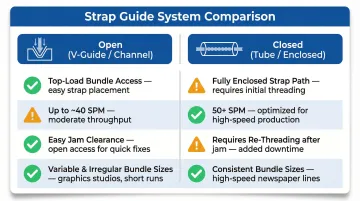
Closed guides maintain strap alignment through the full cycle, which is why they're standard on operations pushing 50+ bundles per minute. Open guides remain the better fit when bundle dimensions change frequently or when quick jam clearance matters more than peak throughput.
Motorized vs. Gravity-Feed Strap Guides
Gravity-feed guides use the machine's main feed mechanism to push strap through guide rails. They work well at standard speeds (up to 35-40 SPM) on horizontal runs and have fewer moving parts to maintain. The tradeoff: at higher SPM or with heavier strap (0.80+ mm), feed can lag and cause cycle delays.
Motorized (power-assisted) guides use driven rollers or air assist to move strap through the arch independently of bundle speed. They maintain consistent feed tension regardless of strap weight — which is why high-speed newspaper lines rely on them.
Specify motorized guides when:
- Sustained speeds exceed 40 SPM
- Strap thickness is 0.70 mm or greater
- Arch configurations include vertical or inverted sections
Arch Size and Guide Configuration for Graphics Applications
Large-format graphics (rolled blueprints, poster tubes, oversized print bundles) require wider and taller arch configurations than standard newspaper bundles.
How to spec the correct arch size:
- Measure maximum bundle cross-section (width × height)
- Add 4-6 inches clearance on each dimension for bundle positioning tolerance
- Verify strap guide path length doesn't exceed machine's rated feed capacity
Example: A graphics shop strapping rolled blueprints (36" diameter × 48" length) needs a minimum 42" × 54" arch opening. Standard newspaper machines (30" × 18" arch) won't accommodate these bundles.
Adjustable arch machines: Some fully automatic machines offer tool-free arch height adjustment (typically 12-36" range). These work well for operations that strap both standard print stacks and occasional oversized graphics bundles—eliminating the need for dedicated machines.
Selecting the Right Strap Material for Newspaper and Graphics Bundling
Three primary strap materials dominate this industry, each with distinct characteristics.
Polypropylene (PP) Strapping
Why PP dominates newspaper bundling:
- Costs 30-40% less than PET, making it the most economical plastic strapping option
- Reduces shipping costs for bundled newspapers due to its low weight
- Break strengths of 120-600 lbs handle typical newspaper bundles (5-50 lbs)
- Coils up to 16,000 feet enable continuous production without frequent reel changes
Standard widths for newspapers: 5 mm, 6 mm (1/4"), and 9 mm (3/8") balance cost and bundle security. High-speed newspaper strapping machines are calibrated for these widths.
Elongation advantage: PP's 17-27% elongation absorbs shock during transit, keeping strapping tight even when bundles are dropped or shifted on delivery routes.
Limitations:
- Lower retained tension than PET—bundles that settle or compress may loosen
- UV degradation in outdoor storage (not ideal for long-term warehousing)
- Not suitable for very heavy bundles (50+ lbs)
Polyester (PET) Strapping
PET makes sense when PP's limitations become a liability. Choose it for:
- Architectural prints, large-format posters, or corrugated bundles exceeding 50 lbs
- Cross-country or international shipments, where PET maintains tension far better than PP over time
- Art reproductions or limited-edition prints where bundle integrity is critical
Key specifications: Break strengths up to 18,850 N (4,200+ lbs), with only 12-20% elongation (vs. 27% for PP). This means PET doesn't stretch as much under load, maintaining tighter bundle compression.
Cost trade-off: PET costs 30-50% more than PP. For a newspaper operation strapping 50,000 bundles daily, that's $200-$400 per day in added material costs. It's worth it only when PP's limitations are causing product damage or customer complaints.
Paper and Corded Strapping
Paper strap (e.g., Signode LEVEX):
- Fully recyclable into paper waste streams
- Reduces dust accumulation inside machines compared to plastic
- Break strengths of 180-430 N suit lightweight print applications (under 10 lbs)
Best-fit applications: Archival prints, art reproductions, or applications where surface contact marks are unacceptable. Paper strap won't leave the embossed lines that plastic strap can imprint on glossy covers.
Corded polyester strap handles higher-value or heavier applications where paper strap falls short:
- Non-abrasive surface won't scratch, stain, or indent printed materials
- Elongation up to 30% absorbs impact shocks during transit
- Break strengths of 350-2,500 lbs cover a wide range of bundle weights
Use corded strap for high-value graphics, media kits with mixed materials (brochures, samples, USB drives), or any application where the strap contacts printed surfaces directly.
Alliance Packaging Group carries all three material types — PP, PET, and corded — with factory-direct pricing, so you can source consumables and equipment from a single supplier.
How to Match the Right Machine to Your Production Volume
Practical Decision Framework
Step 1: Calculate peak hourly demand
- Start with daily bundle count
- Identify peak production window (typically 1-3 hours for newspapers)
- Divide bundles by hours to get bundles per hour at peak
Step 2: Convert to sustained SPM requirement
- Bundles per hour ÷ 60 = bundles per minute
- Add 20-25% buffer for realistic sustained throughput
- This is your minimum machine speed spec
Example calculation:
- Regional newspaper: 15,000 bundles per day
- Peak window: 2 hours (5 AM - 7 AM)
- Peak demand: 15,000 ÷ 2 = 7,500 bundles per hour
- Required SPM: 7,500 ÷ 60 = 125 bundles per minute
- With 25% buffer: 125 × 1.25 = 156 SPM (not realistic for most machines)
This reveals the problem: You need either (a) a longer production window, (b) multiple strapping machines running in parallel, or (c) a high-speed rotary machine capable of 60+ sustained SPM.
Total Cost of Ownership Analysis
Don't spec machines on purchase price alone. Include:
- Strap consumption: Rotary machines use 15-20% less strap per bundle due to optimized strap path — saving $8,000–$12,000 annually at 1 million bundles per year
- Maintenance frequency: Semi-automatic machines need daily cleaning and weekly lubrication; fully automatic machines with enclosed guides typically run 2-3 weeks between service intervals
- Downtime exposure: One hour of downtime during peak window = 3,000–4,000 missed bundles. A backup semi-automatic machine ($8,000) may cost less than a single bad print run
- Operator labor: Semi-auto at 15 bundles per minute requires 62.5 operator-hours per day for 15,000 bundles; a fully automatic machine at 40 SPM reduces that to near-zero direct labor after initial setup
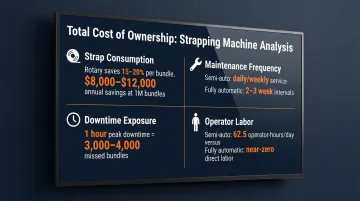
At $18/hour fully loaded labor cost, that 62.5 hours translates to $1,125/day in semi-auto labor costs. Over 250 production days, the savings reach $281,250 — enough to pay back a $40,000 automatic machine in under two months.
Working With a Single-Source Distributor
Once your TCO analysis points to a machine spec, procurement strategy matters almost as much as the equipment itself. Managing separate vendors for machines, strap, buckles, and seals creates invoice friction and inventory gaps that slow down commissioning.
Alliance Packaging Group supplies both strapping equipment and the consumables that run through it — strap, seals, and buckles — with nationwide just-in-time delivery. For print facilities, that means:
- Equipment ships with an initial strap inventory already coordinated
- Factory-direct pricing applies to both machines and materials
- One contact handles troubleshooting, reorders, and service questions
- Volume pricing scales as your production grows
Frequently Asked Questions
What type of strapping machine is best for bundling newspapers?
Fully automatic inline or high-speed rotary strapping machines are best for high-volume newspaper operations requiring 30-60+ bundles per minute. Semi-automatic machines suit smaller print shops or variable-bundle environments where throughput under 15 bundles per minute is acceptable.
How fast do strapping machines run in high-volume newspaper operations?
High-speed newspaper strapping machines typically achieve 35-65 sustained straps per minute (SPM), with rotary machines reaching 70+ SPM. Peak rated speeds are 10-20% higher, but sustained operational speed accounts for strap changes and bundle feed variations.
What is the difference between open and closed strap guides?
Open guides allow top-loading of variable bundles and easier jam clearing, making them ideal for graphics shops with irregular bundle sizes. Closed guides offer faster, more reliable strap feed for high-speed consistent operations, preferred in newspaper mailrooms running 40+ SPM.
What strap width is recommended for newspaper and print applications?
Newspapers typically use 5 mm, 6 mm (1/4"), or 9 mm (3/8") polypropylene strap. Newspapers typically use 5 mm, 6 mm (1/4"), or 9 mm (3/8") polypropylene strap. Narrower widths reduce cost while providing adequate security for 5-50 lb loads. Large-format graphics or heavy print stacks may require 12 mm (1/2") or wider strap.
What strap material works best for the graphics and printing industry?
Polypropylene dominates standard newspaper bundling due to cost and speed. Polyester (PET) is preferred for heavy rolled materials, long-haul shipments, or high-value graphics requiring superior retained tension. Paper or corded strap suits archival prints where surface contact marks are unacceptable.
Can one strapping machine handle both newspaper and large-format graphics bundling?
Adjustable-arch, variable-tension automatic machines can handle both if the arch accommodates your largest bundle size and tension control prevents crushing fragile materials. Operations with very different bundle profiles may benefit from dedicated machines or quick-changeover arch configurations.