Introduction
Small business owners face a critical decision when they need a strapping machine: the equipment is necessary for efficient packaging operations, but the upfront cost can strain limited capital. According to the Federal Reserve's 2025 Small Business Credit Survey, 56% of small businesses sought financing just to meet operating expenses, highlighting how equipment investments compete with day-to-day cash needs.
The choice goes well beyond sticker price. It touches cash flow, tax liability, long-term ownership, and operational flexibility. With 82% of U.S. companies now using financing when acquiring equipment, most businesses are already financing — the real question is which structure works in your favor.
This guide breaks down the true cost of each path, the tax implications of both, and the specific scenarios where leasing or buying makes more financial sense for a small business.
Key Takeaways
- Leasing preserves working capital with predictable monthly payments, ideal for businesses with limited capital or short-term needs
- Buying builds equity and costs less over the machine's lifespan, better for stable, long-term strapping operations
- The 2026 Section 179 deduction limit of $2.56 million and 100% bonus depreciation allow qualifying businesses to write off the full purchase cost in year one
- Base your decision on strapping volume, cash flow, how long you'll use the machine, and whether staying current on technology matters
Leasing vs. Buying a Strapping Machine: Quick Comparison
| Factor | Leasing | Buying |
|---|---|---|
| Upfront Cost | Little to none; first and last month's payment | Full purchase price or down payment (20–30%) |
| Monthly Payment | Fixed payments over 24–60 months | None (if paid cash) or loan payment with interest |
| Ownership | No ownership; return or buy at end of term | Full ownership from day one |
| Maintenance Responsibility | Often included in lease agreement | Buyer responsible for all repairs and parts |
| Tax Treatment | Lease payments fully deductible as operating expense | Depreciation deduction or Section 179 write-off |
| Flexibility to Upgrade | Easy upgrade at lease end | Must sell or trade in existing equipment |
| Total Long-Term Cost | Higher over 5+ years due to cumulative payments | Lower; machine lasts 10–20+ years |
| Best For | Seasonal operations, startups, variable volume | Stable high-volume operations, long-term use |
Leasing a Strapping Machine: What It Means for Small Businesses
Equipment leasing works like a rental: a lender purchases the strapping machine, and you pay fixed monthly installments over a set term—typically 24 to 60 months. At the end, you can return the machine, renew the lease, or purchase it at its remaining market value.
Cash Flow Advantage
Leasing preserves working capital that small businesses can redirect toward inventory, staffing, or other operational needs. With 82% of U.S. companies financing their equipment acquisitions to optimize cash flow, this approach has become standard practice rather than exception.
Instead of paying $8,000–$12,000 upfront for a semi-automatic strapping machine, you might pay $200–$350 per month. That difference matters when you're managing payroll, purchasing strapping materials, or covering unexpected expenses.
Flexibility to Upgrade
Leasing allows businesses to upgrade strapping technology when a term ends — a real advantage as machines continue to improve in cycle speed, tension control, and reliability. For businesses whose packaging volumes or product types may shift, that optionality has direct operational value.
If your e-commerce operation doubles or you move from small boxes to pallet loads, you can upgrade without the hassle of selling used equipment. Some lease agreements also cover repairs and parts, reducing the risk of unexpected downtime costs. Confirm what's included before signing — maintenance terms vary by lessor.
Qualifying Considerations
Most leasing companies require at least 2–3 years in business and a credit score of 600–650. The Equipment Leasing and Finance Association reports an 81% approval rate for small-ticket equipment financing, but newer businesses may face higher rates or need a personal guarantee.
A personal guarantee means you're personally liable for lease payments if your business cannot pay. Your personal assets become collateral. This is standard for owners holding 20% or more equity in the business.
Buying a Strapping Machine: What It Means for Small Businesses
Whether you pay cash or finance through an equipment loan, buying puts the machine on your balance sheet permanently. Here's what that investment actually looks like across different production volumes.
Price Ranges and Budget Reality
Entry-level semi-automatic models: $1,000-$1,500
- Tabletop or floor-standing units
- Manual strap feeding
- Ideal for low-volume operations (under 50 straps per day)
Mid-range semi-automatic models: $7,500-$9,700
- Faster cycle times
- Arch systems that automatically feed strap around packages
- Suitable for moderate volume (100-200 straps per day)
Fully automatic inline systems: $12,000-$20,000+
- Conveyor-integrated
- High-speed operation (60+ straps per minute)
- Operator-free unitizing for high-volume facilities
Beyond the machine cost, budget for strapping materials (polypropylene or polyester) and a preventative maintenance plan to protect your investment.
Total Cost of Ownership Advantage
While the upfront cost is higher, owning a strapping machine that lasts 10-20+ years means the per-use cost drops significantly over time. Well-maintained automatic machines routinely operate for 10-15 years, while even basic semi-automatic models can deliver 5-7 years of service.
Simple calculation:
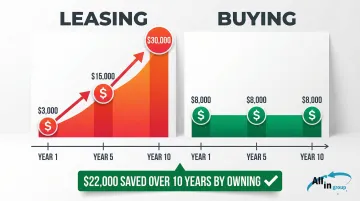
- $8,000 machine purchase vs. $250/month lease
- Over 5 years: $8,000 (owned) vs. $15,000 in lease payments
- Over 10 years: $8,000 (owned) vs. $30,000 if you renewed the lease twice
Those savings compound further once you factor in the tax advantages available to equipment buyers.
Section 179 and Bonus Depreciation Tax Benefits
Businesses that buy equipment may deduct a significant portion of the purchase price in the year of acquisition. For 2026, the IRS Section 179 deduction limit is $2.56 million, allowing most small businesses to write off the entire strapping machine cost immediately.
Additionally, the recent "One Big Beautiful Bill Act" provides 100% bonus depreciation for qualified property acquired after January 19, 2025. This means you can deduct the full purchase price in year one, reducing your tax liability in year one.
Consult a tax advisor to understand how these deductions apply to your specific situation, but for profitable businesses, the math clearly favors buying.
Factory-Direct Pricing Advantage
Buying through a packaging distributor like Alliance Packaging Group that sources factory-direct can reduce the purchase price meaningfully — sometimes enough to close the gap between buying and leasing from day one. When ongoing consumable costs (strapping materials, seals, tensioners) are bundled through the same supplier, the total cost of ownership drops further over the machine's lifespan.
Leasing vs. Buying: Which Option Is Right for Your Small Business?
Key Questions to Ask Yourself
How steady is my strapping volume? Consistent daily strapping needs favor ownership. Seasonal or variable volume favors leasing.
Do I have the capital to buy without straining cash flow? If $8,000–$12,000 would deplete your working capital or prevent other investments, leasing preserves flexibility.
Is this a long-term need or short-term requirement? Equipment you'll use for 5+ years should be owned. Equipment for a 2–3 year project or trial period is better leased.
Do I want ownership as a business asset? Owned equipment appears on your balance sheet and can be used as collateral for future financing.
Clear Situational Recommendations
Choose leasing if:
- You're a newer business preserving cash for growth
- You have seasonal or variable strapping needs
- You anticipate needing technology upgrades in 3-5 years
- You want predictable monthly expenses with potential maintenance inclusion
Choose buying if:
- You have stable, high-volume strapping needs
- You want to build equity in your equipment
- You can absorb the upfront cost without compromising operations
- You plan to use the machine for 5+ years
Equipment Financing: A Third Option
Equipment financing—a loan to purchase—offers ownership benefits while spreading the cost out like a lease. You own the machine from day one, claim depreciation deductions, and build equity. Interest rates vary: the Federal Reserve reported median rates of 7.00% for variable term loans in Q4 2025, while SBA 7(a) loans cap rates at the base rate plus 6.0–6.5% depending on loan size.
Unlike a lease, you're responsible for maintenance—but you avoid the markup lessors charge. Once the loan is paid off, the machine is yours with no buyout fee or return requirement.
Real-World Scenario Comparison
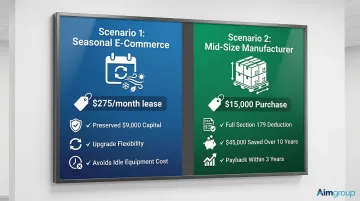
Scenario 1: Seasonal E-Commerce Fulfillment A small e-commerce business ships 200-300 packages daily during Q4 holidays but only 50-75 packages the rest of the year. Leasing a $9,000 semi-automatic strapping machine for $275/month makes sense—they preserve $9,000 in working capital for holiday inventory, can upgrade if volume grows, and avoid paying for a machine that sits idle eight months per year.
For businesses with steadier, year-round demand, the math shifts considerably.
Scenario 2: Mid-Size Manufacturer A manufacturer shipping 500+ pallets monthly year-round purchases a $15,000 fully automatic strapping machine, deducts the full cost under Section 179, and saves $45,000 over 10 years compared to leasing. The machine pays for itself in avoided lease payments within three years, and they control maintenance quality to maximize uptime.
Conclusion
Leasing protects cash flow and offers flexibility, while buying delivers long-term cost savings and ownership equity. Neither option is universally superior—the right answer depends on where your business is financially and operationally.
Assess your monthly strapping volume, capital availability, and 3-5 year business outlook before deciding. Alliance Packaging Group supplies strapping machines and consumables at factory-direct pricing, so whether you buy outright or need to compare equipment costs against a lease, you're working from accurate numbers. Reach out to their team at sales@apg-go.com or 770-309-1012 to discuss your volume requirements and get pricing that reflects your actual usage.
Frequently Asked Questions
Is it better to lease or buy business equipment?
Neither option is universally better. Leasing suits businesses prioritizing cash flow and flexibility, while buying is better for long-term cost efficiency and ownership. The right choice depends on your financial position, equipment lifespan needs, and how long you'll use the machine.
What are the tax benefits of leasing equipment?
Lease payments are typically fully deductible as a business operating expense, so you benefit each payment period rather than in one lump sum. Leasing can also let you spread sales tax across monthly payments instead of paying it all upfront — worth confirming with a tax professional for your situation.
How much does a strapping machine typically cost to buy?
Entry-level semi-automatic models start around $1,000–$1,500, while mid-range semi-automatic machines cost $7,500–$9,700. Fully automatic high-speed systems range from $12,000 to over $20,000. Pricing depends on machine type, throughput requirements, and supplier.
What is the typical lease term for a strapping machine?
Most equipment leases run 24 to 60 months, with 36–48 months being common for packaging machinery. At the end of the term, you can return the machine, renew the lease, or purchase it at fair market value.
Can I upgrade a leased strapping machine if my needs change?
Many lease agreements allow equipment upgrades at the end of the lease term, and some lessors offer mid-term upgrade options. Clarify upgrade flexibility with the lessor before signing the agreement to ensure it aligns with your business growth plans.
Do I need good credit to lease a strapping machine?
Most leasing companies require 2–3 years in business and a credit score of 600–650 or higher. Newer businesses or those with limited credit history may qualify with a personal guarantee, making you personally liable if the business defaults.