Introduction
Procurement managers face a common dilemma when sourcing strapping machines: should they purchase from a familiar, convenient distributor like Uline, or invest time in finding a specialist supplier? Unlike consumables that can be reordered with minimal risk, strapping machines are capital equipment decisions with multi-year operational implications.
The supplier you choose affects far more than the initial price tag. It shapes the technical guidance you receive during selection, the support available when problems arise, and your total cost of ownership over the machine's lifespan.
Many operations default to general distributors out of convenience, only to find they've purchased the wrong machine for their application — or lack access to parts and service when it counts.
This article compares Uline and specialist suppliers across pricing, product range, technical expertise, and service capabilities — so you can choose the option that matches how your operation actually runs.
Key Takeaways
- Uline offers catalog-style access to entry-level strapping machines with minimal technical guidance and limited after-sale support
- Specialist suppliers match machines to your application, offer broader options, and back purchases with ongoing service
- For low-volume, simple strapping needs, Uline can work; for medium-to-high-volume operations, specialist suppliers deliver stronger long-term value
- Total cost of ownership typically favors specialist suppliers, even when sticker prices look similar
- Match your supplier to your volume, load type, and how much downtime you can actually afford
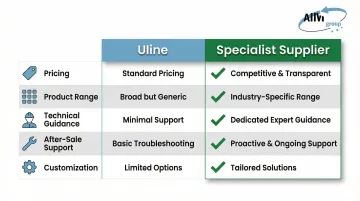
Uline vs. Specialist Supplier: Quick Comparison
| Category | Uline | Specialist Supplier |
|---|---|---|
| Pricing | Fixed catalog pricing; no negotiation. The H-959 semi-automatic lists at $1,149 (drops to $1,099 for 2+). | Factory-direct pricing with volume discounts; bundled equipment-plus-supply agreements often lower ongoing consumable costs. |
| Product Range | Entry-level manual and semi-automatic models for light-duty, basic polypropylene strapping. | Full range: manual tools, semi-automatic tabletop units, and fully automatic inline systems — including industry-specific configurations for food and beverage, pharma, and heavy manufacturing. |
| Technical Guidance | Self-serve model; product descriptions and spec sheets only. No equipment consultation or application engineering. | Application engineers evaluate load dimensions, bundle weight, tension requirements, and throughput rate before recommending a machine. |
| After-Sale Support | Six-month warranty, 30-day returns. Replacement parts available via customer service; no field service contracts or on-site technician support offered. | Parts inventory, preventive maintenance programs, service contracts, and direct technical support — especially important for high-volume operations. |
| Customization | Off-the-shelf only. No customization or integration with conveyor systems or automated packaging lines. | Machines can be configured for specific applications, including conveyor interlock, automated line integration, and multi-machine synchronization. |
What Does Uline Offer When You Buy a Strapping Machine?
Uline operates as a broad-line industrial distributor, stocking thousands of products across packaging, shipping, and warehouse supplies. Strapping machines represent just one SKU category among many, positioned alongside tape dispensers, stretch wrap, and shipping labels.
The draw is practical: fast shipping, no minimum orders, and a brand procurement teams already trust for consumables. For low-complexity purchases where speed matters more than specification precision, this model works well.
The catalog-driven purchase model creates real limitations for capital equipment. Buyers must self-select based on spec sheets, with no guidance on whether the machine actually suits their load weight, strap width, bundle dimensions, or production throughput.
The H-959 model, for example, handles 1/4" to 5/8" strapping with 10-100 lbs tension and straps up to 17 bundles per minute — but matching those specs to your operation requires packaging expertise most procurement teams don't have.
The after-sale gap becomes apparent when issues arise. Uline provides downloadable instructions, parts diagrams, and phone support, but no dedicated field service contracts or on-site technician support. For operations where strapping downtime halts production, that missing service infrastructure carries a real cost — unplanned downtime averages $260,000 per hour across manufacturing operations.
Use Cases Where Uline Works
Uline's strapping machine offering makes sense for specific scenarios:
- Small warehouses strapping cartons for LTL shipments with simple, standardized loads
- Seasonal operations requiring basic equipment for short-duration peaks
- Backup machines for facilities with existing primary strapping equipment
- Low-volume operations strapping fewer than 50 boxes per day with light-duty polypropylene strap
Worth noting: even when buying equipment elsewhere, Uline's consumables — strapping rolls, seals, hand tools — remain a practical ongoing purchase for most operations.
What Does a Specialist Supplier Offer?
A specialist packaging supplier focuses exclusively on packaging and material handling equipment — not a generalist distributor carrying thousands of unrelated SKUs. This focus shapes the depth of their offering, the expertise of their team, and the level of support they can provide.
The buying process starts with a needs assessment, not a product catalog. Specialist suppliers evaluate load dimensions, strapping material (polypropylene, steel, or polyester), bundle weight, required tension, and throughput rate before recommending a machine. This prevents the costly mistake of purchasing equipment that's under-spec'd for your application — a common outcome when buyers self-select on price alone.
Product depth is another area where specialists pull ahead. Specialist suppliers source or configure manual, semi-automatic, and fully automatic strapping machines, including inline systems that integrate with conveyor lines and high-speed sortation equipment. They can match specific strap widths, seal types, and tension requirements to different product categories within your operation.
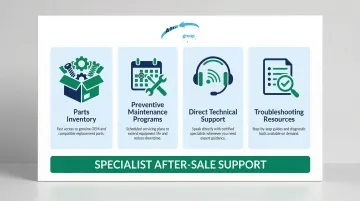
After the sale, specialist suppliers typically offer capabilities that distributors don't:
- Parts inventory for common wear components
- Preventive maintenance programs and scheduled inspections
- Direct technical support from staff who know the equipment
- Documented troubleshooting resources for in-house teams
For high-volume facilities where strapping is a production bottleneck, these resources directly reduce downtime and extend machine lifespan.
Alliance Packaging Group operates on this model — strapping machines sourced alongside consumables, conveyor systems, and automation equipment, with factory-direct pricing and nationwide delivery. Sourcing from a single supplier simplifies procurement and keeps equipment and supply specifications aligned.
Use Cases Where a Specialist Supplier Wins
Specialist expertise becomes non-negotiable in several scenarios:
- Manufacturing lines running multiple shifts where downtime directly impacts production targets
- Distribution centers strapping mixed SKU pallets with varying weights and dimensions
- Food and beverage or pharmaceutical facilities with compliance requirements and sanitation standards
- Any operation integrating strapping into an automated line with conveyor interlock or multi-machine synchronization
- Applications requiring specific strap widths, seal types, or tension requirements that vary by product category
Where the Real Difference Shows Up: Making the Right Call
The sticker price is only one variable in total cost of ownership (TCO). TCO also accounts for downtime when a machine fails without service support, the cost of replacing a wrong-fit purchase, and productivity loss from an under-spec'd system.
The self-serve model's hidden costs surface months after purchase. Without expert guidance, buyers frequently select machines under-spec'd for their actual throughput — leading to premature wear, frequent jams, or a second purchase to replace the first. In FMCG packaging lines, unplanned downtime averages $26,600 per hour when factoring in scrapped product, overtime, and expedited shipping. Getting the specification right from day one isn't optional at that cost.
Choose Uline if:
- Your operation runs low volume (under 50 boxes per day)
- Strapping needs are simple and standardized with consistent load types
- You have in-house mechanical capability to troubleshoot and repair equipment
- Speed of delivery outweighs long-term support considerations
Choose a specialist supplier if:
- You're running medium-to-high volume (100+ boxes per day)
- You need machine integration with conveyors or automated packaging lines
- Strapping is a critical step in production or shipping where downtime creates bottlenecks
- You require ongoing parts availability and service contracts
- Your operation handles varied load types requiring different tension or strap specifications
Case Studies: Where Specialist Support Made the Difference
Ford Motor Company replaced aging strapping equipment with Ovalstrapping machines sourced through a specialist supplier. The transition eliminated significant downtime caused by jams, saved $1.38 per machine per day in energy costs, and achieved a two-year payback. Critically, the specialist's application engineers identified tension and feed specifications that Ford's existing team hadn't been equipped to evaluate — preventing the jam patterns that had plagued the old equipment.
Hansa-Flex AG made a comparable shift — moving from manual strapping to a fully automatic Mosca system. Labor dropped from three full-time employees to one or two working half days, while throughput scaled to 500 packages daily. The pre-purchase needs assessment the specialist conducted was what made that throughput target achievable from day one rather than after months of adjustments.
If your operation is scaling — or if strapping jams and slowdowns are already eating into throughput — Alliance Packaging Group offers packaging assessments to evaluate whether your current setup is properly spec'd. It's a practical way to identify mismatches before they turn into a replacement purchase.
Conclusion
Uline serves a legitimate purpose for simple, transactional purchases where convenience and speed matter most. Strapping machines are capital equipment, though — and capital equipment decisions benefit from expert guidance, especially when production continuity is on the line.
The right machine — matched to your application and backed by a supplier who can support it long-term — drives efficiency, reduces downtime, and lowers your total cost of ownership. That's the difference a specialist brings.
Key questions to ask before you buy:
- Does the supplier understand your load type, strap material, and throughput requirements?
- Can they support the machine after the sale with parts and technical guidance?
- Will they help you spec the right model, not just the most available one?
Alliance Packaging Group works with manufacturers, distributors, and warehouses across the country to source strapping equipment that fits the application — not just the budget line. If you're evaluating options, that conversation is worth having before you click checkout.
Frequently Asked Questions
What is the difference between poly strapping and polyester strapping?
"Poly strapping" typically refers to polypropylene (PP), which offers high elongation (12–50%) but poor tension retention — suited for light-duty carton closing. Polyester (PET) strapping has lower elongation but holds tension far better, making it the right choice for heavy loads like metals, timber, and rigid pallets.
Is Uline a reliable source for strapping machines?
Uline is a legitimate distributor for basic strapping equipment, and reliability depends on your application. For simple, low-volume needs with standardized loads, their H-959 semi-automatic machine can work well. However, complex or high-volume operations benefit from specialist sourcing that provides application engineering, parts availability, and service contracts.
What type of strapping machine is best for a warehouse or distribution center?
Semi-automatic tabletop machines suit moderate-volume operations (50-100+ boxes per day) where an operator positions the package and triggers the strap cycle. Fully automatic inline systems work better for high-throughput environments (200+ boxes per day) requiring minimal labor and conveyor integration. Consult a specialist to match specs to your actual throughput and load requirements.
Can I get replacement parts and service for a strapping machine bought from a general distributor?
General distributors like Uline typically do not offer dedicated parts stocking or field service contracts for strapping machines, creating real downtime risk when components fail. Specialist suppliers maintain parts inventory, offer preventive maintenance programs, and provide direct technical support to minimize unplanned downtime.
How do I know if I need a semi-automatic or fully automatic strapping machine?
The decision comes down to volume and labor costs. If you're running fewer than 200 boxes per day, a semi-automatic machine is usually sufficient. Beyond that threshold — or where labor savings justify it — a fully automatic inline system makes more economic sense.
Does buying from a specialist supplier cost more upfront than buying from Uline?
Upfront prices are often comparable, and factory-direct specialist suppliers can actually come in lower. Total cost of ownership — factoring in service, parts availability, and avoided downtime — typically favors specialists for medium-to-high-volume operations.