Introduction
In 2022, the Federal Motor Carrier Safety Administration (FMCSA) reported 5,837 large trucks were involved in fatal crashes, with cargo shift and lost loads remaining critical risk factors in commercial transport. For construction operations, the consequences are immediate and costly:
- Workers injured by snapped or recoiling strapping
- Materials damaged or destroyed in transit
- DOT fines for improperly secured cargo
- Project delays when loads arrive compromised
- Liability exposure that follows every mile of highway
Construction materials—lumber bundles, brick pallets, rebar, concrete block, and steel coils—are among the most hazardous cargo to move. Their weight, sharp edges, and irregular shapes make them prone to both causing and suffering damage when strapping fails.
This guide covers how to choose the right strapping material, apply it correctly, and verify load security before and during transit.
Key Takeaways
- Steel strapping is required for rigid loads exceeding 4,000 lbs, non-compressible materials, or materials with sharp or hot edges
- Polyester handles heavy settling loads like lumber and brick with superior elongation recovery
- Always use edge protectors on hard-cornered materials to prevent strap failure
- Apply strapping in both horizontal and vertical planes; never rely on a single strap for heavy loads
- Always use mechanical tensioning tools: overtightening causes dangerous snap-back, while undertightening allows load shift in transit
Safety Guidelines for Strapping Construction Materials
Safe strapping of construction materials requires matching strap material to load weight and type, using correct tensioning technique, and protecting both the load and the handler throughout the process. Construction loads introduce compounding risks: extreme weight, sharp material edges, load settling during transit, and outdoor exposure. Effective safety protocols span material selection, application technique, and in-transit monitoring.
General Safety Precautions
Before strapping begins, handlers must wear cut-resistant gloves when working with steel strapping due to sharp edges and snap-back risk. Under OSHA standard 29 CFR 1910.138, employers must provide hand protection against severe cuts and lacerations.
Safety glasses complying with ANSI/ISEA Z87.1 standards are also required. Tensioned straps—especially steel—can snap and cause serious eye injuries.
The load must be stable and fully positioned on the pallet, skid, or flatbed before strapping begins. Strapping a shifting or improperly stacked load increases the risk of strap failure or load collapse during transport.
OSHA accident investigations document the severity of these incidents. In one case, an employee cut 1-inch metal strapping holding a 5-foot tall lumber bundle, and the load immediately collapsed, pinning and severely crushing the worker.
Never stand in the direct path of a tensioned strap during tightening or cutting. When tensioned strapping is cut, the sudden release of stored energy causes violent snap-back. In one documented incident, an employee pulling on metal strapping was struck in the eye when the end snapped back, causing severe laceration requiring hospitalization.
Choosing the Right Strapping Material for Construction Loads
Steel strapping is the correct choice for:
- Loads over 4,000 lbs
- Non-compressible materials (steel coils, metal parts, machinery)
- Loads with sharp or hot edges that would cut through plastic strap
- Situations requiring minimal elongation
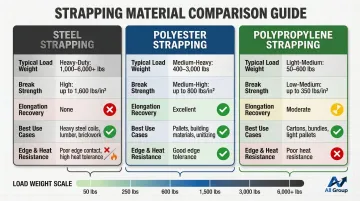
Steel offers the highest tensile strength, with heavy-duty variants reaching break strengths of 5,530 lbs or more. However, steel has zero elongation recovery and will rust when exposed to moisture over time unless treated with protective coatings.
Polyester strapping is preferred for:
- Heavy but non-sharp loads such as lumber bundles, brick packs, and concrete block (typically up to 3,000 lbs)
- Loads that settle during transit
- Outdoor transport or staging
Polyester's key advantage is approximately 70% elongation recovery. When applied, polyester provides around 2% elongation at normal work tension and recovers this elongation to keep the strap tight even as loads settle during transit. Steel cannot compensate for this settling. Heavy-duty polyester straps can achieve break strengths up to 4,000 lbs.
Polypropylene strapping is appropriate only for:
- Lighter construction packaging (corrugated boxes, lighter unitized bundles under 2,000 lbs)
- Short-term bundling in controlled environments
Polypropylene should never be used on heavy or sharp-edged construction loads due to its low elongation recovery and susceptibility to cutting. Standard 1/2" hand-grade polypropylene straps typically offer break strengths between 300 and 600 lbs.
Strap width and thickness selection depends on load weight and dimensions. Industry guidelines recommend a 5:1 ratio of strap break strength to package weight for unitizing and bundling applications. Heavier and larger loads require wider, thicker straps:
| Load Weight | Recommended Strap Width | Minimum Break Strength |
|---|---|---|
| Under 1,000 lbs | 1/2" | 600 lbs |
| 1,000–2,000 lbs | 5/8" | 1,200 lbs |
| 2,000–3,000 lbs | 3/4" | 2,000 lbs |
| 3,000–5,000 lbs | 1" to 1 1/4" | 3,500–5,500 lbs |
Edge protectors and corner boards are required when strapping construction materials with hard corners—bricks, lumber, metal. Edge protectors distribute strap tension across a wider surface area, preventing the strap from cutting into the load or the load from cutting through the strap. 49 CFR §393.104(f)(4) legally mandates edge protection wherever tiedowns are subject to abrasion or cutting.
Alliance Packaging Group stocks steel, polyester, and polypropylene strapping alongside compatible edge protection products, so construction and industrial shippers can source everything from a single supplier.
How to Apply Strapping Safely
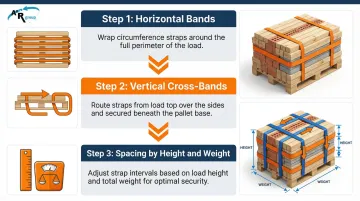
Strap placement strategy for palletized construction loads:
- Apply horizontal bands around the full circumference of the load first to stabilize the perimeter
- Follow with vertical cross-bands over the top and under the pallet to prevent vertical load movement
- Space bands based on load height and weight—taller and heavier loads require more frequent bands
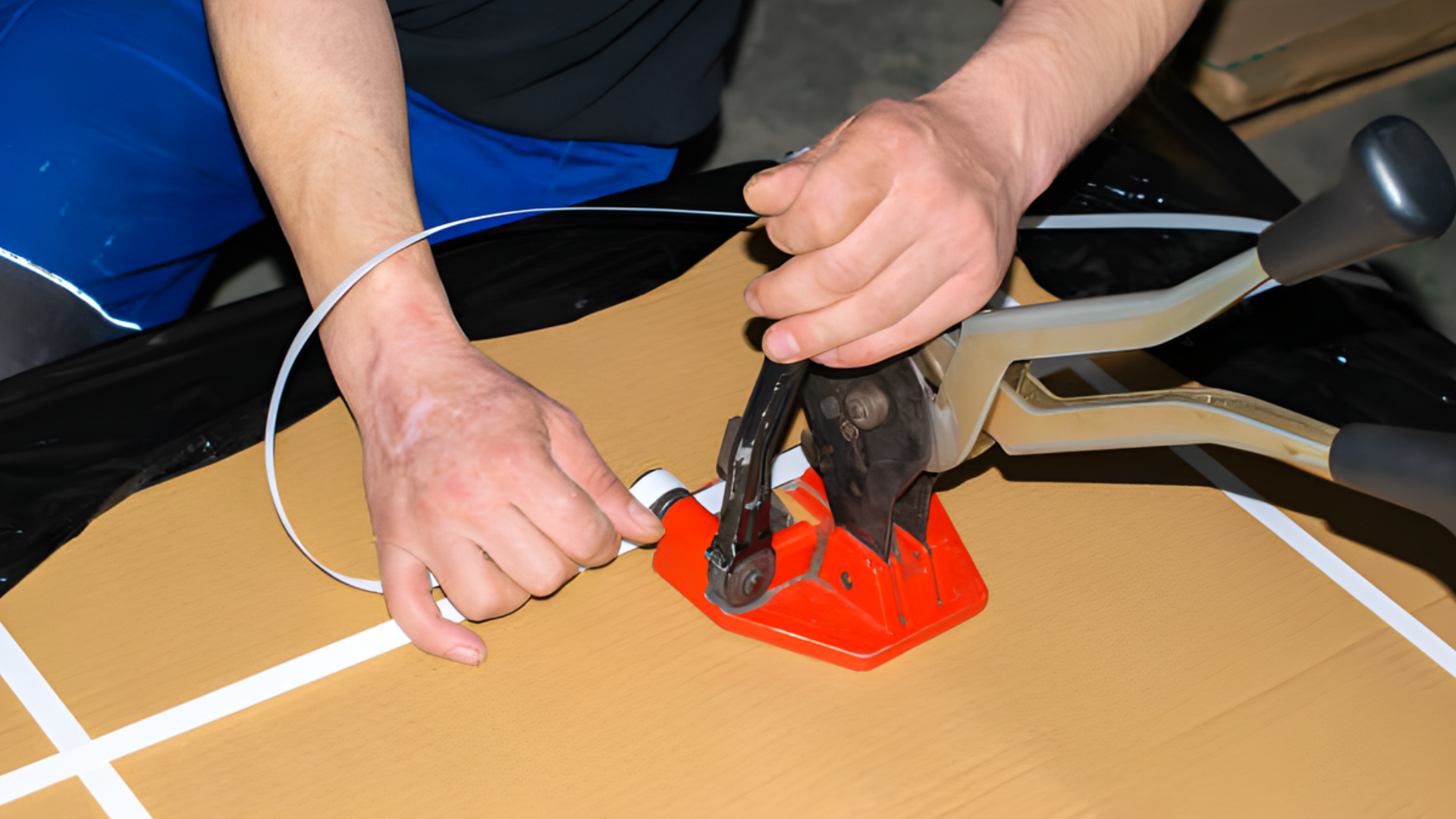
Correct tensioning requires mechanical or pneumatic tools, not manual estimation. Apply enough tension to prevent load movement, but not so tight that it crushes materials, cuts into corners, or risks snap-back. Overtightened steel strapping is a common cause of handler injury. Undertightened straps allow load movement during braking and cornering, which can cause pallet collapse or cargo falling from flatbeds.
Seals and fasteners must match the strap material and load weight. Seal types include:
- Open seals: Used with steel strapping, crimped over overlapping strap ends
- Closed seals: Used with polyester and polypropylene, thread-through design
- Wire buckles: Manual application for lighter loads
- Push buckles: Quick-release for temporary bundling
An incorrect seal can fail under transit vibration even if the strap itself is correctly rated.
Minimum strap count for common construction loads follows 49 CFR 393.110 requirements:
- 1 strap: Articles 5 feet or less in length, 1,100 lbs or less in weight
- 2 straps: Articles 5 feet or less weighing more than 1,100 lbs, OR articles between 5 and 10 feet regardless of weight
- Additional straps: For articles longer than 10 feet, two straps plus one additional strap for every 10 feet of length (or fraction thereof) beyond the first 10 feet
Final pre-departure inspection must verify:
- Each strap is correctly positioned
- Seals are fully crimped or locked
- Tension is even across all bands
- Edge protectors are seated correctly
Document this inspection before the vehicle departs — DOT regulations require records of cargo securement for flatbed and heavy loads.
Environmental and Load Conditions to Consider
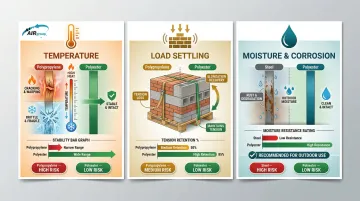
Temperature affects plastic strapping performance. Polypropylene loses tensile strength significantly in high heat and becomes brittle in freezing conditions. Polyester is more temperature-stable, maintaining structural integrity and retained tension across a wider range — a key advantage for outdoor construction yards.
Load settling hits hardest with brick, block, and loose aggregate — these materials compress under vibration and cause strap tension to drop. For these loads, polyester's elongation recovery is what keeps straps tight in transit. Steel strapping has no give; it either goes slack as the load settles or bears down hard enough to damage the surface.
Moisture and corrosion risk for steel strapping accelerates in outdoor transport, rain exposure, or high-humidity environments. Standard carbon steel strapping rusts quickly when exposed to moisture, weakening structural integrity and staining materials. For extended transport or outdoor staging, polyester is a safer choice for loads that can tolerate it. When steel is required, protective coatings significantly extend service life in harsh environments.
Common Safety Mistakes to Avoid
Using Polypropylene Strapping on Sharp-Edged Loads
Polypropylene strapping is not rated for rebar, cut metal, or rough-edged lumber. Sharp contact points cut through the strap under tension, releasing the load and putting other drivers and workers at risk. Use steel or polyester strapping for any construction material with hard or irregular edges.
Skipping Edge Protectors to Save Time
Skipping edge protectors concentrates all strap tension on a single narrow contact point. That pressure causes premature strap failure mid-transport — and in many states, edge protection is a regulatory requirement, not a judgment call. Budget the extra two minutes; it's cheaper than a load-shift incident.
Eyeballing Strap Tension Instead of Using a Tool
Visual judgment cannot reliably detect undertensioned straps. During braking and cornering, even straps that look tight can allow pallet collapse or cargo to slide off a flatbed. Use a tensioning tool on every strap for construction-grade loads — no exceptions.
Skipping Re-Inspection After Partial Unloading
Multi-stop deliveries introduce a hidden risk: removing part of a load redistributes weight and can loosen previously secured straps. Always check strap tension after any partial unload, not just at the start of the route.
Conclusion
Safe transport of construction materials depends on three aligned decisions: - Select the right strapping material based on load type, weight, and exposure conditions
- Apply it correctly using proper tensioning technique and the right tools for the strap type
- Verify load security before departure and at intervals during transit
Construction and logistics teams should document these steps as a standard operating procedure — not leave them to individual judgment on the loading dock. That consistency is what keeps cargo secure, workers safe, and projects on schedule.
Frequently Asked Questions
What is strapping in packaging?
Strapping is the use of flat bands—made from steel, polyester, polypropylene, or woven materials—to bundle, unitize, or secure loads for shipping or storage. It is commonly used across construction, logistics, and industrial applications to prevent load movement and maintain cargo integrity during transport.
What type of strapping is best for heavy construction materials like steel or rebar?
Steel strapping is the recommended choice for non-compressible, sharp, or extremely heavy loads like metal coils and rebar due to its maximum tensile strength and minimal elongation. Polyester strapping suits heavy but non-sharp materials like lumber and brick, where elongation recovery maintains tension as loads settle in transit.
Do I need edge protectors when strapping construction materials?
Yes, edge protectors are strongly recommended for any construction load with hard corners or sharp edges. They distribute strap tension evenly and prevent both strap failure and surface damage to the load. Federal regulations under 49 CFR §393.104(f)(4) mandate edge protection wherever tiedowns are subject to abrasion or cutting.
How tight should strapping be when securing construction loads for transport?
Strapping should be tensioned firmly enough to prevent any load movement but not so tight that it damages the load or creates snap-back risk. Mechanical or pneumatic tensioners—not manual estimation—should always be used for construction-grade loads to achieve correct tension consistently and safely.
How many straps do I need to secure a pallet of construction materials?
The number depends on load weight, height, and transport mode. DOT guidelines call for 1 strap for loads ≤5 ft and ≤1,100 lbs; 2 straps for loads over 1,100 lbs or between 5–10 ft; and 2 straps plus 1 additional strap per every 10 ft beyond the first 10 ft of length.
What are the safety risks of using the wrong strapping material on construction loads?
Using an undersized or incompatible strap—such as polypropylene on sharp-edged materials—risks strap failure, load shift or collapse, handler injuries, and DOT violations. Material selection must match load characteristics to prevent these outcomes.