
Introduction
The Amazon seller ecosystem is massive: in 2024, Amazon Logistics alone handled 6.3 billion parcels, and approximately 1.9 million active sellers compete on the platform. For every one of those sellers, the shipping box directly affects FBA compliance, product safety, and seller reputation.
Many online sellers lose money or face Amazon penalties due to incorrect box types, poor structural integrity, or non-compliant dimensions. The consequences are specific and costly:
- Boxes exceeding 50 lbs trigger outright shipment rejection
- Oversized boxes inflate dimensional weight charges by 400% or more
- Worn or improperly labeled boxes can result in account flags or disposal fees
Getting box selection right isn't optional — it's one of the few packaging decisions that directly affects your FBA standing and your margins.
Key Takeaways
- Amazon FBA boxes must meet strict size (25" max per side), weight (50 lb max), and structural requirements; non-compliance means rejection or penalties
- Knowing five box types — RSC corrugated, double-wall, multi-depth, telescoping, and die-cut mailers — lets you match the right box to every product
- Selecting boxes by product weight, fragility, and dimensions (not price) prevents damage claims and avoidable returns
- Suppliers with 1,000+ box sizes and just-in-time delivery keep your operation consistent as order volume grows
Overview of Amazon Shipping Box Solutions
An "Amazon shipping box solution" refers to the corrugated or rigid container used to pack, protect, and send products either to Amazon FBA fulfillment centers or directly to customers (FBM). These boxes need to hold up structurally, keep costs in check, and meet Amazon's strict packaging requirements — all at once.
U.S. parcel shipments reached 22.37 billion in 2024 — a 3.4% year-over-year increase — and Amazon third-party sellers drive a meaningful share of that volume. The range of products being shipped makes box selection anything but one-size-fits-all. Each category brings different demands:
- Lightweight goods (books, apparel): require minimal crush resistance but tight dimensional fit
- Electronics and fragile items: need higher board strength and interior cushioning compatibility
- Heavy or dense products: depend on high-ECT (edge crush test) boxes to survive stacking in transit
- Multi-item bundles: often call for custom sizing to prevent shifting and reduce void fill costs
Top Amazon Shipping Box Solutions for Online Sellers
The box solutions below are evaluated on structural strength, compliance with Amazon's packaging guidelines, availability in multiple sizes, and suitability across common product categories.
Regular Slotted Container (RSC) Corrugated Boxes
RSC boxes are the most universally used shipping box in e-commerce. All six flaps meet in the center when closed, creating a secure, stackable structure ideal for standard Amazon shipments.
Why RSC boxes work for Amazon sellers:
- Available in hundreds of standard sizes
- Suitable for most product categories
- Cost-effective at volume
- Fully compliant with Amazon FBA box content requirements
| Feature | Details |
|---|---|
| Best For | General merchandise, books, apparel, household goods |
| Standard ECT Rating | 32 ECT (single-wall); suitable for items up to 65 lbs |
| Common Size Range | 6"×6"×6" up to 24"×18"×18" |
RSC boxes with 32 ECT ratings are the industry workhorse, balancing protection and cost for the majority of Amazon shipments.
Double-Wall Heavy-Duty Corrugated Boxes
Double-wall boxes feature two layers of fluted corrugated medium between three liner sheets, providing measurably greater crush resistance and stacking strength compared to single-wall options.
They're the right choice for heavy items (tools, appliances, auto parts), fragile goods requiring extra impact protection, and high-value products where damage claims are costly. Double-wall construction prevents damage during transit and warehouse storage — directly cutting returns and negative feedback.
| Feature | Details |
|---|---|
| Best For | Heavy, dense, or fragile products; items 40–65 lbs |
| ECT Rating | 48–51 ECT for double-wall construction |
| Key Feature | Superior stacking strength; protects against compression during Amazon warehouse storage |
Studies on corrugated box performance show stiffer packaging structures can increase compression strength by up to 37% — a meaningful difference when inventory sits stacked in Amazon fulfillment centers for weeks.
Multi-Depth (MDC) Boxes
Multi-depth boxes are scored at multiple heights so sellers can cut and fold them to one of several depth options from a single box, reducing the need to stock many different box sizes.
For Amazon sellers managing diverse SKUs, the operational payoff is real:
- Fewer box SKUs to track and reorder
- Less wasted void fill per shipment
- Better dimensional weight management, which directly affects carrier costs
| Feature | Details |
|---|---|
| Best For | Sellers with varied product sizes; small-to-mid-scale operations |
| Adjustment Options | Typically 3–4 depth settings per box |
| Cost Benefit | Reduces box inventory overhead; minimizes dimensional weight overage |
Telescoping / Full-Overlap Boxes
Telescoping boxes are two-piece constructions (lid and base) or full-overlap designs where flaps extend fully across the bottom, providing maximum rigidity and protection for large, flat, or artwork-style items.
These are the right call for framed items, posters, mirrors, tile, and flat-pack furniture — any product where a standard flap closure creates a structural weak point along the center seam.
| Feature | Details |
|---|---|
| Best For | Large flat items, artwork, mirrors, framed products |
| Structural Feature | Full-overlap flaps eliminate center seam gap; enhanced puncture resistance |
| Size Range | Typically 24"×18"×3" and above |
Die-Cut Mailer Boxes
Die-cut mailer boxes (also called auto-lock or self-locking boxes) are compact, pre-scored rigid boxes that fold into shape without tape, designed for lightweight, small-volume products and direct-to-consumer shipments.
For FBM sellers, the appeal is straightforward: clean unboxing, no tape required for closure, and compatibility with poly mailer inserts. That said, they're not suited for FBA bulk shipments — lower stacking strength is a liability in fulfillment centers, and Amazon often requires taping tuck tabs that lack proper locking mechanisms.
| Feature | Details |
|---|---|
| Best For | Small consumer goods, cosmetics, supplements, apparel accessories (FBM) |
| Closure Type | Self-locking tuck or auto-bottom; tape may be required for FBA |
| Weight Limit | Generally up to 10–15 lbs |
Amazon's Shipping Box Requirements: What Sellers Must Know
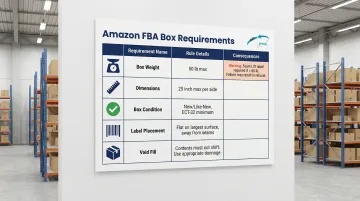
Amazon enforces strict inbound requirements to protect fulfillment center workers and maintain operational efficiency. Non-compliance can result in shipment refusal, disposal fees, or account restrictions. Before you ship a single unit, make sure every box meets the five core standards below.
| Requirement | The Rule | Why It Matters |
|---|---|---|
| Box weight | Max 50 lbs; "Team Lift" label for 50–100 lbs; "Mechanical Lift" label for 100+ lbs | Overweight unlabeled shipments are refused at the dock |
| Box dimensions | No side longer than 25 inches (oversize exceptions apply) | Oversized boxes inflate dimensional weight and raise shipping costs |
| Box condition | New or like-new corrugated only; Amazon recommends B-flute, ECT-32, or 200 lb burst strength | Worn or structurally compromised boxes are rejected outright |
| Label placement | FBA label flat on the largest surface, away from seams and corners | Misplaced labels and uncovered old barcodes cause mis-scanning |
| Void fill | Box dimensions should closely match product size; contents must not shift in transit | Excess empty space adds dimensional weight charges and risks damage |
How to Choose the Right Amazon Shipping Box for Your Products
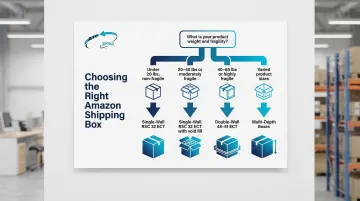
Selecting the right box requires evaluating product weight, dimensions, and fragility first, then matching box ECT rating and wall construction accordingly.
Decision framework:
- Under 20 lbs + non-fragile: Single-wall RSC (32 ECT)
- 20-40 lbs or moderately fragile: Single-wall RSC (32 ECT) with adequate void fill
- 40-65 lbs or highly fragile: Double-wall (48-51 ECT)
- Varied product sizes: Multi-depth boxes to reduce inventory overhead
Avoid the Dimensional Weight Trap
Choosing a box that's too large inflates the "DIM weight" carriers use to calculate shipping costs. UPS applies a domestic divisor of 166; FedEx International uses 139. A lightweight item in an oversized box can end up billed at 4-5 times its actual weight. Tighter box-to-product fit directly reduces outbound freight spend by 20-40%.
Match Your Supplier to Your Growth Rate
Cutting DIM weight costs only works if you can consistently get the right box sizes. Sellers who scale quickly need a supplier with deep inventory — Alliance Packaging Group stocks over 1,000 box sizes available for immediate shipment, with factory-direct pricing and nationwide just-in-time delivery. That breadth keeps growing operations moving without costly stockouts or last-minute substitutions.
Conclusion
The right Amazon shipping box is a functional business asset—it protects products, ensures FBA compliance, controls shipping costs, and shapes the customer unboxing experience. Getting the selection wrong costs money twice: once in damage claims, and again in avoidable surcharges.
Audit your current box inventory against Amazon's requirements and your product weight and dimension specs. Prioritize suppliers who offer broad size selection, consistent quality, and reliable availability over lowest-unit-cost alone.
That supplier criteria points directly to inventory depth and delivery consistency. Alliance Packaging Group stocks over 1,000 box sizes available for immediate shipment, with factory-direct pricing and nationwide just-in-time delivery programs built for sellers who can't afford stock gaps during peak periods. Contact the team at sales@apg-go.com or 770-309-1012 to discuss your specific box requirements.
Frequently Asked Questions
How do Amazon sellers ship their products?
Amazon sellers ship via two main methods: FBA (Fulfillment by Amazon), where sellers send inventory in bulk to Amazon's fulfillment centers using compliant corrugated boxes, and FBM (Fulfilled by Merchant), where sellers pack and ship individual orders directly to customers using their own packaging.
What are the requirements for Amazon shipping boxes?
Amazon FBA boxes must not exceed 50 lbs per box, have no single side exceeding 25 inches for standard items, be new or structurally sound corrugated cardboard, and have FBA shipment labels placed flat away from seams with all other barcodes covered.
Does Amazon sell shipping boxes for sellers?
Amazon does not directly sell corrugated shipping boxes to U.S.-based sellers through Seller Central. Instead, sellers typically source boxes from third-party packaging suppliers or distributors, often at lower cost and with greater size variety than retail sources.
Can I use Amazon shipping boxes to ship my own items?
Amazon-branded boxes can technically be reused, but all existing barcodes and branding must be fully covered before use. For FBA shipments, boxes must be in new or like-new condition, as worn or over-labeled boxes risk rejection at fulfillment centers.
What is the maximum box weight allowed for Amazon FBA shipments?
Amazon FBA boxes must not exceed 50 lbs unless the shipment contains a single oversized item that inherently exceeds this limit. Exceeding the weight limit can result in shipment refusal and suspension of shipping privileges.
What size boxes work best for Amazon FBA shipments?
The right box should closely match product dimensions to minimize void fill and dimensional weight charges. Standard RSC corrugated boxes in the 12"×12"×12" to 18"×18"×18" range work for most product categories, but the best size always depends on your specific SKU dimensions.